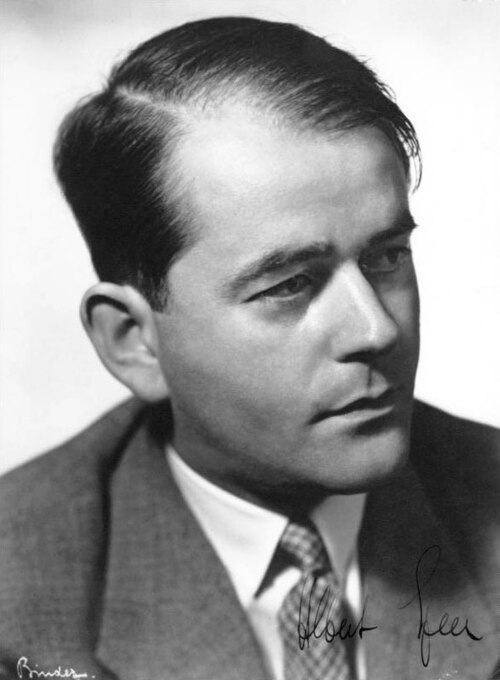
Portrait of Albert Speer

Photo: Binder (maybe Atelier Binder after Alexander Binders death in 1929) · CC BY-SA 3.0 de · Wikimedia Commons

Born in Germany · Nationality German — Politics / Nazi architecture / war economy / forced labour / war crimes

Albert Speer

Documented profile covering 9 controversies, including “1971 / revealed in 2007: Speer letter contradicts public denial of knowledge of announcement of Jewish extermination at Posen” and “1966–1981: public construction of the image of a repentant “good Nazi” through memoirs and interviews”.

Are you concerned? Right of reply

Profile No. 2672 · Updated on 12 October 2026

Portrait of Albert Speer

Photo: Binder (maybe Atelier Binder after Alexander Binders death in 1929) · CC BY-SA 3.0 de · Wikimedia Commons

9Documented controversies+ 1 background event
9Sources
1 followed by a conviction

I. Documented controversies

01

23 December 1971; publication 2007

1971 / revealed in 2007: Speer letter contradicts public denial of knowledge of announcement of Jewish extermination at Posen

No legal proceedings

In a 1971 letter to Hélène Jeanty, made public in 2007, Speer wrote that he was present when Himmler announced at Posen that Jews would be killed. This statement directly conflicts with his public account that he had left the meeting before the explicit discussion of extermination.

State of the evidence
Reported by the press
Attribution
Directly implicated

Sources · 2

  1. [1]
    The GuardianLetter proves Speer knew of Holocaust planPressHigh reliability
  2. [2]
    Documentation Center Nazi Party Rally Grounds, NurembergAlbert Speer in der BundesrepublikOfficial documentVery high reliability

Last verified: 14 September 2026

Add to this entry

02

1966–1981

1966–1981: public construction of the image of a repentant “good Nazi” through memoirs and interviews

No legal proceedings

Following his release from Spandau, Speer became a major media witness and developed in his books and interviews the image of an apolitical technocrat, close to Hitler but largely ignorant of the regime's central crimes. Subsequent research profoundly challenged this self-portrayal.

State of the evidence
Documented
Attribution
Protagonist is a witness

Sources · 1

  1. [1]
    Documentation Center Nazi Party Rally Grounds, NurembergAlbert Speer in der BundesrepublikOfficial documentVery high reliability

Last verified: 14 September 2026

Add to this entry

Case · 4 documented stages

1945–1946: Nuremberg trial — acquitted on counts 1 and 2, convicted of war crimes and crimes against humanity, sentenced to 20 years

Conviction
03

1945–1 October 1946

1945–1946: Nuremberg trial — acquitted on counts 1 and 2, convicted of war crimes and crimes against humanity, sentenced to 20 years

Conviction

Speer was tried before the International Military Tribunal. He was acquitted of conspiracy and crimes against peace but found guilty of war crimes and crimes against humanity, primarily for participation in the forced labour programme, and sentenced to twenty years' imprisonment.

Attribution
Accused

Sources · 2

  1. [1]
    The Avalon Project / Yale Law SchoolJudgment: SpeerCourt recordVery high reliability
  2. [2]
    United States Holocaust Memorial MuseumAlbert SpeerOfficial documentVery high reliability

Last verified: 14 September 2026

Add to this entry

04

February 1942–1945

February 1942: appointed Armaments Minister and head of Organisation Todt, gaining central authority over war economy

Conviction

Following Fritz Todt's death, Hitler appointed Speer Minister of Armaments and Munitions and head of Organisation Todt. His powers subsequently extended to a growing share of war production and the planning of raw materials and labour.

State of the evidence
Documented
Attribution
Political responsibility

Sources · 2

  1. [1]
    The Avalon Project / Yale Law SchoolJudgment: SpeerCourt recordVery high reliability
  2. [2]
    United States Holocaust Memorial MuseumAlbert SpeerOfficial documentVery high reliability

Last verified: 14 September 2026

Add to this entry

05

1942–1945

1942–1945: mass demands for forced labour from Sauckel and knowledge of coercive methods

Conviction

As a dominant member of the Central Planning Board, Speer conveyed the war industry's labour requirements to Fritz Sauckel. The Nuremberg judgment found that he knew those needs would be met through coerced foreign workers and was aware of violent recruitment and exploitation methods.

State of the evidence
Established by a court
Attribution
Political responsibility

Sources · 2

  1. [1]
    The Avalon Project / Yale Law SchoolJudgment: SpeerCourt recordVery high reliability
  2. [2]
    United States Holocaust Memorial MuseumAlbert SpeerOfficial documentVery high reliability

Last verified: 14 September 2026

Add to this entry

08

1939–1942

1939–1942: Speer's department becomes major operator of forced labour camps in Berlin

Conviction

Speer's GBI participated in authorising, constructing and operating an extensive network of forced labour camps around Berlin. The Nazi Forced Labour Documentation Centre states that the GBI operated camps itself and became one of the principal operators of this system in the capital.

State of the evidence
Documented
Attribution
Directly implicated

Sources · 2

  1. [1]
    Documentation Centre for Nazi Forced LabourAlbert SpeerOfficial documentVery high reliability
  2. [2]
    Deutsche Digitale BibliothekGeneralbauinspektor für die Reichshauptstadt (Bestand)ArchiveVery high reliability

Last verified: 14 September 2026

Add to this entry

06

March–April 1945

March–April 1945: opposition to Hitler's final destruction programme recognised as mitigating circumstance at Nuremberg

No legal proceedings

In the Reich's final weeks, Speer opposed orders to systematically destroy industrial and transport facilities and took measures to prevent some destruction. The Nuremberg Tribunal expressly cited this conduct as mitigation.

Attribution
Directly implicated

Sources · 1

  1. [1]
    The Avalon Project / Yale Law SchoolJudgment: SpeerCourt recordVery high reliability

Last verified: 14 September 2026

Add to this entry

07

August 1943–1944

1943–1944: transfer of V-2 production underground to Mittelwerk/Dora and mass use of concentration camp prisoners

Civil / administrative proceedings

Following the bombing of Peenemünde, Hitler, Speer and Himmler arranged for rocket production to be transferred to underground facilities. Speer's ministry created Mittelwerk GmbH, and production became closely linked to the Dora-Mittelbau concentration camp system, where prisoners were exploited in deadly conditions.

State of the evidence
Well documented
Attribution
Political responsibility

Sources · 2

  1. [1]
    United States Holocaust Memorial MuseumMittelbau (Dora) / Main CampOfficial documentVery high reliability
  2. [2]
    The Avalon Project / Yale Law SchoolJudgment: SpeerCourt recordVery high reliability

Last verified: 14 September 2026

Add to this entry

09

1937–1941

1937–1941: “Germania” project and forced eviction of thousands of Jewish tenants from Berlin homes

No legal proceedings

Appointed General Building Inspector in Berlin, Speer incorporated into the capital's redevelopment a mechanism for requisitioning homes occupied by Jews. His administration organised forced evictions and relocations to free flats for non-Jewish households displaced by demolition projects.

State of the evidence
Documented
Attribution
Directly implicated

Sources · 2

  1. [1]
    Zwangsräume BerlinForced Homes — Antisemitic Housing Policy in Berlin 1939–1945Secondary sourceHigh reliability
  2. [2]
    Deutsche Digitale BibliothekGeneralbauinspektor für die Reichshauptstadt (Bestand)ArchiveVery high reliability

Last verified: 14 September 2026

Add to this entry

II. Documented background

Documented biographical or institutional milestones (elections, appointments, foundings, acquisitions…). These are not controversies and are not counted as such.

  1. 1930–1939

    1930–1939: joins NSDAP, rises as Hitler's architect and places monumental architecture in service of Nazi propaganda

    Speer joined the Nazi party, quickly became one of Hitler's favourite architects and designed major elements of the Nazi party rally grounds in Nuremberg. The gatherings and their architecture were conceived as instruments of staging, intimidation and propaganda for the regime.

    Sources · 2
    1. United States Holocaust Memorial Museum — Albert Speer
    2. Documentation Center Nazi Party Rally Grounds, Nuremberg — The construction of the Nazi Party Rally Grounds

III. Constellation of documented links

No documented link with another published profile for now.

Two profiles are linked when a documented controversy of one names the other. The link points to that controversy and its sources; it does not indicate a personal relationship.

IV. Has something changed?

A new court decision, a missing source, a mistake? Tell us what should be updated: every request is read by the editorial team.

Support the archive

Controversia checks and updates its profiles independently. Support is optional and has no effect on the content of profiles.

Donate

iPhone and iPad

Install Controversia

  1. Tap Share
  2. then Add to Home Screen

Tap Share, then Add to Home Screen.