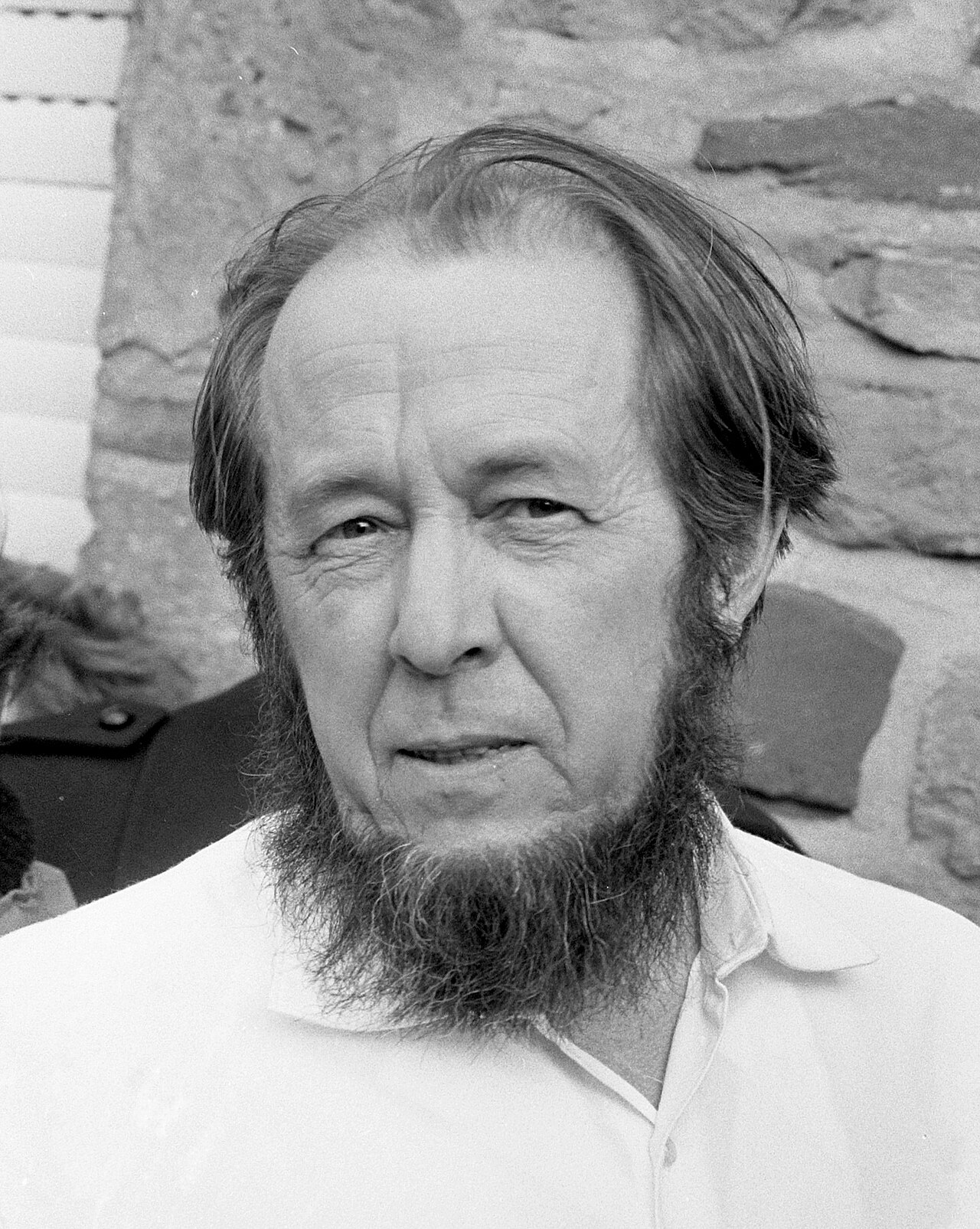
Portrait of Aleksandr Solzhenitsyn

Photo: Bert Verhoeff for Anefo · CC0 · Wikimedia Commons

Born in Russia · Nationality Russian — Literature / dissent / Russian nationalism / political debate

Aleksandr Solzhenitsyn

Documented profile covering 10 controversies, including “2006–2008: rapprochement with Vladimir Putin, state award and anti-Western nationalist positions” and “2008: rejection of genocide classification for Holodomor and allegation of anti-Russian manipulation”.

Are you concerned? Right of reply

Profile No. 2521 · Updated on 12 October 2026

Portrait of Aleksandr Solzhenitsyn

Photo: Bert Verhoeff for Anefo · CC0 · Wikimedia Commons

10Documented controversies
15Sources
0Conviction

I. Documented controversies

01

April 2006–August 2008

2006–2008: rapprochement with Vladimir Putin, state award and anti-Western nationalist positions

No legal proceedings

In his final years, Solzhenitsyn defended aspects of the restoration of state authority under Vladimir Putin, strongly criticised Western policy towards Russia and accepted an important award presented by Putin in 2007, having refused awards under other leaders.

State of the evidence
Documented
Attribution
Directly implicated

Sources · 2

  1. [1]
    The GuardianGulag outcast turns Kremlin apologistPressHigh reliability
  2. [2]
    The Washington PostRussia's Heroic Literary CurmudgeonPressHigh reliability

Last verified: 15 September 2026

Add to this entry

02

April 2008

2008: rejection of genocide classification for Holodomor and allegation of anti-Russian manipulation

No legal proceedings

Solzhenitsyn publicly rejected the classification of the 1932–1933 famine as a genocide specifically directed against Ukrainians and denounced what he described as a Ukrainian nationalist construction adopted by the West.

State of the evidence
Documented
Attribution
Directly implicated

Sources · 1

  1. [1]
    The GuardianSolzhenitsyn attacks Bush over UkrainePressHigh reliability

Last verified: 15 September 2026

Add to this entry

03

2001–2003

2001–2003: 'Two Hundred Years Together' prompts allegations of historical errors and fuelling antisemitism

No legal proceedings

In 'Two Hundred Years Together', Solzhenitsyn examined the history of relations between Russians and Jews and the role of Jewish revolutionaries in Soviet power. Jewish representatives and historians accused the book of factual errors and of providing material that could fuel antisemitism.

State of the evidence
Documented
Attribution
Directly implicated

Sources · 2

  1. [1]
  2. [2]
    The Observer / The Guardian archiveSolzhenitsyn battles illness to complete final volumesPressHigh reliability

Last verified: 15 September 2026

Add to this entry

04

May–29 October 1994

1994: return to Russia and parliamentary speech condemning post-Soviet political and economic system

No legal proceedings

After twenty years in exile, Solzhenitsyn returned to Russia. Before the Duma, he denounced the concentration of power, impoverishment, privatisation and party politics, while repeating his project for Slavic unity. The deputies' reception was noticeably colder than that accorded to the symbol of dissent.

State of the evidence
Documented
Attribution
Directly implicated

Sources · 2

  1. [1]
    The Washington PostSolzhenitsyn Returns to New RussiaPressHigh reliability
  2. [2]

Last verified: 15 September 2026

Add to this entry

05

September 1990–1992

1990–1992: 'Rebuilding Russia' — proposal for common Slavic state and opposition to complete Ukrainian separation

No legal proceedings

Solzhenitsyn called for the dissolution of the USSR but proposed that a new Slavic entity unite Russia, Ukraine, Belarus and certain parts of Kazakhstan. He argued that Russians and Ukrainians formed one deeply intertwined people.

State of the evidence
Documented
Attribution
Directly implicated

Sources · 2

  1. [1]
    The Washington PostSoviets Publish Solzhenitsyn Call for Slavic StatePressHigh reliability
  2. [2]
    The Washington PostWhat Is to Be Done? — review of Rebuilding RussiaPressHigh reliability

Last verified: 15 September 2026

Add to this entry

06

8–20 June 1978

1978: Harvard speech denouncing Western materialism, press, legalism and loss of courage

No legal proceedings

At Harvard, Solzhenitsyn delivered 'A World Split Apart', a speech sharply criticising the West for materialism, excessive legalism, an intrusive press, political weakness and loss of courage. He stated that he could not recommend Western society as a model for Russia.

State of the evidence
Documented
Attribution
Directly implicated

Sources · 3

  1. [1]
    The Washington PostSolzhenitsyn Says West Is Failing as Model for WorldPressHigh reliability
  2. [2]
    The Washington PostA Rebuttal to SolzhenitsynPressHigh reliability
  3. [3]

Last verified: 15 September 2026

Add to this entry

07

March 1976

1976: remarks about post-Franco Spain spark controversy over alleged minimisation of dictatorship

No legal proceedings

During a visit to Spain early in its democratic transition, Solzhenitsyn compared conditions there with Soviet realities and argued that freedoms were far greater than in the USSR. His remarks were strongly criticised as minimising Franco's dictatorship.

State of the evidence
Documented
Attribution
Directly implicated

Sources · 1

  1. [1]
    Archivo educativo NavarraEntrevista de Solzhenitsyn en España, 1976 — transcriptionPrimary sourceMedium reliability

Last verified: 15 September 2026

Add to this entry

08

1970–13 February 1974

1970–1974: Nobel Prize, publication of 'The Gulag Archipelago', treason accusation, loss of citizenship and expulsion

Case dismissed / dropped

Awarded the Nobel Prize in Literature in 1970, Solzhenitsyn published 'The Gulag Archipelago' abroad. The authorities arrested him in February 1974, accused him of treason, stripped him of his citizenship and expelled him to West Germany.

State of the evidence
Documented
Attribution
Directly implicated
Course of the proceedings
  1. Formally charged — Formal charge before the current outcome

Sources · 2

  1. [1]
  2. [2]
    Encyclopedia.comAleksandr Isayevich SolzhenitsynSecondary sourceHigh reliability

Last verified: 15 September 2026

Add to this entry

09

1962–November 1969

1962–1969: publication of 'One Day in the Life of Ivan Denisovich', tightening censorship and expulsion from Writers' Union

No legal proceedings

Following the exceptional authorisation to publish 'One Day in the Life of Ivan Denisovich' in 1962, the political climate became more restrictive. Solzhenitsyn's manuscripts circulated abroad and his relations with the Soviet authorities deteriorated until his expulsion from the Writers' Union in 1969.

State of the evidence
Documented
Attribution
Directly implicated

Sources · 1

  1. [1]
    Encyclopedia.comAleksandr Isayevich SolzhenitsynSecondary sourceHigh reliability

Last verified: 15 September 2026

Add to this entry

10

February 1945–1956

1945–1956: arrest for private letters criticising Stalin, eight years in camps and internal exile before rehabilitation

Acquitted / conviction overturned

A decorated Red Army captain, Solzhenitsyn was arrested in 1945 after private letters criticising Stalin were intercepted. He was sentenced to eight years' imprisonment and forced labour, followed by internal exile. After Stalin's death, he was released and rehabilitated.

State of the evidence
Established by a court
Attribution
Protagonist is the victim
Course of the proceedings
  1. Formally charged — Formal charge before the current outcome

Sources · 2

  1. [1]
    Encyclopedia.com / Oxford reference sourcesAleksandr Isayevich SolzhenitsynSecondary sourceHigh reliability
  2. [2]
    The Washington PostNobel Winner Chronicled Tyranny of Soviet UnionPressHigh reliability

Last verified: 15 September 2026

Add to this entry

II. Constellation of documented links

No documented link with another published profile for now.

Two profiles are linked when a documented controversy of one names the other. The link points to that controversy and its sources; it does not indicate a personal relationship.

III. Has something changed?

A new court decision, a missing source, a mistake? Tell us what should be updated: every request is read by the editorial team.

Support the archive

Controversia checks and updates its profiles independently. Support is optional and has no effect on the content of profiles.

Donate

iPhone and iPad

Install Controversia

  1. Tap Share
  2. then Add to Home Screen

Tap Share, then Add to Home Screen.