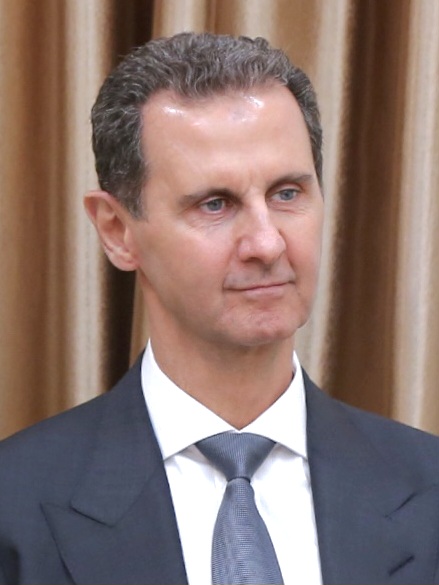
Portrait of Bashar al-Assad

Photo: khamenei.ir · CC BY 4.0 · Wikimedia Commons

Born in Syria · Nationality Syrian — Authoritarian presidency / civil war / international crimes / chemical weapons / detention / war economy

Bashar al-Assad

Documented profile covering 26 controversies, including “2007–2026: Secret al-Kibar nuclear reactor destroyed by Israel, followed by IAEA non-cooperation dispute” and “2026: First Syrian conviction of Assad — death sentence in absentia for murder, torture, arbitrary arrests and crimes against humanity”.

Are you concerned? Right of reply

Profile No. 1820 · Updated on 12 October 2026

Portrait of Bashar al-Assad

Photo: khamenei.ir · CC BY 4.0 · Wikimedia Commons

26Documented controversies+ 1 background event
23Sources
· 1 followed by a conviction

I. Documented controversies

01

2007–September 2026

2007–2026: Secret al-Kibar nuclear reactor destroyed by Israel, followed by IAEA non-cooperation dispute

No legal proceedings

The al-Kibar site, destroyed by Israel in 2007, was identified by the IAEA as very likely having been a nuclear reactor that should have been declared; in 2026, the IAEA Director General stated that it had been almost complete and potentially capable of producing plutonium.

State of the evidence
Documented
Attribution
Political responsibility

Last verified: 13 September 2026

Add to this entry

Case · 5 documented stages

2026: First Syrian conviction of Assad — death sentence in absentia for murder, torture, arbitrary arrests and crimes against humanity

Conviction
02

11 August 2026

2026: First Syrian conviction of Assad — death sentence in absentia for murder, torture, arbitrary arrests and crimes against humanity

Conviction

A Syrian court sentenced Bashar al-Assad to death in absentia, finding him guilty of offences including intentional murder, torture, arbitrary arrests and crimes against humanity; it was the first Syrian conviction against him since his fall.

State of the evidence
Established by a court
Attribution
Personally implicated

Last verified: 13 September 2026

Add to this entry

03

2011–2024

2011–2024: Extensive system of arbitrary detention, torture and enforced disappearance

Conviction

During the war, Syrian security services detained, tortured and forcibly disappeared tens of thousands of people across a network of prisons and intelligence facilities.

State of the evidence
Documented
Attribution
Command responsibility

Last verified: 13 September 2026

Add to this entry

20

March–April 2011

March 2011: Daraa crackdown following arrest and torture of children

Conviction

The crackdown on demonstrations in Daraa, triggered by the arrest and torture of children, included lethal gunfire, mass arrests and torture; HRW concluded that crimes against humanity had been committed in the region.

State of the evidence
Documented
Attribution
Command responsibility

Last verified: 13 September 2026

Add to this entry

21

2011

2011: Nationwide expansion of repression and evidence of command responsibility reaching highest levels

Conviction

Testimonies and documents gathered by HRW described orders and chains of command linking violence against demonstrations to senior levels of the state; the organisation considered the evidence strongly indicative of knowledge and involvement at the highest level.

State of the evidence
Documented
Attribution
Command responsibility

Last verified: 13 September 2026

Add to this entry

22

2011

2011: Deadly campaign and torture in Homs Governorate

Conviction

HRW documented killings of protesters, arbitrary arrests, disappearances and widespread torture by security forces in Homs.

State of the evidence
Documented
Attribution
Command responsibility

Last verified: 13 September 2026

Add to this entry

04

2013–2024

2013–2024: Incomplete chemical weapons declarations and longstanding dispute with OPCW

Civil / administrative proceedings

Following Syria's accession to the Chemical Weapons Convention, the OPCW identified gaps and inconsistencies in its declaration for years and investigated multiple uses of chemical agents.

State of the evidence
Documented
Attribution
Political responsibility

Sources · 2

  1. [1]
    OPCWInvestigation and Identification Team (IIT)Official documentVery high reliability
  2. [2]

Last verified: 13 September 2026

Add to this entry

05

2019–2024

2019–2024: War economy, sanctions and socioeconomic collapse under regime

No legal proceedings

The regime presided over an economic collapse marked by hyperinflation, widespread poverty, predatory networks and growing dependence on allies, exacerbated by war and Western sanctions.

State of the evidence
Documented
Attribution
Political responsibility

Sources · 2

  1. [1]
    Council of the European UnionSyria: Council renews restrictive measures targeting the former al-Assad regimeOfficial documentVery high reliability
  2. [2]

Last verified: 13 September 2026

Add to this entry

06

années 2010–December 2024

2010s–2024: Industrial-scale Captagon production within networks linked to regime and Assad relatives

No legal proceedings

Following the regime's fall, Reuters documented extensive industrial Captagon infrastructure linked to networks close to the state and notably Maher al-Assad; experts estimated that the trade generated billions.

State of the evidence
Documented

Sources · 1

  1. [1]

Last verified: 13 September 2026

Add to this entry

07

26 June 2024

June 2024: French arrest warrant for complicity in crimes against humanity linked to 2013 chemical attacks upheld on appeal

No legal proceedings

French courts upheld an arrest warrant against Assad for complicity in crimes against humanity and war crimes concerning the 2013 chemical attacks.

State of the evidence
Documented
Attribution
Directly implicated

Sources · 1

  1. [1]

Last verified: 13 September 2026

Add to this entry

08

8 December 2024

December 2024: Regime collapses and Assad flees to Russia

No legal proceedings

The 2024 rebel offensive brought about the fall of Damascus and the end of Assad's rule; he fled to Russia, which granted him asylum.

State of the evidence
Documented
Attribution
Political responsibility

Sources · 2

  1. [1]
  2. [2]
    Council of the European UnionSyria: Council renews restrictive measures targeting the former al-Assad regimeOfficial documentVery high reliability

Last verified: 13 September 2026

Add to this entry

09

2018–2021

2018–2021: Arrests, torture and disappearances of refugees returning to government-held areas

No legal proceedings

HRW documented returns from Lebanon and Jordan followed by arbitrary arrests, torture, disappearances and, in some cases, deaths or sexual violence.

State of the evidence
Documented
Attribution
Political responsibility

Sources · 1

  1. [1]

Last verified: 13 September 2026

Add to this entry

10

2014–2021

2014 and 2021: Presidential elections held during war and widely considered neither free nor fair

No legal proceedings

Assad was re-elected during the war in ballots held mainly in regime-controlled areas, with severely limited genuine opposition and without conditions recognised as those of free elections.

State of the evidence
Documented
Attribution
Directly implicated

Sources · 2

  1. [1]
  2. [2]
    Council of the European UnionSyria: Council renews restrictive measures targeting the former al-Assad regimeOfficial documentVery high reliability

Last verified: 13 September 2026

Add to this entry

11

2013–2018

2013–2018: Sieges of rebel areas and starvation policy, notably Madaya and Eastern Ghouta

No legal proceedings

The government besieged several rebel-held enclaves, restricting food, medical care and evacuations; Madaya and Eastern Ghouta became symbols of starvation used as a means of pressure.

State of the evidence
Documented

Sources · 2

  1. [1]
    Amnesty InternationalHarrowing accounts of life under siege in SyriaNGO reportVery high reliability
  2. [2]
    Human Rights WatchWorld Report 2017: SyriaNGO reportVery high reliability

Last verified: 13 September 2026

Add to this entry

12

7 April 2018

April 2018: Douma chlorine attack formally attributed to Syrian air force by OPCW

No legal proceedings

The OPCW Investigation and Identification Team concluded that there were reasonable grounds to believe that the Syrian air force had dropped chlorine cylinders on Douma, killing 43 named individuals.

State of the evidence
Documented

Sources · 2

  1. [1]
  2. [2]
    OPCWInvestigation and Identification Team (IIT)Official documentVery high reliability

Last verified: 13 September 2026

Add to this entry

13

April–May 2018

2018: Law No. 10 on property criticised over risks of expropriating displaced people and refugees

No legal proceedings

Law No. 10 enabled the creation of redevelopment areas requiring complex procedures to prove ownership, raising fears that refugees and displaced people would lose their property.

State of the evidence
Documented

Sources · 1

  1. [1]
    Human Rights WatchSyria: Questions and Answers on New Property LawNGO reportVery high reliability

Last verified: 13 September 2026

Add to this entry

14

2014–2017

2014–2017: Repeated attacks against hospitals, rescue workers and civilian infrastructure

No legal proceedings

Syrian and Russian forces were accused of repeated strikes on hospitals, schools, markets and rescue workers, particularly in opposition-held areas.

State of the evidence
Documented

Sources · 2

  1. [1]
    Human Rights WatchWorld Report 2016: SyriaNGO reportVery high reliability
  2. [2]
    Human Rights WatchWorld Report 2017: SyriaNGO reportVery high reliability

Last verified: 13 September 2026

Add to this entry

15

4 April 2017

April 2017: Khan Shaykhun sarin attack and broader chemical weapons campaign

No legal proceedings

The OPCW confirmed the use of sarin at Khan Shaykhun; HRW concluded that available evidence strongly indicated an attack by government forces and placed the episode within a series of chemical attacks.

State of the evidence
Confirmed

Sources · 3

  1. [1]
  2. [2]
  3. [3]
    OPCWInvestigation and Identification Team (IIT)Official documentVery high reliability

Last verified: 13 September 2026

Add to this entry

16

2012–2016

2012–2016: Indiscriminate bombing and widespread use of barrel bombs against civilian areas

No legal proceedings

Government forces extensively used barrel bombs and other unguided weapons in populated areas, causing heavy civilian casualties.

State of the evidence
Documented

Sources · 2

  1. [1]
    Human Rights WatchWorld Report 2016: SyriaNGO reportVery high reliability
  2. [2]
    Human Rights WatchWorld Report 2017: SyriaNGO reportVery high reliability

Last verified: 13 September 2026

Add to this entry

17

2015–December 2016

2015–2016: Aleppo campaign with Russian support, incendiary and cluster munitions

No legal proceedings

The recapture of eastern Aleppo by Russian-backed Syrian forces was accompanied by intensive strikes, incendiary weapons, cluster munitions and considerable civilian harm.

State of the evidence
Documented

Sources · 1

  1. [1]
    Human Rights WatchWorld Report 2017: SyriaNGO reportVery high reliability

Last verified: 13 September 2026

Add to this entry

18

2011–2015

2011–2015: Mass hangings and extermination at Saydnaya prison

No legal proceedings

Amnesty International estimated that up to 13,000 people were secretly hanged at Saydnaya between 2011 and 2015, within a system of torture, food deprivation and executions.

State of the evidence
Documented
Attribution
Command responsibility

Sources · 1

  1. [1]

Last verified: 13 September 2026

Add to this entry

19

21 August 2013

August 2013: Sarin attack in Ghouta kills hundreds

Formally charged

The UN mission confirmed the large-scale use of sarin in Ghouta. HRW considered that available evidence strongly pointed to government forces; French proceedings subsequently targeted Assad for complicity in crimes relating to the 2013 chemical attacks.

Sources · 3

  1. [1]
  2. [2]
    Human Rights WatchWorld Report 2014: SyriaNGO reportVery high reliability
  3. [3]

Last verified: 13 September 2026

Add to this entry

23

2000–2010

2000–2010: Arbitrary detention, torture, disappearances and persistent restrictions during first decade

No legal proceedings

During Assad's first decade, HRW documented continuing repression of opponents, Kurds, human rights defenders and journalists, involving arbitrary detention, torture and enforced disappearances.

State of the evidence
Documented
Attribution
Command responsibility

Sources · 1

  1. [1]

Last verified: 13 September 2026

Add to this entry

24

February–April 2005

2005: Syrian military withdraws from Lebanon under intense international pressure after Rafic Hariri assassination

No legal proceedings

Assad agreed to withdraw Syrian troops from Lebanon following Rafic Hariri's assassination and strong Lebanese and international mobilisation against Damascus's influence.

Attribution
Political responsibility

Sources · 2

  1. [1]
    Al JazeeraSyria to move troops to east LebanonPressHigh reliability
  2. [2]

Last verified: 13 September 2026

Add to this entry

25

March 2004

2004: Crackdown on Kurdish unrest in Qamishli

No legal proceedings

Security forces fired on Kurdish protesters during unrest in Qamishli, killing dozens and arresting hundreds of Kurds.

State of the evidence
Documented
Attribution
Command responsibility

Sources · 1

  1. [1]

Last verified: 13 September 2026

Add to this entry

26

2000–2001

2000–2001: Hopes of 'Damascus Spring' followed by swift closure of political space

No legal proceedings

Following his accession to the presidency in 2000, a brief opening of public debate was followed by the arrest and conviction of figures associated with the 'Damascus Spring' and the closure of political forums.

State of the evidence
Documented
Attribution
Political responsibility

Sources · 1

  1. [1]

Last verified: 13 September 2026

Add to this entry

II. Documented background

Documented biographical or institutional milestones (elections, appointments, foundings, acquisitions…). These are not controversies and are not counted as such.

  1. May 2007

    2007: Re-election without genuine multiparty competition

    Assad obtained a new term through a referendum with no opposing candidate, in a system where the Ba'ath Party and security services severely restricted political competition.

    Sources · 1
    1. Human Rights Watch — A Wasted Decade: Human Rights in Syria during Bashar al-Assad’s First Ten Years in Power

III. Constellation of documented links

  • Linked profile (portrait or initials) — click to open it
  • Line width: number of documented references
  • Hover over or tap a line: controversies and sources

Two profiles are linked when a documented controversy of one names the other. The link points to that controversy and its sources; it does not indicate a personal relationship.

List of documented links (1)
  1. Ahmed al-Sharaa1 documented reference

IV. Has something changed?

A new court decision, a missing source, a mistake? Tell us what should be updated: every request is read by the editorial team.

Support the archive

Controversia checks and updates its profiles independently. Support is optional and has no effect on the content of profiles.

Donate

iPhone and iPad

Install Controversia

  1. Tap Share
  2. then Add to Home Screen

Tap Share, then Add to Home Screen.