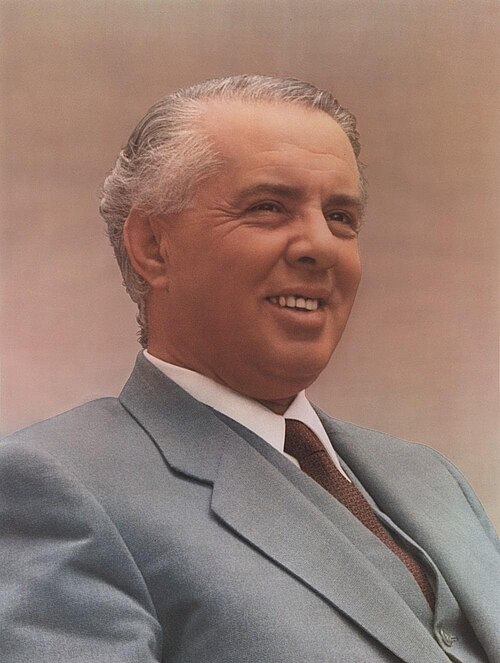
Portrait of Enver Hoxha

Photo: Petrit Kumi · Public domain

Born in Albania · Nationality Albanian — Communist dictatorship / Stalinism / purges / Sigurimi / religious persecution / economic isolation

Enver Hoxha

Documented profile covering 17 controversies, including “1940s–1985: systemic repression through Sigurimi, prisons, forced labour and internal exile” and “1940s–1980s: collective punishment of fugitives' and 'enemies'' families through administrative internment”.

Are you concerned? Right of reply

Profile No. 2051 · Updated on 12 October 2026

Portrait of Enver Hoxha

Photo: Petrit Kumi · Public domain

17Documented controversies
7Sources
0Formal charge · all time
0Conviction

I. Documented controversies

01

années 1940–1985

1940s–1985: systemic repression through Sigurimi, prisons, forced labour and internal exile

No legal proceedings

Under Hoxha, Albania developed an exceptionally intrusive security apparatus. Actual or suspected opponents were imprisoned, sent to labour camps, subjected to administrative internment or executed.

State of the evidence
Well documented
Attribution
Command responsibility

Sources · 2

  1. [1]
    Human Rights WatchHuman Rights in Post-Communist AlbaniaNGO reportVery high reliability
  2. [2]
    U.S. Department of State via ecoi.netCountry Report on Human Rights Practices for 1986 — AlbaniaNGO reportVery high reliability

Last verified: 14 September 2026

Add to this entry

02

années 1940–1985

1940s–1980s: collective punishment of fugitives' and 'enemies'' families through administrative internment

Civil / administrative proceedings

The regime imposed internment not only on opponents but also on relatives of people who had fled Albania or were considered politically dangerous. Entire families could be relocated or interned without trial.

State of the evidence
Documented

Sources · 2

  1. [1]
    U.S. Department of State via ecoi.netCountry Report on Human Rights Practices for 1986 — AlbaniaNGO reportVery high reliability
  2. [2]
    Human Rights WatchHuman Rights in Post-Communist AlbaniaNGO reportVery high reliability

Last verified: 14 September 2026

Add to this entry

03

années 1960–1985

1960s–1985: near-total ban on private foreign travel and criminalisation of attempts to escape

No legal proceedings

Hoxha's Albania effectively prohibited private travel abroad. Attempts to cross the border unlawfully could result in severe penalties, while fugitives' families faced reprisals or internment.

State of the evidence
Documented

Sources · 2

  1. [1]
    Human Rights WatchHuman Rights in Post-Communist AlbaniaNGO reportVery high reliability
  2. [2]
    U.S. Department of State via ecoi.netCountry Report on Human Rights Practices for 1986 — AlbaniaNGO reportVery high reliability

Last verified: 14 September 2026

Add to this entry

04

1944–1985

1944–1985: political, social and economic isolation leaves Albania among Europe's poorest and most closed countries

No legal proceedings

The combined diplomatic breaks, economic autarky, travel ban, censorship and militarisation transformed Albania into the most closed state in the European bloc. Human Rights Watch described the country as one of Europe's poorest and most repressive by the end of the regime.

State of the evidence
Well documented
Attribution
Directly implicated

Sources · 2

  1. [1]
    Human Rights WatchHuman Rights in Post-Communist AlbaniaNGO reportVery high reliability
  2. [2]
    The Washington PostAfter Rift With China, Albania Is Running Out of FriendsPressHigh reliability

Last verified: 14 September 2026

Add to this entry

05

1981–September 1983

1981–1983: final major purge — arrests, show trials and executions of Kadri Hazbiu and other senior officials

Conviction — against Kadri Hazbiu

Protagonist not prosecuted — these proceedings are not counted in their formal charges or convictions.

After Shehu's death, Hoxha brought down several ministers and senior officials accused of a vast conspiracy. Kadri Hazbiu, Feçor Shehu, Llambi Ziçishti and others were tried; several were executed in 1983.

Attribution
Directly implicated
Person targeted by the proceedings
Kadri Hazbiu
Role of the person profiled
Protagonist not prosecuted

Sources · 1

  1. [1]
    East European Politics and Societies and CulturesEnver Hoxha’s Last Purge: Inside the Ruling Circle of Communist Albania (1981–1983)Academic publicationVery high reliability

Last verified: 14 September 2026

Add to this entry

06

18 December 1981–1982

1981: death of Mehmet Shehu, followed by erasure and posthumous denunciation of prime minister as 'traitor'

No legal proceedings

Prime Minister Mehmet Shehu, Hoxha's ally for decades and the regime's second-in-command, was found dead. The regime announced a suicide, then swiftly recast him as a 'traitor' and leader of a foreign conspiracy, erasing his public image and persecuting his associates.

State of the evidence
Documented
Attribution
Directly implicated

Sources · 2

  1. [1]
    U.S. Department of State, Office of the HistorianAlbania after Shehu: The Internal SceneArchiveVery high reliability
  2. [2]
    East European Politics and Societies and CulturesEnver Hoxha’s Last Purge: Inside the Ruling Circle of Communist Albania (1981–1983)Academic publicationVery high reliability

Last verified: 14 September 2026

Add to this entry

07

1971–années 1980

1971–1980s: massive bunkerisation programme at very high economic cost

No legal proceedings

Fearing a foreign invasion, Hoxha launched a fortification programme that led to construction of more than 170,000 bunkers. The project consumed substantial resources in an impoverished country.

State of the evidence
Documented
Attribution
Directly implicated

Sources · 1

  1. [1]
    Armed Forces Museum of AlbaniaBunkerizationOfficial documentVery high reliability

Last verified: 14 September 2026

Add to this entry

08

1977–July 1978

1978: definitive break with China and loss of last major source of external economic support

No legal proceedings

Hoxha denounced China's new policies as revisionist. In 1978, Beijing ended economic and military aid and withdrew its experts, leaving Albania without a major ally or comparable source of external support.

State of the evidence
Well documented
Attribution
Directly implicated

Sources · 1

  1. [1]
    The Washington PostAfter Rift With China, Albania Is Running Out of FriendsPressHigh reliability

Last verified: 14 September 2026

Add to this entry

09

1976 et suites

1976: Constitution prohibits foreign loans and joint investments — institutional entrenchment of autarky

No legal proceedings

The 1976 Constitution intensified autarky by prohibiting certain foreign loans, concessions and joint ventures. The economic system became even less capable of accessing external capital and technology.

State of the evidence
Documented
Attribution
Directly implicated

Sources · 2

  1. [1]
    The Washington PostAfter Rift With China, Albania Is Running Out of FriendsPressHigh reliability
  2. [2]
    Human Rights WatchHuman Rights in Post-Communist AlbaniaNGO reportVery high reliability

Last verified: 14 September 2026

Add to this entry

10

September 1968

1968: withdrawal from Warsaw Pact following invasion of Czechoslovakia

No legal proceedings

Following the Warsaw Pact forces' invasion of Czechoslovakia, Hoxha formally withdrew Albania from the military alliance.

State of the evidence
Well documented
Attribution
Directly implicated

Sources · 1

  1. [1]
    The Washington PostAfter Rift With China, Albania Is Running Out of FriendsPressHigh reliability

Last verified: 14 September 2026

Add to this entry

11

1946–1967

1946–1967: gradual collectivisation of agriculture and effective elimination of rural private property

No legal proceedings

The regime progressively collectivised agriculture until almost all independent private farming had been eliminated. Ownership and transfer of land were drastically restricted and then socialised.

State of the evidence
Documented
Attribution
Directly implicated

Sources · 1

  1. [1]
    Human Rights WatchHuman Rights in Post-Communist AlbaniaNGO reportVery high reliability

Last verified: 14 September 2026

Add to this entry

12

February–November 1967

1967: campaign to eliminate religious practice and de facto proclamation of atheist state

No legal proceedings

Hoxha encouraged a campaign to close mosques, churches and monasteries. More than two thousand religious sites were closed or converted, religious communities lost their legal status, and clergy were humiliated, imprisoned or persecuted.

State of the evidence
Documented
Attribution
Directly implicated

Sources · 2

  1. [1]
    Amnesty InternationalAlbania — Amnesty International report on law and religionNGO reportVery high reliability
  2. [2]
    Human Rights WatchHuman Rights in Post-Communist AlbaniaNGO reportVery high reliability

Last verified: 14 September 2026

Add to this entry

13

1960–1961

1961: break with Soviet Union following de-Stalinisation and country's increasing isolation

No legal proceedings

Hoxha rejected Khrushchev's de-Stalinisation and progressively broke with Moscow. Albania then moved closer to China while maintaining a particularly rigid Stalinist line.

State of the evidence
Well documented
Attribution
Directly implicated

Sources · 2

  1. [1]
    Human Rights WatchHuman Rights in Post-Communist AlbaniaNGO reportVery high reliability
  2. [2]
    The Washington PostAfter Rift With China, Albania Is Running Out of FriendsPressHigh reliability

Last verified: 14 September 2026

Add to this entry

14

1948–11 June 1949

1948–1949: break with Yugoslavia, purge of Koçi Xoxe and execution of former second-in-command

Conviction — against Koçi Xoxe

Protagonist not prosecuted — these proceedings are not counted in their formal charges or convictions.

After the Tito–Stalin split, Hoxha turned against the pro-Yugoslav faction. Koçi Xoxe, a former Interior Minister and major regime figure, was arrested, tried and executed in 1949.

State of the evidence
Well documented
Attribution
Directly implicated
Person targeted by the proceedings
Koçi Xoxe
Role of the person profiled
Protagonist not prosecuted

Sources · 2

  1. [1]
    East European Politics and Societies and CulturesEnver Hoxha’s Last Purge: Inside the Ruling Circle of Communist Albania (1981–1983)Academic publicationVery high reliability
  2. [2]
    Human Rights WatchHuman Rights in Post-Communist AlbaniaNGO reportVery high reliability

Last verified: 14 September 2026

Add to this entry

15

1947

1947: trial of 'group of deputies' and elimination of remaining parliamentary opposition

Conviction — against the "group of deputies"

Protagonist not prosecuted — these proceedings are not counted in their formal charges or convictions.

Deputies and intellectuals from the Democratic Front were accused of conspiring against the regime and sentenced to death or lengthy imprisonment following investigations marked by torture and forced confessions, according to numerous historical accounts.

State of the evidence
Well documented
Person targeted by the proceedings
the "group of deputies"
Role of the person profiled
Protagonist not prosecuted

Sources · 1

  1. [1]
    Human Rights WatchHuman Rights in Post-Communist AlbaniaNGO reportVery high reliability

Last verified: 14 September 2026

Add to this entry

16

1944–1946

1944–1946: establishment of one-party communist state and elimination of political pluralism

No legal proceedings

After the communists' victory at the end of the Second World War, Hoxha consolidated a one-party regime. Independent institutions, opposition and the free press were progressively eliminated.

State of the evidence
Well documented
Attribution
Directly implicated

Sources · 1

  1. [1]
    Human Rights WatchHuman Rights in Post-Communist AlbaniaNGO reportVery high reliability

Last verified: 14 September 2026

Add to this entry

17

March–April 1945 et suites

1945: special tribunals and executions of former officials, opponents and non-communist figures

Conviction — against a third party

Protagonist not prosecuted — these proceedings are not counted in their formal charges or convictions.

The new regime established special tribunals targeting officials of the former state, suspected collaborators and political opponents. Several death sentences and extremely severe prison terms were imposed in an environment lacking judicial independence.

State of the evidence
Documented
Role of the person profiled
Protagonist not prosecuted

Sources · 1

  1. [1]
    Human Rights WatchHuman Rights in Post-Communist AlbaniaNGO reportVery high reliability

Last verified: 14 September 2026

Add to this entry

II. Constellation of documented links

No documented link with another published profile for now.

Two profiles are linked when a documented controversy of one names the other. The link points to that controversy and its sources; it does not indicate a personal relationship.

III. Has something changed?

A new court decision, a missing source, a mistake? Tell us what should be updated: every request is read by the editorial team.

Support the archive

Controversia checks and updates its profiles independently. Support is optional and has no effect on the content of profiles.

Donate

iPhone and iPad

Install Controversia

  1. Tap Share
  2. then Add to Home Screen

Tap Share, then Add to Home Screen.