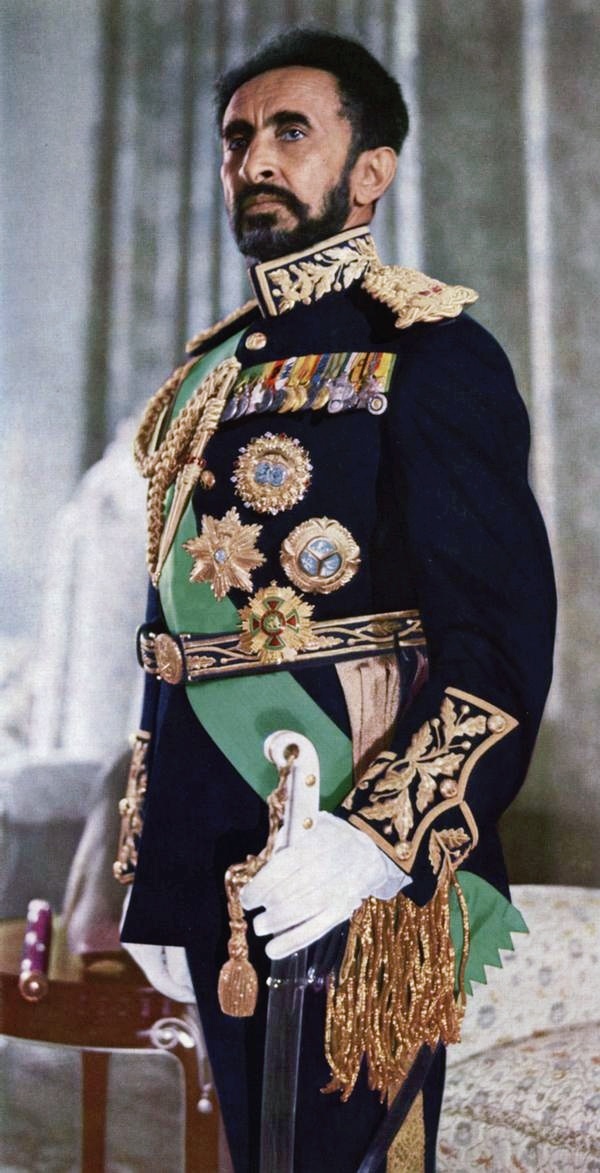
Portrait of Haile Selassie

Photo: unknown; according to [1] and [2] an official portrait of which b/w copies were distributed by the Ethiopian government · Public domain

Born in Ethiopia · Nationality Ethiopian — Monarchy / politics / famine / territorial conflict / repression

Haile Selassie

Documented profile covering 8 controversies, including “1950s–1974: Failure to achieve substantial land reform and persistence of rural inequalities” and “1967–1974: Repression of student movements demanding land reform, freedoms and political transformation”.

Are you concerned? Right of reply

Profile No. 2174 · Updated on 12 October 2026

Portrait of Haile Selassie

Photo: unknown; according to [1] and [2] an official portrait of which b/w copies were distributed by the Ethiopian government · Public domain

8Documented controversies
10Sources
0Formal charge · all time
0Conviction

I. Documented controversies

01

années 1950–1974

1950s–1974: Failure to achieve substantial land reform and persistence of rural inequalities

No legal proceedings

Concentrated landownership, sharecropping arrangements and the interests of major landowners linked to the administration and army limited reform. The agrarian question became one of the principal grievances against the monarchy, encapsulated in the slogan "land to the tiller".

State of the evidence
Documented

Sources · 1

  1. [1]
    Journal of Asian and African Studies / SAGELand Reform in Ethiopia: Why did it fail?Academic publicationHigh reliability

Last verified: 14 September 2026

Add to this entry

02

1967–1974

1967–1974: Repression of student movements demanding land reform, freedoms and political transformation

No legal proceedings

The Ethiopian student movement became more radical in its demands for agrarian reform, democracy and social justice. Demonstrations, strikes and protests were regularly dispersed, with arrests, institutional closures and episodes of lethal violence.

State of the evidence
Documented

Sources · 1

  1. [1]
    Global Nonviolent Action Database / Swarthmore CollegeEthiopian students protest against Emperor Haile Selassie’s regime, 1967-1974Academic publicationHigh reliability

Last verified: 14 September 2026

Add to this entry

03

1972–1973

1972–1973: Wollo famine — delayed relief, concealment and crisis of monarchical legitimacy

No legal proceedings

The Wollo famine caused tens of thousands of deaths. Historical and humanitarian sources describe awareness of the problem at the highest levels of government, delayed relief and efforts to minimise or conceal the scale of the disaster, making it a major symbol of the regime's failure.

State of the evidence
Well documented
Attribution
Political responsibility

Sources · 1

  1. [1]

Last verified: 14 September 2026

Add to this entry

04

1958; 1965–1966

1958 and 1965–1966: Deadly famines in Tigray/Wollo and inadequate state response

No legal proceedings

Before the great famine of 1972–1973, severe famines had already struck northern Ethiopia and killed tens of thousands of people. Africa Watch research highlights deficiencies in the imperial regime's warning systems, relief mechanisms and political accountability.

State of the evidence
Documented

Sources · 1

  1. [1]

Last verified: 14 September 2026

Add to this entry

05

1952–1962

1952–1962: Gradual erosion of federated Eritrea's political and cultural autonomy

No legal proceedings

The federal settlement adopted under UN auspices guaranteed Eritrea its own government, parliament and rights. Under the imperial regime, parties were banned, the independent press closed, local languages progressively marginalised and institutional autonomy reduced.

State of the evidence
Documented
Attribution
Political responsibility

Sources · 3

  1. [1]
    U.S. Department of StateBackground Note: Eritrea — federation and annexation historyOfficial documentVery high reliability
  2. [2]
    U.S. Office of the HistorianUnited States Position on Federation of Eritrea with EthiopiaArchiveVery high reliability
  3. [3]
    Human Rights WatchService for Life — historical background on EritreaNGO reportVery high reliability

Last verified: 14 September 2026

Add to this entry

06

November 1962

1962: Unilateral dissolution of federation and annexation of Eritrea by Ethiopia

No legal proceedings

In November 1962, Eritrea's federal autonomy was abolished and the territory annexed as an Ethiopian province. This decision fuelled the independence conflict that would last nearly three decades.

State of the evidence
Documented
Attribution
Directly implicated

Sources · 2

  1. [1]
    U.S. Department of StateBackground Note: Eritrea — federation and annexation historyOfficial documentVery high reliability
  2. [2]
    U.S. Office of the HistorianUnited States Position on Federation of Eritrea with EthiopiaArchiveVery high reliability

Last verified: 14 September 2026

Add to this entry

07

December 1960–1961

December 1960: Attempted coup reveals political discontent and restoration of strengthened personal rule

No legal proceedings

An attempted coup led by members of the imperial apparatus while the Emperor was abroad was bloodily suppressed. Contemporary American diplomatic assessments regarded it as revealing deep social and political discontent and a highly personalised system.

State of the evidence
Documented

Sources · 2

  1. [1]
    U.S. Office of the HistorianNational Intelligence Estimate: The Outlook for EthiopiaOfficial documentVery high reliability
  2. [2]
    The Journal of Modern African Studies / Cambridge University PressThe Ethiopian Coup d’État of December 1960Academic publicationVery high reliability

Last verified: 14 September 2026

Add to this entry

08

1930–1942

1930–1942: Gradual abolition of slavery, criticised as too slow before complete prohibition

No legal proceedings

Under Haile Selassie, Ethiopia pursued a gradual policy of restricting slavery, but the institution persisted until its complete legal abolition in 1942. The slow pace prompted international criticism, notably in the context of membership and return to international institutions.

State of the evidence
Documented
Attribution
Directly implicated

Sources · 2

  1. [1]
    Library of CongressAbolition of Slavery in EthiopiaOfficial documentVery high reliability
  2. [2]
    Law and History Review / Cambridge University PressAbolitionist Decrees in Ethiopia: The Evolution of Antislavery Legal Strategies from Menilek to Haile Selassie, 1889–1942Academic publicationVery high reliability

Last verified: 14 September 2026

Add to this entry

II. Constellation of documented links

  • Linked profile (portrait or initials) — click to open it
  • Line width: number of documented references
  • Hover over or tap a line: controversies and sources

Two profiles are linked when a documented controversy of one names the other. The link points to that controversy and its sources; it does not indicate a personal relationship.

List of documented links (1)
  1. Mengistu Haile Mariam2 documented references

III. Has something changed?

A new court decision, a missing source, a mistake? Tell us what should be updated: every request is read by the editorial team.

Support the archive

Controversia checks and updates its profiles independently. Support is optional and has no effect on the content of profiles.

Donate

iPhone and iPad

Install Controversia

  1. Tap Share
  2. then Add to Home Screen

Tap Share, then Add to Home Screen.