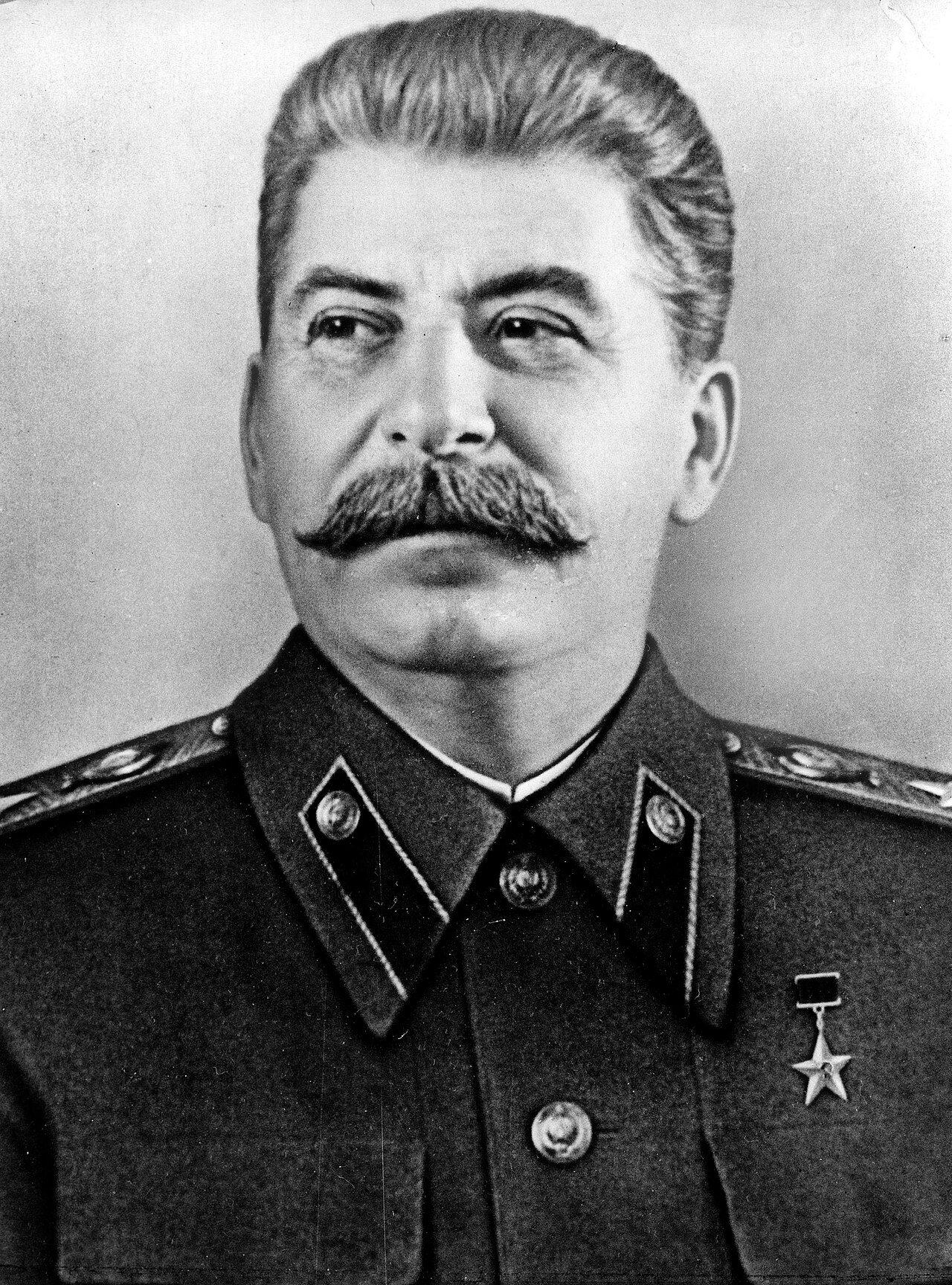
Portrait of Joseph Stalin

Photo: Ivan Shagin · Public domain

Born in Georgia · Nationality Russian — Dictatorship / state terror / famines / deportations / war / Soviet politics

Joseph Stalin

Documented profile covering 20 controversies, including “1930–1953: expansion of Gulag and widespread use of forced labour” and “1948–1953: campaign against "cosmopolitanism" and intensification of state antisemitism”.

Are you concerned? Right of reply

Profile No. 1926 · Updated on 12 October 2026

Portrait of Joseph Stalin

Photo: Ivan Shagin · Public domain

20Documented controversies
8Sources
0Formal charge · all time
0Conviction

I. Documented controversies

01

années 1930–1953

1930–1953: expansion of Gulag and widespread use of forced labour

No legal proceedings

Under Stalin, the Gulag labour camp network became a pillar of political repression and certain major economic projects. Millions of prisoners passed through the camps under frequently lethal conditions.

State of the evidence
Documented

Sources · 2

  1. [1]
  2. [2]
    Center for Slavic, Eurasian and East European Studies / George Mason UniversityGulag: Soviet Forced Labor Camps and the Struggle for FreedomArchiveHigh reliability

Last verified: 13 September 2026

Add to this entry

02

1948–1953

1948–1953: campaign against "cosmopolitanism" and intensification of state antisemitism

No legal proceedings

Writers, scientists and officials, particularly Jews, were targeted as "rootless cosmopolitans", lost their positions or were arrested. The official press fostered an increasingly antisemitic atmosphere.

State of the evidence
Documented

Sources · 1

  1. [1]

Last verified: 13 September 2026

Add to this entry

03

1952–March 1953

1952–1953: "Doctors' Plot" — predominantly Jewish doctors falsely accused of murder and espionage

No legal proceedings

Soviet doctors were arrested and accused of murdering or plotting to murder Soviet leaders on behalf of foreign powers. The campaign fuelled a new wave of antisemitism and raised fears of wider purges.

State of the evidence
Documented

Sources · 1

  1. [1]

Last verified: 13 September 2026

Add to this entry

04

1948–1952

1948–1952: liquidation of Jewish Anti-Fascist Committee and executions during "Night of the Murdered Poets"

No legal proceedings

The regime dissolved the Jewish Anti-Fascist Committee, arrested its leading members and conducted a secret trial. In August 1952, several Yiddish intellectuals and Jewish leaders were executed following fabricated accusations of espionage and nationalism.

State of the evidence
Documented

Sources · 1

  1. [1]

Last verified: 13 September 2026

Add to this entry

05

24 June 1948–12 May 1949

1948–1949: blockade of West Berlin and major international crisis

No legal proceedings

Stalin imposed a blockade of land and river access to Berlin's Western sectors amid currency reform and conflict over Germany's future. The United States and United Kingdom organised a massive airlift until the blockade was lifted.

State of the evidence
Documented
Attribution
Directly implicated

Sources · 1

  1. [1]
    NATOThe Berlin BlockadeOfficial documentVery high reliability

Last verified: 13 September 2026

Add to this entry

06

August 1948

1948: triumph of Lysenkoism and institutional suppression of scientific genetics

No legal proceedings

At the 1948 session of the Lenin Academy of Agricultural Sciences, Trofim Lysenko's theories were imposed as official doctrine and modern genetics was condemned. Researchers lost their positions and the discipline suffered lasting disruption.

State of the evidence
Documented
Attribution
Political responsibility

Sources · 1

  1. [1]

Last verified: 13 September 2026

Add to this entry

07

1941–1944

1941–1944: collective deportations of peoples accused of disloyalty

No legal proceedings

The Stalinist regime carried out mass deportations of Volga Germans, Chechens, Ingush, Crimean Tatars, Kalmyks, Karachays, Balkars and other groups, collectively accusing them of collaboration or disloyalty.

State of the evidence
Documented

Sources · 1

  1. [1]

Last verified: 13 September 2026

Add to this entry

08

1939–1941

1939–1941: mass deportations of Polish citizens from Soviet-occupied territories

No legal proceedings

Following the annexation of eastern Poland, Soviet authorities deported hundreds of thousands of Poles, military personnel, civil servants, landowners, families and other people deemed politically suspect to the interior of the USSR.

State of the evidence
Documented

Sources · 1

  1. [1]
    United States Holocaust Memorial MuseumPolish Refugees in Iran during World War IIArchiveVery high reliability

Last verified: 13 September 2026

Add to this entry

09

17 September 1939–1940

1939: Soviet invasion of eastern Poland and annexation of territories

No legal proceedings

Two weeks after the German attack, the Red Army entered eastern Poland in accordance with the partition envisaged in the secret German-Soviet protocol. The territories were annexed to Soviet republics.

State of the evidence
Documented
Attribution
Directly implicated

Sources · 1

  1. [1]
    United States Holocaust Memorial MuseumGerman-Soviet PactArchiveVery high reliability

Last verified: 13 September 2026

Add to this entry

10

5 March–May 1940

1940: Katyn massacre — approval of execution of thousands of Polish officers and prisoners

No legal proceedings

On 5 March 1940, Stalin and several Politburo members approved an NKVD proposal to execute Polish prisoners deemed enemies of Soviet power. Approximately 22,000 people were killed at several locations, including the site associated with the name Katyn.

State of the evidence
Documented
Attribution
Directly implicated

Sources · 1

  1. [1]
    CIA Center for the Study of IntelligenceStalin's Killing FieldAcademic publicationVery high reliability

Last verified: 13 September 2026

Add to this entry

11

November 1939–March 1940

1939–1940: Winter War against Finland

No legal proceedings

After Soviet territorial demands were rejected, the USSR attacked Finland. The League of Nations expelled the Soviet Union. Despite heavy losses, Moscow secured territory under the March 1940 peace treaty.

State of the evidence
Documented
Attribution
Directly implicated

Sources · 1

  1. [1]
    Encyclopaedia BritannicaSoviet-Finnish WarSecondary sourceHigh reliability

Last verified: 13 September 2026

Add to this entry

12

1940

1940: annexation of Baltic states and seizure of Bessarabia under Soviet pressure

No legal proceedings

Within the spheres of influence agreed with Germany, the USSR imposed military bases and then annexed Estonia, Latvia and Lithuania, and forced Romania to cede Bessarabia and Northern Bukovina.

State of the evidence
Documented
Attribution
Directly implicated

Sources · 1

  1. [1]
    United States Holocaust Memorial MuseumGerman-Soviet PactArchiveVery high reliability

Last verified: 13 September 2026

Add to this entry

13

23 August 1939

1939: Molotov–Ribbentrop Pact and secret protocol dividing spheres of influence with Hitler

No legal proceedings

Stalin approved the non-aggression pact with Nazi Germany and its secret protocol defining the division of parts of Eastern Europe. The text provided in particular for the partition of Poland.

State of the evidence
Documented
Attribution
Directly implicated

Sources · 1

  1. [1]
    United States Holocaust Memorial MuseumGerman-Soviet PactArchiveVery high reliability

Last verified: 13 September 2026

Add to this entry

14

1934–1938

1934–1938: Great Terror — mass arrests, executions and deportations

No legal proceedings

Following the assassination of Sergei Kirov, Stalin launched successive purges culminating in 1937–1938. Millions of people were arrested, sent to camps or executed; the terror affected party officials, administrators, military officers, intellectuals and ordinary citizens.

State of the evidence
Documented
Attribution
Directly implicated

Sources · 1

  1. [1]

Last verified: 13 September 2026

Add to this entry

15

1936–1938

1936–1938: Moscow Trials, forced confessions and elimination of Old Bolsheviks

No legal proceedings

The major public trials in Moscow portrayed Zinoviev, Kamenev, Bukharin, Rykov and other former leaders as conspirators and traitors. Confessions were obtained through coercion and many of those convicted were executed.

State of the evidence
Documented
Attribution
Political responsibility

Sources · 1

  1. [1]

Last verified: 13 September 2026

Add to this entry

16

1937–1938

1937–1938: purge of Red Army high command

No legal proceedings

Stalin had numerous senior commanders, including Marshal Mikhail Tukhachevsky, arrested and executed or imprisoned on charges of conspiracy and espionage.

State of the evidence
Documented
Attribution
Directly implicated

Sources · 1

  1. [1]

Last verified: 13 September 2026

Add to this entry

17

1937–1938

1937–1938: NKVD national operations targeting Poles and other minorities

No legal proceedings

During the Great Terror, the NKVD conducted operations targeting populations deemed potentially disloyal, including the "Polish Operation", leading to tens of thousands of executions and deportations.

State of the evidence
Documented

Sources · 1

  1. [1]

Last verified: 13 September 2026

Add to this entry

18

1929–1933

1929–1933: forced collectivisation and "dekulakisation" — mass deportations and destruction of peasant communities

No legal proceedings

Stalin imposed accelerated agricultural collectivisation and a campaign against the "kulaks". Millions of peasants were dispossessed; approximately one million households classified as kulaks were deported, according to archives presented by the Library of Congress.

State of the evidence
Documented
Attribution
Directly implicated

Sources · 1

  1. [1]

Last verified: 13 September 2026

Add to this entry

19

1932–1933

1932–1933: Ukrainian famine (Holodomor) aggravated by quotas, confiscations and travel restrictions

No legal proceedings

Famine struck Ukraine, the North Caucasus and the Volga region following collectivisation. In Ukraine, grain quotas were maintained or increased, reserves were seized and peasants were prevented from fleeing, resulting in millions of deaths.

State of the evidence
Documented

Sources · 1

  1. [1]

Last verified: 13 September 2026

Add to this entry

20

1924–1929

1924–1929: gradual political elimination of rivals and concentration of personal power

No legal proceedings

After Lenin's death, Stalin used his control of the party apparatus to marginalise Trotsky, Zinoviev, Kamenev, Bukharin and other rivals in succession, until he became the undisputed leader of the USSR.

State of the evidence
Documented
Attribution
Directly implicated

Sources · 1

  1. [1]

Last verified: 13 September 2026

Add to this entry

II. Constellation of documented links

No documented link with another published profile for now.

Two profiles are linked when a documented controversy of one names the other. The link points to that controversy and its sources; it does not indicate a personal relationship.

III. Has something changed?

A new court decision, a missing source, a mistake? Tell us what should be updated: every request is read by the editorial team.

Support the archive

Controversia checks and updates its profiles independently. Support is optional and has no effect on the content of profiles.

Donate

iPhone and iPad

Install Controversia

  1. Tap Share
  2. then Add to Home Screen

Tap Share, then Add to Home Screen.