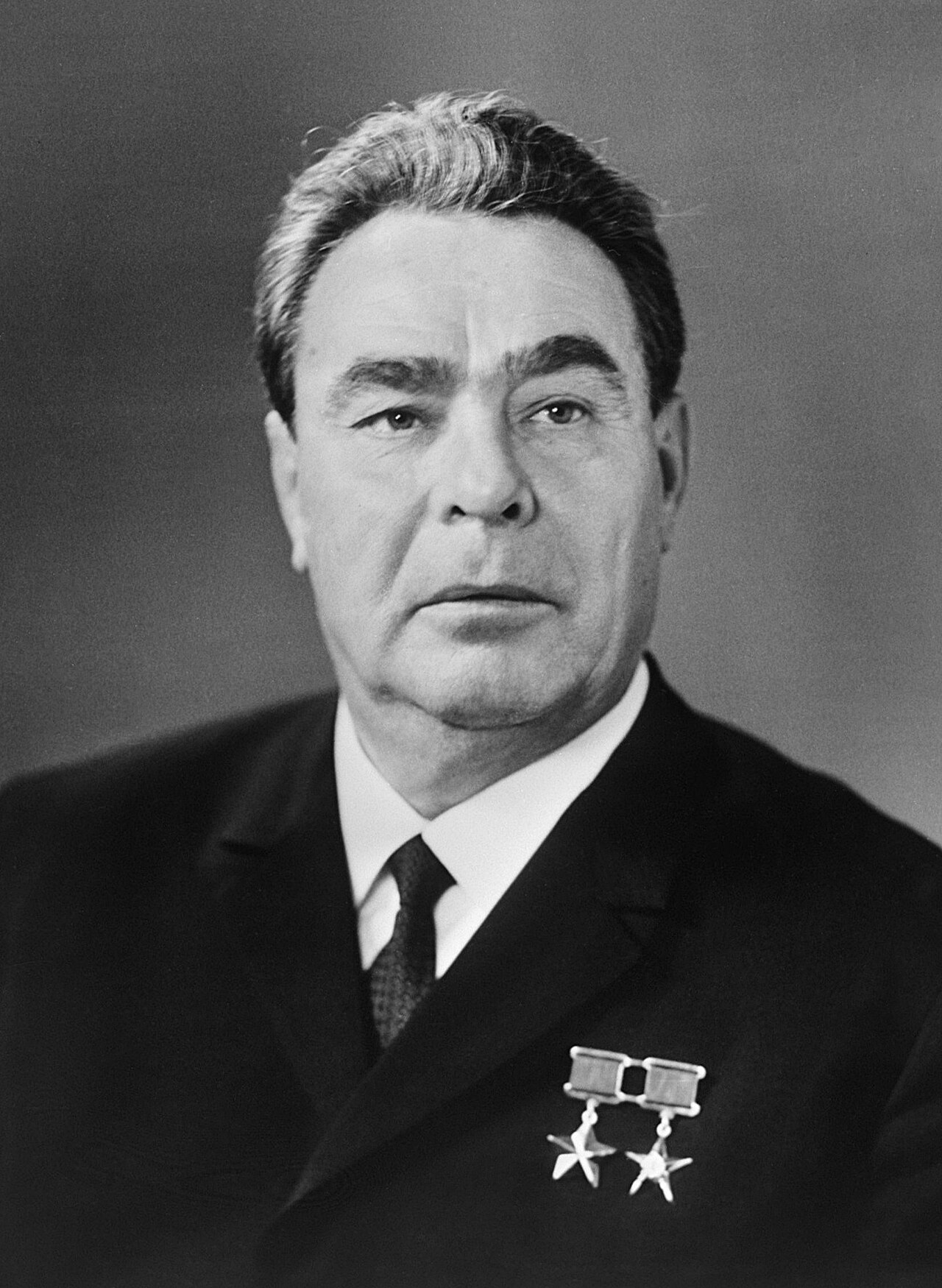
Portrait of Leonid Brezhnev

Photo: Vladimir Musaelyan · CC0 · Wikimedia Commons

Born in Ukraine · Nationality Soviet — Politics / regimes / war / Soviet Union

Leonid Brezhnev

Documented profile covering 11 controversies, including “1970s: nepotism and rapid promotion of son-in-law Yuri Churbanov” and “1976–1982: repression of Moscow Helsinki Group despite Helsinki commitments”.

Are you concerned? Right of reply

Profile No. 2544 · Updated on 12 October 2026

Portrait of Leonid Brezhnev

Photo: Vladimir Musaelyan · CC0 · Wikimedia Commons

11Documented controversies+ 3 background events
10Sources
0Formal charge · all time
0Conviction

I. Documented controversies

01

années 1970–1988

1970s: nepotism and rapid promotion of son-in-law Yuri Churbanov

Conviction — against a third party

Protagonist not prosecuted — these proceedings are not counted in their formal charges or convictions.

After marrying Galina Brezhneva, Yuri Churbanov rose rapidly to become First Deputy Minister of Internal Affairs. Following Brezhnev's death, he was tried and convicted for corruption in a major bribery case.

State of the evidence
Established by a court
Role of the person profiled
Protagonist not prosecuted

Sources · 1

  1. [1]
    The Washington PostSoviet CorruptionPressHigh reliability

Last verified: 15 September 2026

Add to this entry

02

1976–1982

1976–1982: repression of Moscow Helsinki Group despite Helsinki commitments

Conviction — against dissidents

Protagonist not prosecuted — these proceedings are not counted in their formal charges or convictions.

The Moscow Helsinki Group documented human rights violations in relation to the 1975 Final Act. Its members were monitored, arrested, tried, imprisoned or forced into exile until the group was almost completely suppressed in the early 1980s.

State of the evidence
Documented
Person targeted by the proceedings
dissidents
Role of the person profiled
Protagonist not prosecuted

Sources · 2

  1. [1]
    National Security ArchiveSoviet Crackdown on the Moscow Helsinki GroupArchiveVery high reliability
  2. [2]
    The Washington PostPresident Leonid Ilyich Brezhnev: 1906-1982PressHigh reliability

Last verified: 15 September 2026

Add to this entry

03

années 1970–1982

1970s–1982: economic stagnation, institutional inertia and 'gerontocracy'

No legal proceedings

Brezhnev's long rule is associated with slowing growth, postponed structural reforms, increased bureaucratic rigidity and extreme ageing of the leadership. These developments gave rise to the expression 'Era of Stagnation'.

State of the evidence
Documented
Attribution
Directly implicated

Sources · 1

  1. [1]
    The Washington PostPresident Leonid Ilyich Brezhnev: 1906-1982PressHigh reliability

Last verified: 15 September 2026

Add to this entry

04

fin des années 1970–10 November 1982

Late 1970s–1982: serious decline in health, staged public appearances and increasingly delegated governance

No legal proceedings

Suffering from increasingly severe health problems, Brezhnev remained in power as his abilities visibly declined. The Soviet system continued to organise appearances intended to demonstrate continuity of leadership.

State of the evidence
Reported by the press
Attribution
Personally implicated

Sources · 1

  1. [1]
    The Washington PostPresident Leonid Ilyich Brezhnev: 1906-1982PressHigh reliability

Last verified: 15 September 2026

Add to this entry

05

22 January 1980

January 1980: Andrei Sakharov stripped of honours and internally exiled to Gorky

Civil / administrative proceedings

Following Sakharov's criticism of the invasion of Afghanistan, the Presidium stripped him of his honours and sent him into internal exile in Gorky, a city closed to foreigners, without an ordinary criminal trial.

State of the evidence
Documented
Attribution
Directly implicated

Sources · 1

  1. [1]
    The Washington PostSoviets Strip Sakharov of Honors, Exile HimPressHigh reliability

Last verified: 15 September 2026

Add to this entry

06

12–27 December 1979

12–27 December 1979: decision to invade Afghanistan taken by small circle around Brezhnev

No legal proceedings

A small group meeting in Brezhnev's office adopted the decision that led to the large-scale entry of Soviet forces into Afghanistan. The intervention initiated a lengthy, deadly war and seriously damaged East–West relations.

State of the evidence
Documented
Attribution
Shared responsibility

Sources · 1

  1. [1]
    National Security Archive“On the Situation in A”, December 12, 1979Primary sourceVery high reliability

Last verified: 15 September 2026

Add to this entry

07

February 1974

February 1974: arrest, revocation of citizenship and expulsion of Aleksandr Solzhenitsyn

Civil / administrative proceedings

Following the foreign publication of 'The Gulag Archipelago', authorities arrested Solzhenitsyn, stripped him of Soviet citizenship and expelled him to West Germany.

State of the evidence
Documented

Sources · 2

  1. [1]
    The Washington PostPresident Leonid Ilyich Brezhnev: 1906-1982PressHigh reliability
  2. [2]

Last verified: 15 September 2026

Add to this entry

08

1969–1972

1969–1972: escalation and management of Sino-Soviet tensions amid military risks

No legal proceedings

Under Brezhnev, the Sino-Soviet split led in 1969 to violent border clashes and a period of heightened strategic tension between two communist nuclear powers.

State of the evidence
Documented
Attribution
Shared responsibility

Sources · 1

  1. [1]
    The Washington PostPresident Leonid Ilyich Brezhnev: 1906-1982PressHigh reliability

Last verified: 15 September 2026

Add to this entry

09

20–21 August 1968

August 1968: invasion of Czechoslovakia and crushing of Prague Spring

No legal proceedings

After months of pressure on Alexander Dubček, the USSR and several Warsaw Pact allies invaded Czechoslovakia and ended the Prague Spring reforms. Brezhnev regarded maintaining Soviet control as more important than détente with the West.

State of the evidence
Documented
Attribution
Directly implicated

Sources · 2

  1. [1]
    U.S. Department of State, Office of the HistorianSoviet Invasion of Czechoslovakia, 1968Official documentVery high reliability
  2. [2]
    National Security ArchiveThe Prague Spring '68ArchiveVery high reliability

Last verified: 15 September 2026

Add to this entry

10

12 November 1968

November 1968: formulation of 'Brezhnev Doctrine' of limited sovereignty

No legal proceedings

Brezhnev publicly defended the idea that a threat to socialism in one bloc country became a common concern, a doctrine used to justify intervention in Czechoslovakia and later as a Soviet framework for legitimising other interventions.

State of the evidence
Documented
Attribution
Directly implicated

Sources · 1

  1. [1]
    U.S. Department of State, Office of the HistorianSoviet Invasion of Czechoslovakia, 1968Official documentVery high reliability

Last verified: 15 September 2026

Add to this entry

11

1965–1966

1965–1966: Sinyavsky–Daniel trial and symbolic end of part of the cultural 'Thaw'

Conviction — against a third party

Protagonist not prosecuted — these proceedings are not counted in their formal charges or convictions.

Writers Andrei Sinyavsky and Yuli Daniel were arrested and convicted for publishing satirical works abroad under pseudonyms. The trial became a symbol of renewed ideological repression under the new leadership.

Role of the person profiled
Protagonist not prosecuted

Sources · 1

  1. [1]
    The Washington PostPresident Leonid Ilyich Brezhnev: 1906-1982PressHigh reliability

Last verified: 15 September 2026

Add to this entry

II. Documented background

Documented biographical or institutional milestones (elections, appointments, foundings, acquisitions…). These are not controversies and are not counted as such.

  1. années 1960–1982

    Late 1960s–early 1980s: punitive psychiatry and detention of dissidents

    Under Brezhnev, the political misuse of psychiatry became one instrument of repression against certain dissidents, who could be diagnosed and institutionalised for political opposition. Andropov's KGB played a central role in the system.

    Sources · 1
    1. BJPsych Bulletin / PMC — Is there a resumption of political psychiatry in the former Soviet Union?
  2. 1972–1975

    1972–1975: détente, SALT I and Helsinki Accords — counterpoint to coercive policies

    Brezhnev participated in an important phase of détente with the United States: the SALT I agreements, summit meetings and the 1975 Helsinki Final Act. These agreements reduced certain strategic risks and established commitments concerning security and human rights.

    Sources · 1
    1. The Washington Post — President Leonid Ilyich Brezhnev: 1906-1982
  3. October 1964

    1964: central role in Khrushchev's removal and accession to power

    Brezhnev participated in the group of leaders who prepared and imposed Khrushchev's removal. He became First Secretary and gradually the regime's dominant figure.

    Sources · 2
    1. The Washington Post — President Leonid Ilyich Brezhnev: 1906-1982
    2. Encyclopaedia Britannica — Nikita Khrushchev

III. Constellation of documented links

No documented link with another published profile for now.

Two profiles are linked when a documented controversy of one names the other. The link points to that controversy and its sources; it does not indicate a personal relationship.

IV. Has something changed?

A new court decision, a missing source, a mistake? Tell us what should be updated: every request is read by the editorial team.

Support the archive

Controversia checks and updates its profiles independently. Support is optional and has no effect on the content of profiles.

Donate

iPhone and iPad

Install Controversia

  1. Tap Share
  2. then Add to Home Screen

Tap Share, then Add to Home Screen.