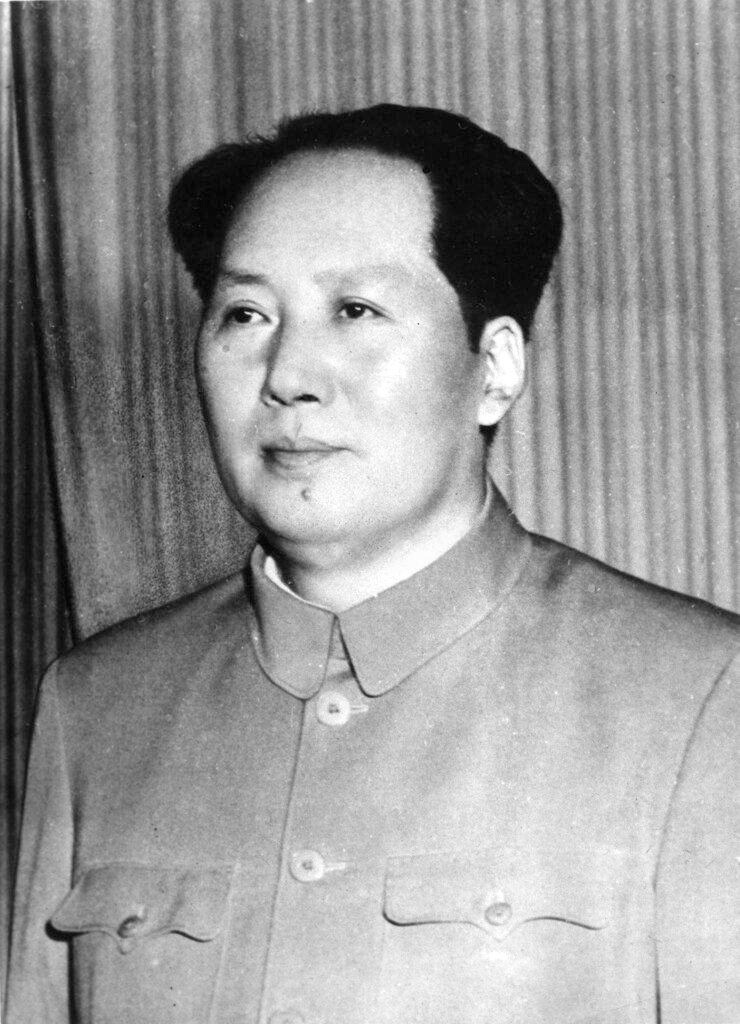
Portrait of Mao Zedong

Photo: Chen Zhengqing (1917–1966) · Public domain

Born in China · Nationality Chinese — Revolution / dictatorship / political campaigns / famine / Cultural Revolution / Chinese politics

Mao Zedong

Documented profile covering 19 controversies, including “1966–1976: personality cult, Little Red Book and suppression of intellectual diversity” and “1971: Lin Biao crisis — former designated successor accused of coup following death in plane crash”.

Are you concerned? Right of reply

Profile No. 1927 · Updated on 12 October 2026

Portrait of Mao Zedong

Photo: Chen Zhengqing (1917–1966) · Public domain

19Documented controversies+ 1 background event
15Sources
0Formal charge · all time
0Conviction

I. Documented controversies

01

1966–1976

1966–1976: personality cult, Little Red Book and suppression of intellectual diversity

No legal proceedings

During the Cultural Revolution, Mao's portraits, quotations and thought became ubiquitous. Hundreds of millions of copies of the Little Red Book were distributed, and personal loyalty to the Chairman became an essential political marker.

State of the evidence
Documented

Sources · 1

  1. [1]
    The National Archives (UK)The Cultural RevolutionArchiveVery high reliability

Last verified: 13 September 2026

Add to this entry

02

September 1971

1971: Lin Biao crisis — former designated successor accused of coup following death in plane crash

No legal proceedings

Lin Biao, Defence Minister and Mao's officially designated successor, died with his family in a crash in Mongolia after leaving China hastily. The regime subsequently accused him of planning a coup and an assassination attempt against Mao.

State of the evidence
Disputed

Sources · 1

  1. [1]
    Encyclopaedia BritannicaLin BiaoSecondary sourceHigh reliability

Last verified: 13 September 2026

Add to this entry

03

1968–années 1970

1968–1970s: "Down to the Countryside" movement — mass relocation of urban youth

No legal proceedings

Millions of urban young people, including former Red Guards, were sent to live and work in the countryside and border regions to be "re-educated" by peasants and reduce urban tensions.

State of the evidence
Documented
Attribution
Directly implicated

Sources · 2

  1. [1]
    The National Archives (UK)The Cultural Revolution – Source 2aArchiveVery high reliability
  2. [2]
    The National Archives (UK)The Cultural Revolution – Source 2bArchiveVery high reliability

Last verified: 13 September 2026

Add to this entry

04

1966–1969

1966–1969: purge of Liu Shaoqi and other Communist leaders

No legal proceedings

President Liu Shaoqi, formerly the regime's second-ranking official, was denounced as a "traitor" and "capitalist", stripped of office, detained in harsh conditions and died in custody in 1969. Deng Xiaoping and many officials were also purged.

State of the evidence
Documented
Attribution
Political responsibility

Sources · 1

  1. [1]
    The National Archives (UK)The Cultural RevolutionArchiveVery high reliability

Last verified: 13 September 2026

Add to this entry

05

1966–1968

1966–1968: Red Guards, struggle sessions, persecution and destruction of "Four Olds"

No legal proceedings

Mao encouraged the mobilisation of Red Guards. Teachers, intellectuals, officials and people associated with the old order were humiliated, beaten, imprisoned or killed; temples, books, works of art and cultural property were destroyed in the campaign against the "Four Olds".

State of the evidence
Documented

Sources · 1

  1. [1]
    The National Archives (UK)The Cultural RevolutionArchiveVery high reliability

Last verified: 13 September 2026

Add to this entry

06

1967–1968

1967–1968: factional warfare and local massacres during Cultural Revolution

No legal proceedings

In numerous provinces, revolutionary mobilisation degenerated into armed clashes between factions, local purges and massacres. The state and People's Liberation Army subsequently intervened unevenly to impose order.

State of the evidence
Documented

Sources · 1

  1. [1]
    The National Archives (UK)The Cultural RevolutionArchiveVery high reliability

Last verified: 13 September 2026

Add to this entry

07

May–August 1966

1966: launch of Cultural Revolution to reassert Mao's authority and eliminate rivals

No legal proceedings

Mao launched the Cultural Revolution by denouncing "bourgeois" and "counterrevolutionary" elements within the party and society. He mobilised young people and weakened ordinary party structures to regain political supremacy challenged after the Great Leap.

State of the evidence
Documented
Attribution
Directly implicated

Sources · 1

  1. [1]
    The National Archives (UK)The Cultural RevolutionArchiveVery high reliability

Last verified: 13 September 2026

Add to this entry

08

1962–1965

1962–1965: renewed class struggle and Socialist Education Movement

No legal proceedings

Following a period of economic correction after the famine, Mao renewed his emphasis on class struggle and supported the Socialist Education Movement, targeting officials considered corrupt or insufficiently revolutionary.

State of the evidence
Documented
Attribution
Directly implicated

Sources · 1

  1. [1]
    Cambridge University PressThe Cambridge History of ChinaAcademic publicationVery high reliability

Last verified: 13 September 2026

Add to this entry

09

1958–1962

1958–1962: Great Famine — tens of millions of deaths during Great Leap Forward

No legal proceedings

The Great Leap Forward caused or aggravated a catastrophic famine. Grain requisitions, inflated statistics, destruction of warning mechanisms, restrictions on movement and continuation of radical policies despite information about hunger contributed to tens of millions of deaths.

State of the evidence
Documented

Sources · 2

  1. [1]
    Cambridge University Press / The China QuarterlyMao Zedong and the Famine of 1959–1960: A Study in WilfulnessAcademic publicationVery high reliability
  2. [2]
    Cambridge University PressA Critical Introduction to Mao — excerptAcademic publicationVery high reliability

Last verified: 13 September 2026

Add to this entry

10

1958–1960

1958–1960: "backyard furnaces" and industrial mobilisation disrupting agriculture

No legal proceedings

The Great Leap Forward mobilised millions of people to produce steel in small local furnaces, often at the cost of destroying useful tools and objects and shifting large numbers of workers away from harvesting.

State of the evidence
Documented
Attribution
Directly implicated

Sources · 1

  1. [1]
    Encyclopaedia BritannicaMao ZedongSecondary sourceHigh reliability

Last verified: 13 September 2026

Add to this entry

11

1958–1960

1958–1960: "Four Pests" Campaign and ecological imbalance following mass extermination of sparrows

No legal proceedings

As part of the Great Leap Forward, Mao launched a mobilisation against rats, flies, mosquitoes and sparrows. Mass extermination of sparrows removed a predator of insect pests and contributed to ecological imbalances that aggravated agricultural difficulties.

State of the evidence
Documented
Attribution
Directly implicated

Last verified: 13 September 2026

Add to this entry

12

1950–1959

1950–1959: forced incorporation of Tibet and 1959 uprising

No legal proceedings

The People's Liberation Army entered Tibet in 1950. The Seventeen Point Agreement of 1951 formalised incorporation into the PRC amid a major imbalance of power. Tensions over reforms and the Chinese presence culminated in the 1959 uprising, suppressed by the military, and the Dalai Lama's flight.

State of the evidence
Documented

Sources · 1

  1. [1]
    Encyclopaedia BritannicaTibet - Chinese occupation, Dalai Lama, BuddhismSecondary sourceHigh reliability

Last verified: 13 September 2026

Add to this entry

13

1957–1959

1957–1959: Anti-Rightist Campaign — persecution of hundreds of thousands of intellectuals and officials

No legal proceedings

Following the Hundred Flowers Campaign, critics of the party were labelled "rightists". Hundreds of thousands lost their jobs and status, were sent to forced labour or the countryside, and endured years of persecution.

State of the evidence
Documented
Attribution
Directly implicated

Sources · 1

  1. [1]
    Cambridge University PressA Critical Introduction to Mao — excerptAcademic publicationVery high reliability

Last verified: 13 September 2026

Add to this entry

14

July–August 1959

1959: Lushan Conference — purge of Peng Dehuai following criticism of Great Leap and revival of radical policies

No legal proceedings

Defence Minister Peng Dehuai sent Mao a letter criticising the excesses of the Great Leap. Mao turned the debate into a test of loyalty, had Peng condemned as a "rightist" and revived an ideological campaign that further reduced the possibility of reporting the famine.

State of the evidence
Documented
Attribution
Directly implicated

Sources · 1

  1. [1]
    Cambridge University Press / The China QuarterlyMao Zedong and the Famine of 1959–1960: A Study in WilfulnessAcademic publicationVery high reliability

Last verified: 13 September 2026

Add to this entry

15

1956–1957

1956–1957: Hundred Flowers Campaign — criticism encouraged, then critics targeted

No legal proceedings

Mao encouraged intellectuals and citizens to criticise the party under the "Hundred Flowers" slogan. After criticism intensified in spring 1957, the policy abruptly reversed.

State of the evidence
Documented
Attribution
Directly implicated

Sources · 1

  1. [1]
    Cambridge University PressA Hundred FlowersAcademic publicationVery high reliability

Last verified: 13 September 2026

Add to this entry

16

May 1955–1956

1955: campaign against Hu Feng and expansion of repression of intellectuals

No legal proceedings

Marxist critic Hu Feng, who called for greater literary autonomy, was accused of organising a vast conspiracy against the state. A nationwide denunciation campaign spread to intellectuals and writers associated, directly or indirectly, with his ideas.

State of the evidence
Documented

Sources · 1

  1. [1]
    Cambridge University Press / The China QuarterlyHu Feng's Conflict with the Communist Literary AuthoritiesAcademic publicationVery high reliability

Last verified: 13 September 2026

Add to this entry

17

1949–1953

1949–1953: violent land reform and executions of landowners

No legal proceedings

Following the establishment of the People's Republic, the regime implemented land reform that redistributed land but was accompanied by struggle sessions, detention and executions of landowners classified as "landlords".

State of the evidence
Documented

Sources · 1

  1. [1]
    Encyclopaedia BritannicaMao ZedongSecondary sourceHigh reliability

Last verified: 13 September 2026

Add to this entry

18

1950–1953

1950–1953: Campaign to Suppress Counterrevolutionaries and execution quotas

No legal proceedings

Mao launched the Campaign to Suppress Counterrevolutionaries against former Nationalist agents, opponents and people designated enemies of the new regime. Central directives included quantified execution targets, encouraging waves of killings.

State of the evidence
Documented
Attribution
Directly implicated

Sources · 2

  1. [1]
    Cambridge University Press / The China QuarterlyReconsidering the Campaign to Suppress CounterrevolutionariesAcademic publicationVery high reliability
  2. [2]
    Cambridge University Press / Journal of Chinese HistoryQuota, Class, and Political Violence in Mao's ChinaAcademic publicationVery high reliability

Last verified: 13 September 2026

Add to this entry

19

1951–1952

1951–1952: Three-Anti and Five-Anti Campaigns — political and economic coercion of officials and entrepreneurs

No legal proceedings

Campaigns against corruption, waste and bureaucracy, followed by those against economic offences, targeted public officials and urban entrepreneurs. Interrogations, denunciations, self-criticism sessions, heavy penalties and extreme pressure profoundly transformed the private sector.

State of the evidence
Documented

Sources · 1

  1. [1]
    Encyclopaedia BritannicaMao ZedongSecondary sourceHigh reliability

Last verified: 13 September 2026

Add to this entry

II. Documented background

Documented biographical or institutional milestones (elections, appointments, foundings, acquisitions…). These are not controversies and are not counted as such.

  1. 1958

    1958: launch of Great Leap Forward and collectivisation into people's communes

    Mao launched the Great Leap Forward to accelerate industrialisation and agricultural production simultaneously. People's communes sharply curtailed the autonomy of rural families and production targets were set unrealistically.

    Sources · 2
    1. The National Archives (UK) — The Cultural Revolution
    2. Cambridge University Press / The China Quarterly — Mao Zedong and the Famine of 1959–1960: A Study in Wilfulness

III. Constellation of documented links

No documented link with another published profile for now.

Two profiles are linked when a documented controversy of one names the other. The link points to that controversy and its sources; it does not indicate a personal relationship.

IV. Has something changed?

A new court decision, a missing source, a mistake? Tell us what should be updated: every request is read by the editorial team.

Support the archive

Controversia checks and updates its profiles independently. Support is optional and has no effect on the content of profiles.

Donate

iPhone and iPad

Install Controversia

  1. Tap Share
  2. then Add to Home Screen

Tap Share, then Add to Home Screen.