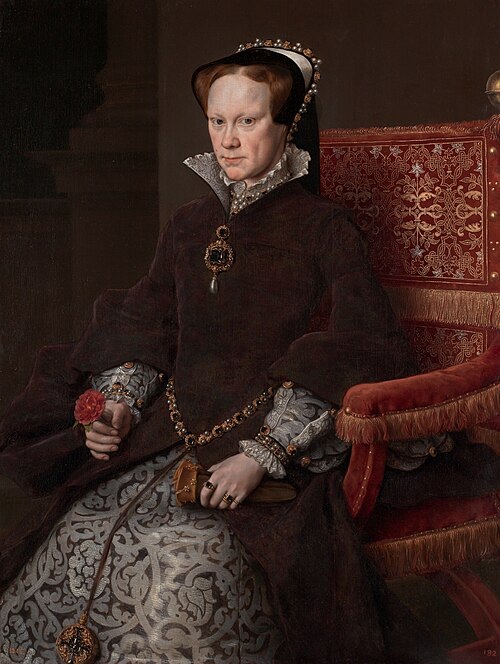
Born in United Kingdom · Nationality English — Tudor monarchy / Catholic restoration / religious persecution / succession / war

Mary I of England

Documented profile covering 7 controversies, including “1555–1558: Heresy laws restored and approximately 290 Protestants burned” and “1556: Thomas Cranmer executed after recantations and subsequent public repudiation of them”.

Are you concerned? Right of reply

Profile No. 2131 · Updated on 12 October 2026

Portrait of Mary I of England

Photo: Wikimedia Commons

7Documented controversies+ 2 background events
7Sources
0Formal charge · all time
0Conviction

I. Documented controversies

01

February 1555–1558

1555–1558: Heresy laws restored and approximately 290 Protestants burned

Conviction — against about 290 Protestants

Protagonist not prosecuted — these proceedings are not counted in their formal charges or convictions.

After medieval heresy laws are restored, Mary's regime has approximately 290 Protestants burned, many of them ordinary people but also leading religious figures. These persecutions become the most enduringly controversial feature of her reign.

State of the evidence
Documented
Attribution
Directly implicated
Person targeted by the proceedings
about 290 Protestants
Role of the person profiled
Protagonist not prosecuted

Sources · 1

  1. [1]
    Historic Royal PalacesKings and Queens of England and Britain — Mary IOfficial documentVery high reliability

Last verified: 14 September 2026

Add to this entry

02

21 March 1556

1556: Thomas Cranmer executed after recantations and subsequent public repudiation of them

Conviction — against Thomas Cranmer

Protagonist not prosecuted — these proceedings are not counted in their formal charges or convictions.

Thomas Cranmer, former Archbishop of Canterbury and a principal architect of the English Reformation, is burned at Oxford after signing several recantations. At his execution, he publicly repudiates his recantations and reaffirms his Protestant beliefs.

State of the evidence
Documented
Person targeted by the proceedings
Thomas Cranmer
Role of the person profiled
Protagonist not prosecuted

Sources · 1

  1. [1]
    Historic Royal PalacesTower Green and Scaffold siteOfficial documentHigh reliability

Last verified: 14 September 2026

Add to this entry

03

16 October 1555

1555: Hugh Latimer and Nicholas Ridley burned at Oxford

Conviction — against Hugh Latimer and Nicholas Ridley

Protagonist not prosecuted — these proceedings are not counted in their formal charges or convictions.

Former Protestant bishops Hugh Latimer and Nicholas Ridley are burned at Oxford for heresy. Their deaths become one of the most famous episodes of the Marian persecutions and subsequently reinforce the Protestant narrative of martyrdom.

State of the evidence
Documented
Person targeted by the proceedings
Hugh Latimer and Nicholas Ridley
Role of the person profiled
Protagonist not prosecuted

Sources · 1

  1. [1]
    Historic Royal PalacesMary I: first crowned Queen of EnglandOfficial documentVery high reliability

Last verified: 14 September 2026

Add to this entry

04

1553–1554

1553–1554: Gradual restoration of Catholicism and reversal of Edward VI's religious policies

No legal proceedings

Following her accession, Mary seeks to restore Catholic practice, reverse much of Edward VI's Protestant reforms and reconcile the kingdom with Rome.

State of the evidence
Documented
Attribution
Directly implicated

Sources · 1

  1. [1]
    The National ArchivesRole of a Queen - Mary I and AnneArchiveVery high reliability

Last verified: 14 September 2026

Add to this entry

05

January–February 1554

1554: Proposed marriage to Philip of Spain and Wyatt's Rebellion

No legal proceedings

Mary's decision to marry Philip of Spain provokes strong opposition, fuelled by fears of Spanish domination and religious tensions. Thomas Wyatt leads a rebellion that reaches the outskirts of London before being defeated.

State of the evidence
Documented
Attribution
Political responsibility

Sources · 1

  1. [1]
    Historic Royal PalacesMary IOfficial documentVery high reliability

Last verified: 14 September 2026

Add to this entry

06

12 February 1554

1554: Execution of Lady Jane Grey after pardon initially contemplated

Conviction — against Lady Jane Grey

Protagonist not prosecuted — these proceedings are not counted in their formal charges or convictions.

Lady Jane Grey, approximately sixteen or seventeen years old, had been convicted of treason following her nine-day reign. Mary had initially hesitated to execute her cousin, but Wyatt's Rebellion and the involvement of Jane's father made her politically too dangerous; Mary then authorises her execution.

State of the evidence
Documented
Attribution
Directly implicated
Person targeted by the proceedings
Lady Jane Grey
Role of the person profiled
Protagonist not prosecuted

Sources · 1

  1. [1]
    Historic Royal PalacesLady Jane Grey: The 'Nine Day Queen'Official documentVery high reliability

Last verified: 14 September 2026

Add to this entry

07

17 March–May 1554

March–May 1554: Elizabeth imprisoned in Tower on suspicion of involvement in rebellion

No legal proceedings

Following Wyatt's Rebellion, the future Elizabeth I is sent to the Tower of London, suspected of knowing about or being connected with the plot. In her "Tide Letter", Elizabeth denies involvement and asks not to be condemned without evidence.

State of the evidence
Documented
Attribution
Directly implicated

Sources · 1

  1. [1]
    The National ArchivesThe Tide LetterArchiveVery high reliability

Last verified: 14 September 2026

Add to this entry

II. Documented background

Documented biographical or institutional milestones (elections, appointments, foundings, acquisitions…). These are not controversies and are not counted as such.

  1. 1557–January 1558

    1557–1558: Entry into war alongside Spain and loss of Calais

    England enters the war against France alongside Philip's Spain. In January 1558, the French capture Calais, the last major English territory on the continent, a loss that severely damages the prestige of Mary's reign.

    Sources · 1
    1. Historic Royal Palaces — Kings and Queens of England and Britain — Mary I
  2. 1555–1557

    1555 and 1557: Phantom pregnancies, succession crisis and political weakening

    Mary believes on two occasions that she is pregnant, prompting the court to prepare for a royal birth. No child is born, leaving the Catholic succession unresolved and increasing the likelihood that Elizabeth will succeed her.

    Sources · 1
    1. Historic Royal Palaces — Henry VIII's children

III. Constellation of documented links

No documented link with another published profile for now.

Two profiles are linked when a documented controversy of one names the other. The link points to that controversy and its sources; it does not indicate a personal relationship.

IV. Has something changed?

A new court decision, a missing source, a mistake? Tell us what should be updated: every request is read by the editorial team.

Support the archive

Controversia checks and updates its profiles independently. Support is optional and has no effect on the content of profiles.

Donate

iPhone and iPad

Install Controversia

  1. Tap Share
  2. then Add to Home Screen

Tap Share, then Add to Home Screen.