Born in Russia · Nationality Russian — Politics / regimes / war / Soviet Union

Nikita Khrushchev

Documented profile covering 16 controversies, including “1956: de-Stalinisation, mass releases and rehabilitations” and “1958–1964: extensive anti-religious campaign, closures and restrictions targeting religious communities”.

Are you concerned? Right of reply

Profile No. 2543 · Updated on 12 October 2026

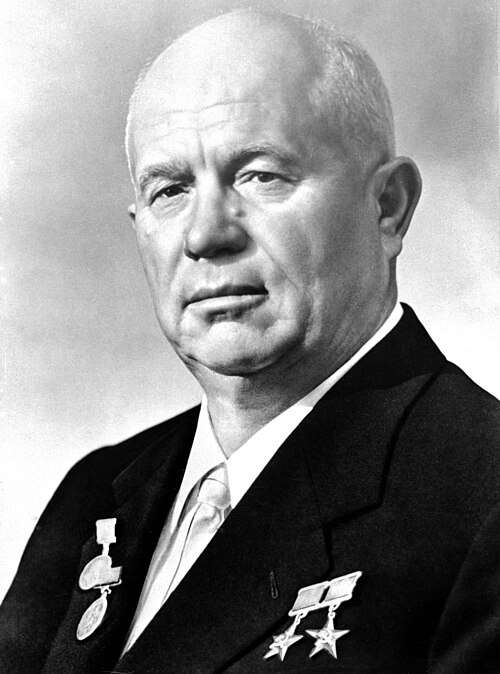
Portrait of Nikita Khrushchev

Photo: Wikimedia Commons

16Documented controversies+ 4 background events
18Sources
0Formal charge · all time
0Conviction

I. Documented controversies

01

1956–1964

1956: de-Stalinisation, mass releases and rehabilitations

No legal proceedings

Under Khrushchev, the Gulag system was substantially reduced, hundreds of thousands of prisoners were released or rehabilitated, and Stalinist mass terror declined markedly.

State of the evidence
Documented
Attribution
Directly implicated

Sources · 2

  1. [1]
    U.S. Department of State, Office of the HistorianKhrushchev and the Twentieth Congress of the Communist Party, 1956Official documentVery high reliability
  2. [2]
    Encyclopaedia BritannicaNikita KhrushchevAcademic publicationVery high reliability

Last verified: 15 September 2026

Add to this entry

02

1958–1964

1958–1964: extensive anti-religious campaign, closures and restrictions targeting religious communities

No legal proceedings

Khrushchev renewed an ideological offensive against religion: financial restrictions, atheist propaganda, closures of places of worship and administrative pressure affected various faiths.

State of the evidence
Well documented
Attribution
Directly implicated

Sources · 2

  1. [1]
    Oxford AcademicThe Anti-Religious Campaign, 1959–1964Academic publicationVery high reliability
  2. [2]
    Princeton Scholarship Online / Oxford AcademicThe Specter Haunting Soviet Communism: Antireligious Campaigns under KhrushchevAcademic publicationVery high reliability

Last verified: 15 September 2026

Add to this entry

03

1954–1964

1954–1964: Virgin Lands campaign, ambitious agricultural initiatives and grain crisis

No legal proceedings

Khrushchev launched the massive cultivation of the 'Virgin Lands' and other highly ambitious agricultural campaigns. The initial harvests were impressive, but erosion, unstable yields and poor harvests subsequently contributed to difficulties and grain imports.

State of the evidence
Documented
Attribution
Directly implicated

Sources · 2

  1. [1]
    Encyclopedia of UkraineVirgin landsEncyclopediaVery high reliability
  2. [2]
    Encyclopaedia BritannicaNikita KhrushchevAcademic publicationVery high reliability

Last verified: 15 September 2026

Add to this entry

04

14 October 1964

October 1964: ousted by colleagues over 'voluntarism', reorganisations and leadership style

No legal proceedings

Brezhnev, Kosygin and other leaders organised Khrushchev's removal. Criticisms concerned his economic improvisations, constant reorganisations, agricultural setbacks and personal management of power.

State of the evidence
Documented
Attribution
Directly implicated

Sources · 1

  1. [1]
    Encyclopaedia BritannicaNikita KhrushchevAcademic publicationVery high reliability

Last verified: 15 September 2026

Add to this entry

05

1 December 1962

December 1962: public attack on abstract art at Manege exhibition

No legal proceedings

During his visit to the Manege exhibition in Moscow, Khrushchev fiercely attacked modernist and abstract artists. The episode marked a significant tightening of the limits of the cultural 'Thaw'.

State of the evidence
Documented
Attribution
Directly implicated

Sources · 1

  1. [1]
    University of Illinois — Seventeen Moments in Soviet HistoryKhrushchev on the ArtsAcademic publicationHigh reliability

Last verified: 15 September 2026

Add to this entry

06

1 June–August 1962

June–August 1962: Novocherkassk massacre, secret trials and cover-up

Conviction — against a third party

Protagonist not prosecuted — these proceedings are not counted in their formal charges or convictions.

After prices and production targets rose, workers demonstrated in Novocherkassk. Soviet forces fired on the crowd, killing and injuring dozens; trials followed, including seven death sentences, while the affair was concealed for many years.

State of the evidence
Documented
Attribution
Political responsibility
Role of the person profiled
Protagonist not prosecuted

Sources · 1

  1. [1]

Last verified: 15 September 2026

Add to this entry

07

May–28 October 1962

1962: secret deployment of nuclear missiles to Cuba and crisis on brink of war

No legal proceedings

Khrushchev reached a secret agreement with Fidel Castro to install Soviet nuclear missiles in Cuba. Their discovery triggered thirteen days of confrontation during which the two superpowers came close to nuclear conflict.

State of the evidence
Documented
Attribution
Directly implicated

Sources · 1

  1. [1]
    U.S. Department of State, Office of the HistorianThe Cuban Missile Crisis, October 1962Official documentVery high reliability

Last verified: 15 September 2026

Add to this entry

08

1–16 May 1960

May 1960: exploitation of U-2 incident and collapse of Paris summit

No legal proceedings

After American pilot Francis Gary Powers was captured, Khrushchev publicly revealed that the pilot had survived and exploited the incident to demand a US apology. The Paris summit collapsed amid the confrontation.

State of the evidence
Documented
Attribution
Directly implicated

Sources · 2

  1. [1]
    U.S. Department of State, Office of the HistorianThe U-2 Incident and the Paris SummitOfficial documentVery high reliability
  2. [2]
    U.S. Department of State, Office of the HistorianForeign Relations of the United States: U-2 and Paris SummitArchiveVery high reliability

Last verified: 15 September 2026

Add to this entry

09

1957–16 June 1958

1957–1958: arrest and execution of Imre Nagy and Pál Maléter after Hungarian Revolution

Conviction — against Imre Nagy

Protagonist not prosecuted — these proceedings are not counted in their formal charges or convictions.

Imre Nagy, head of the insurgent government, and Pál Maléter were secretly tried and executed in 1958. Western diplomatic archives considered the affair closely linked to Soviet control of post-uprising Hungary.

Person targeted by the proceedings
Imre Nagy
Role of the person profiled
Protagonist not prosecuted

Sources · 1

  1. [1]
    U.S. Department of State, Office of the HistorianForeign Relations of the United States, 1958–1960, Eastern Europe; Soviet UnionArchiveVery high reliability

Last verified: 15 September 2026

Add to this entry

10

October–November 1958

1958: campaign against Boris Pasternak following Nobel Prize in Literature

No legal proceedings

After Boris Pasternak was awarded the Nobel Prize, Soviet authorities launched a campaign that forced him to refuse the award. Nobel sources indicate that Khrushchev personally participated in the pressure and later admitted regretting his conduct.

State of the evidence
Documented
Attribution
Directly implicated

Sources · 2

  1. [1]
    NobelPrize.orgBoris Pasternak – FactsArchiveVery high reliability
  2. [2]
    NobelPrize.orgThe Nobel Peace Prize: revelations from the Soviet pastArchiveVery high reliability

Last verified: 15 September 2026

Add to this entry

11

June 1957

June 1957: reverses Presidium vote and politically eliminates 'Anti-Party Group'

No legal proceedings

Malenkov, Molotov and Kaganovich secured a majority in the Presidium to oust Khrushchev. He appealed to the Central Committee, reversed the majority and had his rivals removed from senior positions.

State of the evidence
Documented
Attribution
Directly implicated

Sources · 2

  1. [1]
    Encyclopedia.comAnti-Party GroupAcademic publicationHigh reliability
  2. [2]
    Encyclopaedia BritannicaNikita KhrushchevAcademic publicationVery high reliability

Last verified: 15 September 2026

Add to this entry

12

25 February 1956

February 1956: 'Secret Speech' denouncing Stalin's cult of personality and some of his crimes

No legal proceedings

At the 20th Party Congress, Khrushchev denounced Stalin's cult of personality, the purges of Party officials and several mass abuses in a closed session. The speech initiated a major phase of de-Stalinisation and rehabilitation.

State of the evidence
Documented
Attribution
Directly implicated

Sources · 2

  1. [1]
    Fordham Internet Modern History SourcebookKhrushchev's Secret Speech, 1956Primary sourceHigh reliability
  2. [2]
    U.S. Department of State, Office of the HistorianKhrushchev and the Twentieth Congress of the Communist Party, 1956Official documentVery high reliability

Last verified: 15 September 2026

Add to this entry

13

23 October–November 1956

October–November 1956: Soviet army crushes Hungarian Revolution

No legal proceedings

After initially pulling back, the Soviet leadership decided to intervene on a massive scale in Hungary. Soviet tanks crushed the uprising, causing thousands of casualties and installing János Kádár's government.

State of the evidence
Documented
Attribution
Directly implicated

Sources · 2

  1. [1]
    U.S. Department of State, Office of the HistorianKhrushchev and the Twentieth Congress of the Communist Party, 1956Official documentVery high reliability
  2. [2]
    U.S. Department of State, Office of the HistorianForeign Relations of the United States, 1958–1960, Eastern Europe; Soviet UnionArchiveVery high reliability

Last verified: 15 September 2026

Add to this entry

14

1939–1940

1939–1940: Sovietisation of annexed western Ukraine and repression of opponents

No legal proceedings

Following the Soviet annexation of Polish territories in 1939, the apparatus led by Khrushchev in Ukraine participated in their forced integration into the Soviet system, amid arrests, deportations and the elimination of independent political organisations.

State of the evidence
Documented
Attribution
Directly implicated

Sources · 2

  1. [1]
    Encyclopedia of UkrainePurgesEncyclopediaVery high reliability
  2. [2]
    Encyclopaedia BritannicaNikita KhrushchevAcademic publicationVery high reliability

Last verified: 15 September 2026

Add to this entry

15

January 1938–1939

1938–1939: arrival in Ukraine at the height of a massive purge of Party and state

No legal proceedings

Appointed First Secretary of the Communist Party of Ukraine in January 1938, Khrushchev took charge of the organisation as it was being rebuilt after devastating purges; repression and the replacement of officials continued under his authority.

State of the evidence
Documented
Attribution
Directly implicated

Sources · 2

  1. [1]
    Encyclopedia of UkrainePurgesEncyclopediaVery high reliability
  2. [2]
    Encyclopaedia BritannicaNikita KhrushchevAcademic publicationVery high reliability

Last verified: 15 September 2026

Add to this entry

16

1936–1937

1936–1937: Party leadership in Moscow during the Great Purges

No legal proceedings

As First Secretary in Moscow and a member of the Stalinist apparatus, Khrushchev participated in implementing the purges and supported campaigns against officials labelled enemies. His political rise took place at the height of the Great Terror.

State of the evidence
Documented
Attribution
Directly implicated

Sources · 1

  1. [1]
    Encyclopaedia BritannicaNikita KhrushchevAcademic publicationVery high reliability

Last verified: 15 September 2026

Add to this entry

II. Documented background

Documented biographical or institutional milestones (elections, appointments, foundings, acquisitions…). These are not controversies and are not counted as such.

  1. 28 October 1962–August 1963

    October 1962–1963: missile withdrawal, hotline and Partial Test Ban Treaty — de-escalation after Cuba

    Khrushchev ordered the dismantling and return of Soviet missiles from Cuba in exchange for American commitments, then participated in the de-escalation that led to the hotline and the 1963 Partial Nuclear Test Ban Treaty.

    Sources · 2
    1. U.S. Department of State, Office of the Historian — Message From Chairman Khrushchev to President Kennedy, October 28, 1962
    2. U.S. Department of State, Office of the Historian — The Cuban Missile Crisis, October 1962
  2. 10 November 1958–1961

    November 1958: Berlin ultimatum triggers three-year crisis

    Khrushchev demanded that Western powers withdraw from West Berlin within six months, triggering a crisis that raised the risk of major military confrontation in Europe.

    Sources · 1
    1. U.S. Department of State, Office of the Historian — The Berlin Crisis, 1958–1961
  3. June–August 1961

    1961: renewed confrontation over Berlin and de facto acceptance of Berlin Wall's construction

    Following the Vienna summit, Khrushchev renewed his threats concerning Berlin. In August, the East German regime closed the border and built the Wall, a measure made possible by Soviet political and military support.

    Sources · 1
    1. U.S. Department of State, Office of the Historian — The Berlin Crisis, 1958–1961
  4. October 1956

    October 1956: Polish crisis — threat of intervention followed by compromise with Gomułka

    Khrushchev travelled to Warsaw as Soviet forces were being mobilised and the Polish leadership was installing Władysław Gomułka. After a tense confrontation, Moscow ultimately accepted the new Polish leadership and avoided military intervention.

    Sources · 1
    1. U.S. Department of State, Office of the Historian — Khrushchev and the Twentieth Congress of the Communist Party, 1956

III. Constellation of documented links

No documented link with another published profile for now.

Two profiles are linked when a documented controversy of one names the other. The link points to that controversy and its sources; it does not indicate a personal relationship.

IV. Has something changed?

A new court decision, a missing source, a mistake? Tell us what should be updated: every request is read by the editorial team.

Support the archive

Controversia checks and updates its profiles independently. Support is optional and has no effect on the content of profiles.

Donate

iPhone and iPad

Install Controversia

  1. Tap Share
  2. then Add to Home Screen

Tap Share, then Add to Home Screen.