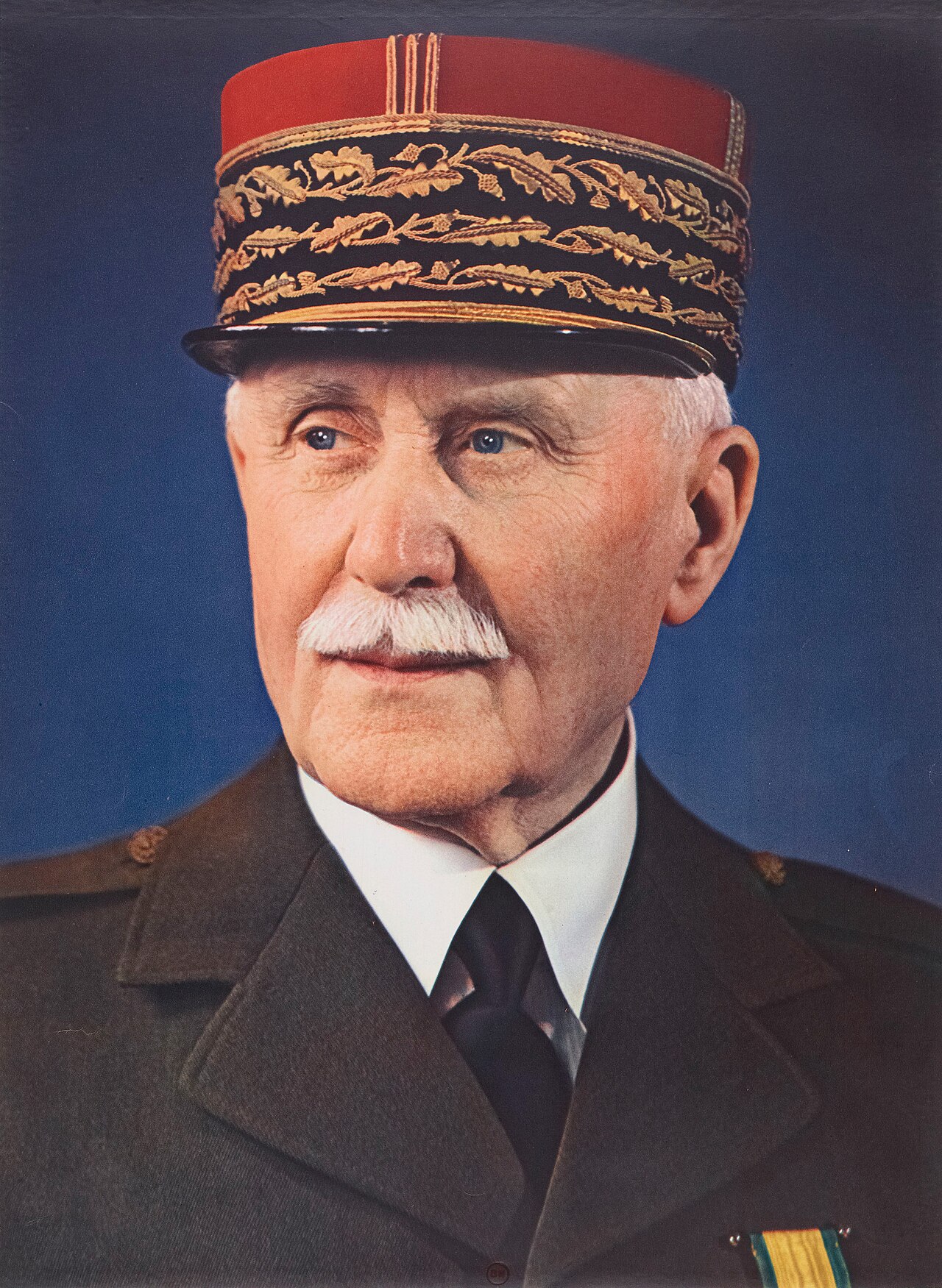
Portrait of Philippe Pétain

Photo: Imprimerie Draeger à Montrouge en région parisienne · Public domain

Born in France · Nationality French — military / Vichy regime / state antisemitism / collaboration / Second World War

Philippe Pétain

Documented profile covering 13 controversies, including “1945: Trial for high treason and collaboration with enemy — death sentence, national degradation and commutation to life imprisonment” and “1940–1944: "National Revolution" — dismantling republican institutions, cult of leadership and authoritarian policies”.

Are you concerned? Right of reply

Profile No. 2111 · Updated on 12 October 2026

Portrait of Philippe Pétain

Photo: Imprimerie Draeger à Montrouge en région parisienne · Public domain

13Documented controversies+ 2 background events
17Sources
1 followed by a conviction

I. Documented controversies

01

23 July–15 August 1945; commutation August 1945

1945: Trial for high treason and collaboration with enemy — death sentence, national degradation and commutation to life imprisonment

Conviction

On returning to France, Pétain was tried before the High Court. He was found guilty of high treason and collaboration with the enemy, sentenced to death, subjected to national degradation and confiscation of his property. General de Gaulle commuted the death sentence to life imprisonment, notably because of his age and military record.

State of the evidence
Established by a court
Attribution
Accused

Sources · 1

  1. [1]
    Ministère des Armées et des Anciens combattantsPhilippe PétainOfficial documentVery high reliability

Last verified: 14 September 2026

Add to this entry

02

July 1940–August 1944

1940–1944: "National Revolution" — dismantling republican institutions, cult of leadership and authoritarian policies

No legal proceedings

Under Pétain, the French State replaced republican traditions with "Work, Family, Fatherland", indefinitely suspended parliamentary sittings, concentrated executive power and promoted a conservative, corporatist and anti-parliamentary "National Revolution".

State of the evidence
Documented
Attribution
Political responsibility

Sources · 1

  1. [1]
    Assemblée nationale1938–juillet 1940 : des décrets-lois au vote des pleins pouvoirs au maréchal PétainParliamentary recordVery high reliability

Last verified: 14 September 2026

Add to this entry

03

16 February 1943–1944

1943: Compulsory Labour Service — forced transfer of French workers to German war economy

Civil / administrative proceedings

The law of 16 February 1943 established the Compulsory Labour Service, allowing French age groups to be compelled to work in Germany. The system became one of the most visible manifestations of economic collaboration and drove numerous draft evaders into hiding and the maquis.

State of the evidence
Documented

Sources · 1

  1. [1]

Last verified: 14 September 2026

Add to this entry

04

1943–August 1944

1943–1944: Pétain remains Vichy leader despite full occupation and intensified repression

No legal proceedings

After German occupation of the southern zone, Vichy's effective sovereignty diminished further, but Pétain remained head of state while Laval's government, the Milice and repressive services deepened political, police and economic collaboration.

State of the evidence
Documented
Attribution
Shared responsibility

Sources · 2

  1. [1]
    Ministère des Armées et des Anciens combattantsPhilippe PétainOfficial documentVery high reliability
  2. [2]
    United States Holocaust Memorial MuseumFranceArchiveVery high reliability

Last verified: 14 September 2026

Add to this entry

05

16–17 July 1942

1942: Vel d'Hiv roundup — more than 13,000 Jews arrested by French police under Vichy authority

No legal proceedings

French police arrested more than 13,000 Jews in Paris during the Vel d'Hiv roundup, as part of operations agreed between German authorities and the Vichy government. Families were held in appalling conditions before transfer to Drancy and other camps and subsequent deportation.

State of the evidence
Documented

Sources · 1

  1. [1]
    United States Holocaust Memorial MuseumLa rafle du Vél' d'Hiv'ArchiveVery high reliability

Last verified: 14 September 2026

Add to this entry

06

August–September 1942

1942: Deportations extended to families and children — Pétain personally warned about children's fate

No legal proceedings

In late summer, French authorities changed their policy to include entire families, including children, in deportation transports. In September, Swiss minister Walter Stucki personally approached Pétain about the deportations and the children's fate; a US diplomatic telegram reported that Pétain deplored the situation but regarded it as an internal matter.

Attribution
Political responsibility

Sources · 2

  1. [1]
    United States Holocaust Memorial MuseumFranceArchiveVery high reliability
  2. [2]
    U.S. Office of the HistorianThe Minister in Switzerland to the Secretary of State, September 26, 1942ArchiveVery high reliability

Last verified: 14 September 2026

Add to this entry

07

8–11 November 1942

1942: Armed resistance to Allied landings in North Africa under Vichy orders

No legal proceedings

During Operation Torch, French forces loyal to Vichy fought American and British troops at Oran and in Morocco. Orders from Vichy required resistance, and the fighting caused thousands of French and Allied deaths and injuries before local ceasefires.

State of the evidence
Documented
Attribution
Command responsibility

Sources · 1

  1. [1]
    Ministère des Armées et des Anciens combattants8 novembre 1942. Opération « Torch », les débarquements alliés en Afrique du NordOfficial documentVery high reliability

Last verified: 14 September 2026

Add to this entry

08

17–22 June 1940

1940: Call to "stop fighting" and decision to seek armistice with Germany

No legal proceedings

Having become Prime Minister following Paul Reynaud's resignation, Pétain announced on 17 June that the fighting must stop and requested an armistice. The Franco-German armistice was signed on 22 June following government approval. The decision ended the continuation of war by the metropolitan government and paved the way for the Vichy regime.

State of the evidence
Documented
Attribution
Political responsibility

Sources · 2

  1. [1]
    Ministère des Armées et des Anciens combattantsPhilippe PétainOfficial documentVery high reliability
  2. [2]
    Ministère des Armées et des Anciens combattantsLa mémoire des armistices de 1940Official documentVery high reliability

Last verified: 14 September 2026

Add to this entry

09

10–11 July 1940

1940: Full powers of 10 July and constitutional acts of 11 July — authoritarian concentration of power

Civil / administrative proceedings

By 569 votes to 80, the National Assembly gave the government under Pétain's authority and signature the power to promulgate a new constitution. The following day, Pétain adopted constitutional acts making him head of the French State, conferring full governmental powers upon him and adjourning Parliament.

State of the evidence
Documented
Attribution
Directly implicated

Sources · 2

  1. [1]
    Assemblée nationale1938–juillet 1940 : des décrets-lois au vote des pleins pouvoirs au maréchal PétainParliamentary recordVery high reliability
  2. [2]
    Assemblée nationaleCérémonie en l’honneur des 80 parlementairesParliamentary recordVery high reliability

Last verified: 14 September 2026

Add to this entry

10

3 October 1940

1940: First Statute on Jews — Pétain's handwritten annotations make draft harsher

No legal proceedings

The original document of the first Statute on Jews bears handwritten annotations by Pétain. The Mémorial de la Shoah emphasises that they demonstrate his personal involvement in preparing the legislation and his wish to make several provisions harsher, notably exclusions from professions.

Attribution
Personally implicated

Sources · 1

  1. [1]
    Mémorial de la ShoahStatut des Juifs annoté par PétainArchiveVery high reliability

Last verified: 14 September 2026

Add to this entry

11

4 October 1940

1940: Law authorising internment of foreign Jews in French camps

Civil / administrative proceedings

Following the first Statute, Vichy authorised prefects to intern "foreigners of the Jewish race" in French camps at their discretion. Camps such as Les Milles became places of internment and subsequently transit under difficult conditions.

State of the evidence
Documented
Attribution
Political responsibility

Sources · 2

  1. [1]
    United States Holocaust Memorial MuseumLes Milles CampArchiveVery high reliability
  2. [2]
    Mémorial de la ShoahStatut des JuifsArchiveVery high reliability

Last verified: 14 September 2026

Add to this entry

12

24–30 October 1940

1940: Montoire and speech of 30 October — Pétain publicly commits France to "path of collaboration"

No legal proceedings

Pétain met Hitler at Montoire on 24 October. Six days later, in a radio broadcast, he accepted the principle of collaboration with Germany and declared he was entering "the path of collaboration", specifying that it was his own policy.

State of the evidence
Documented
Attribution
Directly implicated

Last verified: 14 September 2026

Add to this entry

13

May–fin 1917

1917: Suppression of mutinies — 554 death sentences and 49 executions, alongside improvements in living conditions

Conviction — against a third party

Protagonist not prosecuted — these proceedings are not counted in their formal charges or convictions.

Appointed commander-in-chief following the failure of the Chemin des Dames offensive, Pétain suppressed mutinies in the French army. The Ministry of the Armed Forces records 554 death sentences and 49 executions, while noting that he limited executions ordered by courts-martial and improved soldiers' material conditions and morale.

State of the evidence
Documented
Attribution
Directly implicated
Role of the person profiled
Protagonist not prosecuted

Sources · 1

  1. [1]
    Ministère des Armées et des Anciens combattantsPhilippe PétainOfficial documentVery high reliability

Last verified: 14 September 2026

Add to this entry

II. Documented background

Documented biographical or institutional milestones (elections, appointments, foundings, acquisitions…). These are not controversies and are not counted as such.

  1. 30 January 1943–1944

    1943: Establishment of French Milice under Joseph Darnand

    A French State law established the French Milice in January 1943, with Joseph Darnand becoming its Secretary-General. The Milice subsequently played a central role in repressing the Resistance, carrying out arrests, torture and persecution in cooperation with the occupying power.

    Sources · 2
    1. Légifrance — Loi du 30 janvier 1943 — création et statut de la Milice française
    2. Légifrance — Arrêté du 30 janvier 1943 — nomination de Joseph Darnand
  2. été 1942

    1942: Vichy government agrees to roundups and deportations of Jews, prioritising foreigners and stateless persons

    Following agreement by the Vichy government, German authorities and French police organised roundups in both occupied and unoccupied zones. The Vichy administration sought in particular to surrender foreign and stateless Jews in the hope of protecting French Jews, a strategy that directly contributed to deportations eastward.

    Sources · 2
    1. United States Holocaust Memorial Museum — France
    2. U.S. Office of the Historian — Telegram from Vichy, August 7, 1942

III. Constellation of documented links

  • Linked profile (portrait or initials) — click to open it
  • Line width: number of documented references
  • Hover over or tap a line: controversies and sources

Two profiles are linked when a documented controversy of one names the other. The link points to that controversy and its sources; it does not indicate a personal relationship.

List of documented links (4)
  1. Caroline Parmentier2 documented references
  2. Emmanuel Macron1 documented reference
  3. Éric Zemmour1 documented reference
  4. Sébastien Delogu1 documented reference

IV. Has something changed?

A new court decision, a missing source, a mistake? Tell us what should be updated: every request is read by the editorial team.

Support the archive

Controversia checks and updates its profiles independently. Support is optional and has no effect on the content of profiles.

Donate

iPhone and iPad

Install Controversia

  1. Tap Share
  2. then Add to Home Screen

Tap Share, then Add to Home Screen.