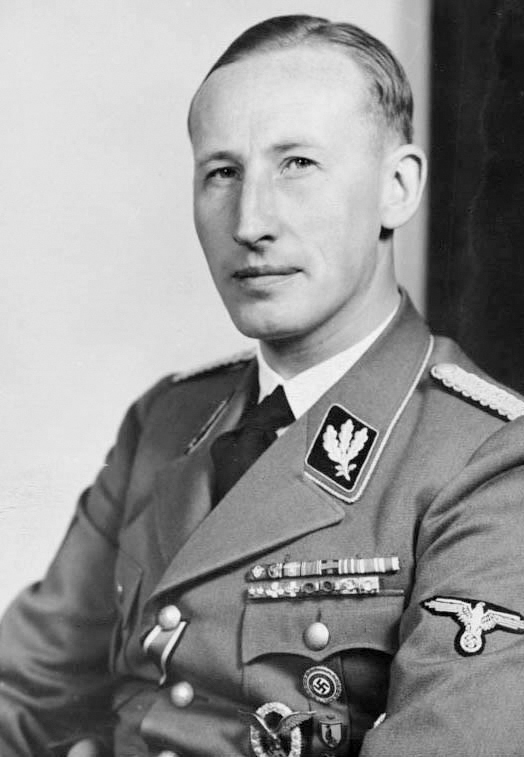
Portrait of Reinhard Heydrich

Photo: Heinrich Hoffmann · CC BY-SA 3.0 de · Wikimedia Commons

Born in Germany · Nationality German — Politics / SS / political police / Holocaust / occupation / mass crimes

Reinhard Heydrich

Documented profile covering 6 controversies, including “1941–1942: terror in Protectorate of Bohemia and Moravia and establishment of Theresienstadt ghetto” and “1942: Operation Anthropoid assassination, Heydrich's death and Nazi reprisals including Lidice”.

Are you concerned? Right of reply

Profile No. 2695 · Updated on 12 October 2026

Portrait of Reinhard Heydrich

Photo: Heinrich Hoffmann · CC BY-SA 3.0 de · Wikimedia Commons

6Documented controversies+ 4 background events
6Sources
0Formal charge · all time
0Conviction

I. Documented controversies

01

September 1941–printemps 1942

1941–1942: terror in Protectorate of Bohemia and Moravia and establishment of Theresienstadt ghetto

No legal proceedings

Appointed Deputy Protector, Heydrich carried out brutal repression: in October–November 1941, special courts imposed 342 death sentences and 1,289 people were handed over to the Gestapo. He also oversaw persecution of Czech Jews and creation of the Theresienstadt ghetto.

State of the evidence
Well documented
Attribution
Directly implicated

Sources · 2

  1. [1]
    United States Holocaust Memorial MuseumReinhard Heydrich: In DepthOfficial documentVery high reliability
  2. [2]
    Deutsches Historisches Museum — LeMOReinhard HeydrichArchiveVery high reliability

Last verified: 14 September 2026

Add to this entry

02

27 May–June 1942

1942: Operation Anthropoid assassination, Heydrich's death and Nazi reprisals including Lidice

No legal proceedings

Czechoslovak agents trained with British support attacked Heydrich in Prague on 27 May; he died from an infection on 4 June. The regime subsequently launched ferocious reprisals, including the destruction of Lidice and Ležáky.

State of the evidence
Well documented

Sources · 3

  1. [1]
    United States Holocaust Memorial MuseumReinhard Heydrich: In DepthOfficial documentVery high reliability
  2. [2]
    United States Holocaust Memorial MuseumLidice: The Annihilation of a Czech TownOfficial documentVery high reliability
  3. [3]
    Deutsches Historisches Museum — LeMOReinhard HeydrichArchiveVery high reliability

Last verified: 14 September 2026

Add to this entry

03

June–August 1941

1941: orders to Einsatzgruppen during invasion of USSR and shift towards massacres of entire Jewish communities

No legal proceedings

Before and after the invasion of the Soviet Union, Heydrich issued extermination orders targeting, in particular, Jews holding positions within the Soviet apparatus. The Einsatzgruppen rapidly extended the killings to the annihilation of entire Jewish communities.

State of the evidence
Well documented
Attribution
Directly implicated

Sources · 1

  1. [1]
    United States Holocaust Memorial MuseumReinhard Heydrich: In DepthOfficial documentVery high reliability

Last verified: 14 September 2026

Add to this entry

04

1934–1939

1934–1939: systematic repression of opponents and administrative internment in concentration camps

No legal proceedings

Under Heydrich, the Gestapo, SD and criminal police identified communists, Social Democrats, religious opponents, homosexuals, Roma and other groups as “enemies” or “asocial”, subjecting them to arrests and indefinite internment under protective custody.

State of the evidence
Well documented
Attribution
Command responsibility

Sources · 1

  1. [1]
    United States Holocaust Memorial MuseumReinhard Heydrich: In DepthOfficial documentVery high reliability

Last verified: 14 September 2026

Add to this entry

05

1938

1938: forced emigration in Vienna, extortion of Jewish assets and round-ups after Kristallnacht

No legal proceedings

Heydrich's services developed in Vienna a central office coordinating forced Jewish emigration and financing it through extortion. After Kristallnacht, the SS and police organised the arrest of approximately 30,000 Jewish men who were sent to concentration camps.

State of the evidence
Well documented
Attribution
Directly implicated

Sources · 2

  1. [1]
    United States Holocaust Memorial MuseumReinhard Heydrich: In DepthOfficial documentVery high reliability
  2. [2]
    United States Holocaust Memorial MuseumKristallnachtOfficial documentVery high reliability

Last verified: 14 September 2026

Add to this entry

06

1933–1936

1933–1936: centralisation of political police, leadership of Gestapo and then Security Police

No legal proceedings

With Himmler, Heydrich participated in centralising Germany's political police forces. After the SA purge, he commanded the Gestapo while continuing to head the SD, then became chief of the new Security Police comprising the Gestapo and criminal police.

State of the evidence
Well documented
Attribution
Directly implicated

Sources · 1

  1. [1]
    United States Holocaust Memorial MuseumReinhard Heydrich: In DepthOfficial documentVery high reliability

Last verified: 14 September 2026

Add to this entry

II. Documented background

Documented biographical or institutional milestones (elections, appointments, foundings, acquisitions…). These are not controversies and are not counted as such.

  1. 20 January 1942

    1942: chairs Wannsee Conference to coordinate extermination of European Jews

    Heydrich convened fifteen senior officials at Wannsee, explained to them that Hitler had authorised the physical annihilation of European Jews and demanded cooperation from their administrations in implementing the “Final Solution”.

    Sources · 3
    1. United States Holocaust Memorial Museum — Reinhard Heydrich: In Depth
    2. United States Holocaust Memorial Museum — Wannsee Conference and the "Final Solution"
    3. Deutsches Historisches Museum — LeMO — Reinhard Heydrich
  2. 31 July–fin 1941

    1941: Göring's mandate to coordinate “Final Solution” and organisation of deportations eastwards

    Göring tasked Heydrich with coordinating the “Final Solution” across Europe. The RSHA subsequently organised, with other administrations, round-ups and convoys transporting German, Austrian and Czech Jews eastwards, where many were murdered.

    Sources · 2
    1. United States Holocaust Memorial Museum — Reinhard Heydrich: In Depth
    2. United States Holocaust Memorial Museum — Reinhard Heydrich: Timeline
  3. September 1939

    1939: RSHA established under his command and Einsatzgruppen deployed in Poland

    Heydrich assumed leadership of the new Reichssicherheitshauptamt, merging the Security Police and SD. Six Einsatzgruppen accompanied the invasion of Poland, executed or targeted thousands of members of Polish elites and concentrated Jewish communities pending their displacement.

    Sources · 1
    1. United States Holocaust Memorial Museum — Reinhard Heydrich: In Depth
  4. 1931–January 1933

    1931–1933: creation of Sicherheitsdienst, SS political intelligence apparatus

    Recruited by Himmler, Heydrich designed and developed the Sicherheitsdienst (SD), which quickly became the Nazi party's main political intelligence service.

    Sources · 1
    1. United States Holocaust Memorial Museum — Reinhard Heydrich: In Depth

III. Constellation of documented links

  • Linked profile (portrait or initials) — click to open it
  • Line width: number of documented references
  • Hover over or tap a line: controversies and sources

Two profiles are linked when a documented controversy of one names the other. The link points to that controversy and its sources; it does not indicate a personal relationship.

List of documented links (1)
  1. Baldur von Schirach1 documented reference

IV. Has something changed?

A new court decision, a missing source, a mistake? Tell us what should be updated: every request is read by the editorial team.

Support the archive

Controversia checks and updates its profiles independently. Support is optional and has no effect on the content of profiles.

Donate

iPhone and iPad

Install Controversia

  1. Tap Share
  2. then Add to Home Screen

Tap Share, then Add to Home Screen.