Born in Zimbabwe · Nationality Zimbabwean — politics / human rights / elections / land reform / economy / public statements

Robert Mugabe

Documented profile covering 13 controversies, including “2008–2009: Marange — military operation in diamond fields, more than 200 deaths and forced labour” and “2008: campaign of violence after first-round defeat and presidential runoff without genuine competition”.

Are you concerned? Right of reply

Profile No. 1986 · Updated on 12 October 2026

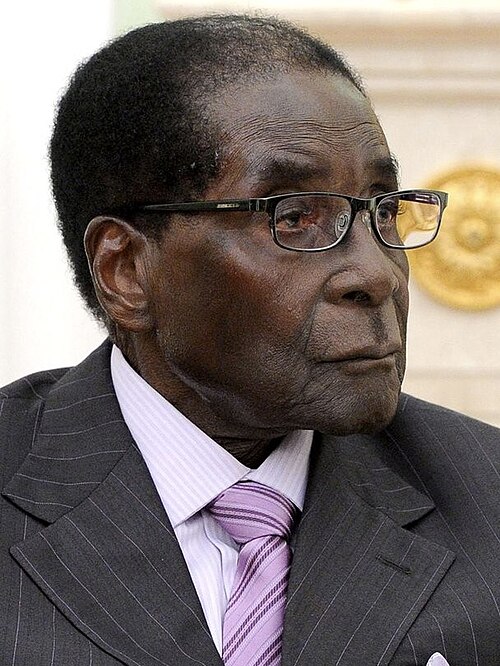
Portrait of Robert Mugabe

Photo: Wikimedia Commons

13Documented controversies
12Sources
0Formal charge · all time
0Conviction

I. Documented controversies

01

October 2008–2009

2008–2009: Marange — military operation in diamond fields, more than 200 deaths and forced labour

No legal proceedings

The army took control of the Marange diamond fields. Human Rights Watch documented more than 200 deaths during the operation's first weeks, along with torture, beatings, forced labour involving adults and children, extortion and smuggling.

State of the evidence
Documented

Last verified: 14 September 2026

Add to this entry

02

March–June 2008

2008: campaign of violence after first-round defeat and presidential runoff without genuine competition

No legal proceedings

After ZANU-PF lost its parliamentary majority and Mugabe came second in the first presidential round, security forces, militias and party supporters launched a campaign of violence against the MDC. Human Rights Watch documented at least 200 deaths and approximately 5,000 people beaten or tortured; Morgan Tsvangirai withdrew from the runoff.

State of the evidence
Documented

Sources · 2

  1. [1]
    Human Rights WatchUniversal Periodic Review of ZimbabweNGOHigh reliability
  2. [2]
    U.S. Department of State2008 Human Rights Report: ZimbabweOfficial documentHigh reliability

Last verified: 14 September 2026

Add to this entry

03

2000–2008

2000–2008: economic collapse and extreme hyperinflation under Mugabe government policies

No legal proceedings

Zimbabwe experienced massive economic contraction, the collapse of public services and historic hyperinflation. The IMF recorded a decline of approximately 40% in real GDP between 2000 and 2007, followed by another sharp contraction in 2008, while inflation reached extreme levels.

State of the evidence
Documented
Attribution
Political responsibility

Last verified: 14 September 2026

Add to this entry

04

March 2007

2007: arrest and beating of dozens of opposition leaders and activists

No legal proceedings

Police harshly suppressed an opposition gathering in Harare and arrested more than fifty activists, including Morgan Tsvangirai, several of whom were severely beaten in custody.

State of the evidence
Documented

Sources · 1

  1. [1]
    Human Rights WatchReversing Zimbabwe's Dismal Rights Record Since 1980NGOHigh reliability

Last verified: 14 September 2026

Add to this entry

05

May–July 2005

2005: Operation Murambatsvina — mass demolitions and evictions affecting approximately 700,000 people

No legal proceedings

The government launched a major campaign to demolish informal housing, businesses and urban neighbourhoods. According to the UN and human rights organisations, approximately 700,000 people lost their homes, livelihoods or both, without adequate rehousing.

State of the evidence
Documented
Attribution
Political responsibility

Sources · 2

  1. [1]
    Human Rights WatchZimbabwe: Operation MurambatsvinaNGOHigh reliability
  2. [2]
    Human Rights WatchReversing Zimbabwe's Dismal Rights Record Since 1980NGOHigh reliability

Last verified: 14 September 2026

Add to this entry

06

2000–2002

2000–2002: accelerated land reform, violent farm invasions and political patronage

No legal proceedings

Accelerated land reform, intended to correct land ownership patterns inherited from colonialism, was accompanied by violent farm invasions, assaults and killings of farmers and farm workers, as well as politically driven allocation of land to people close to the government.

State of the evidence
Documented
Attribution
Political responsibility

Sources · 2

  1. [1]
    Human Rights WatchZimbabwe: Abuses Plague Land ReformNGOHigh reliability
  2. [2]
    Human Rights WatchReversing Zimbabwe's Dismal Rights Record Since 1980NGOHigh reliability

Last verified: 14 September 2026

Add to this entry

07

2001–March 2002

2002: presidential election marked by intimidation, violence and restrictive laws targeting opposition and media

No legal proceedings

Ahead of the 2002 presidential election, the government strengthened laws restricting gatherings, media and political activity, while opposition activists and journalists suffered intimidation, arrests and violence. Independent observers strongly challenged the freedom and fairness of the election.

State of the evidence
Documented
Attribution
Directly implicated

Sources · 1

  1. [1]
    Human Rights WatchZimbabwe: Commonwealth Must ActNGOHigh reliability

Last verified: 14 September 2026

Add to this entry

08

1995–années 2000

1995–2000s: homophobic rhetoric, including statements likening gay people to beings 'worse than dogs and pigs'

No legal proceedings

Mugabe repeatedly made strongly hostile statements about gay people, which became a lasting feature of his domestic and international political rhetoric.

State of the evidence
Documented
Attribution
Personally implicated

Sources · 1

  1. [1]
    The GuardianZimbabwe's media warPressHigh reliability

Last verified: 14 September 2026

Add to this entry

09

6 October 2000

2000: presidential pardon covering political violence during election campaign

No legal proceedings

Following a parliamentary election campaign marked by serious violence, Mugabe granted a pardon to perpetrators of political offences committed between January and July 2000, notably excluding murder, rape and fraud.

State of the evidence
Documented
Attribution
Political responsibility

Sources · 2

  1. [1]
  2. [2]
    Human Rights WatchReversing Zimbabwe's Dismal Rights Record Since 1980NGOHigh reliability

Last verified: 14 September 2026

Add to this entry

10

1995

1995: general amnesty for numerous politically motivated crimes, including torture and abductions

No legal proceedings

Mugabe granted another amnesty covering a broad range of politically motivated offences, including beatings, arson, abductions and torture. According to human rights organisations, this measure reinforced a culture of impunity.

State of the evidence
Documented
Attribution
Political responsibility

Sources · 2

  1. [1]
    Human Rights WatchReversing Zimbabwe's Dismal Rights Record Since 1980NGOHigh reliability
  2. [2]

Last verified: 14 September 2026

Add to this entry

11

1993

1993: pardon of two agents convicted of attempting to assassinate opposition figure Patrick Kombayi

Conviction — against a third party

Protagonist not prosecuted — these proceedings are not counted in their formal charges or convictions.

Two security service agents convicted of attempting to assassinate opposition figure Patrick Kombayi were pardoned by Mugabe. The case became a prominent example of protection afforded to agents involved in political violence.

State of the evidence
Established by a court
Attribution
Political responsibility
Role of the person profiled
Protagonist not prosecuted

Sources · 1

  1. [1]
    Human Rights WatchReversing Zimbabwe's Dismal Rights Record Since 1980NGOHigh reliability

Last verified: 14 September 2026

Add to this entry

12

1988

1988: amnesty and clemency following Unity Accord, including perpetrators of political abuses

No legal proceedings

Following the agreement between ZANU and ZAPU, a clemency measure covered security force members and dissidents involved in violence during the preceding period. Human Rights Watch regards this practice as a milestone in political impunity.

State of the evidence
Documented
Attribution
Political responsibility

Sources · 1

  1. [1]

Last verified: 14 September 2026

Add to this entry

13

1982–1987

1982–1987: Gukurahundi — massacres in Matabeleland and the Midlands by Fifth Brigade

No legal proceedings

Under Mugabe, the Fifth Brigade was deployed against a purported dissident insurgency in Matabeleland. Operations involved massacres, torture, disappearances and violence against Ndebele civilians. Human Rights Watch cited at least 10,000 deaths, while other estimates reach approximately 20,000.

State of the evidence
Documented
Attribution
Command responsibility

Sources · 2

  1. [1]
    Human Rights WatchRobert Mugabe Leaves Behind Legacy of AbuseNGOHigh reliability
  2. [2]
    Human Rights WatchED must pay attention to human rightsNGOHigh reliability

Last verified: 14 September 2026

Add to this entry

II. Constellation of documented links

  • Linked profile (portrait or initials) — click to open it
  • Line width: number of documented references
  • Hover over or tap a line: controversies and sources

Two profiles are linked when a documented controversy of one names the other. The link points to that controversy and its sources; it does not indicate a personal relationship.

List of documented links (2)
  1. Thabo Mbeki2 documented references
  2. Tedros Adhanom Ghebreyesus1 documented reference

III. Has something changed?

A new court decision, a missing source, a mistake? Tell us what should be updated: every request is read by the editorial team.

Support the archive

Controversia checks and updates its profiles independently. Support is optional and has no effect on the content of profiles.

Donate

iPhone and iPad

Install Controversia

  1. Tap Share
  2. then Add to Home Screen

Tap Share, then Add to Home Screen.