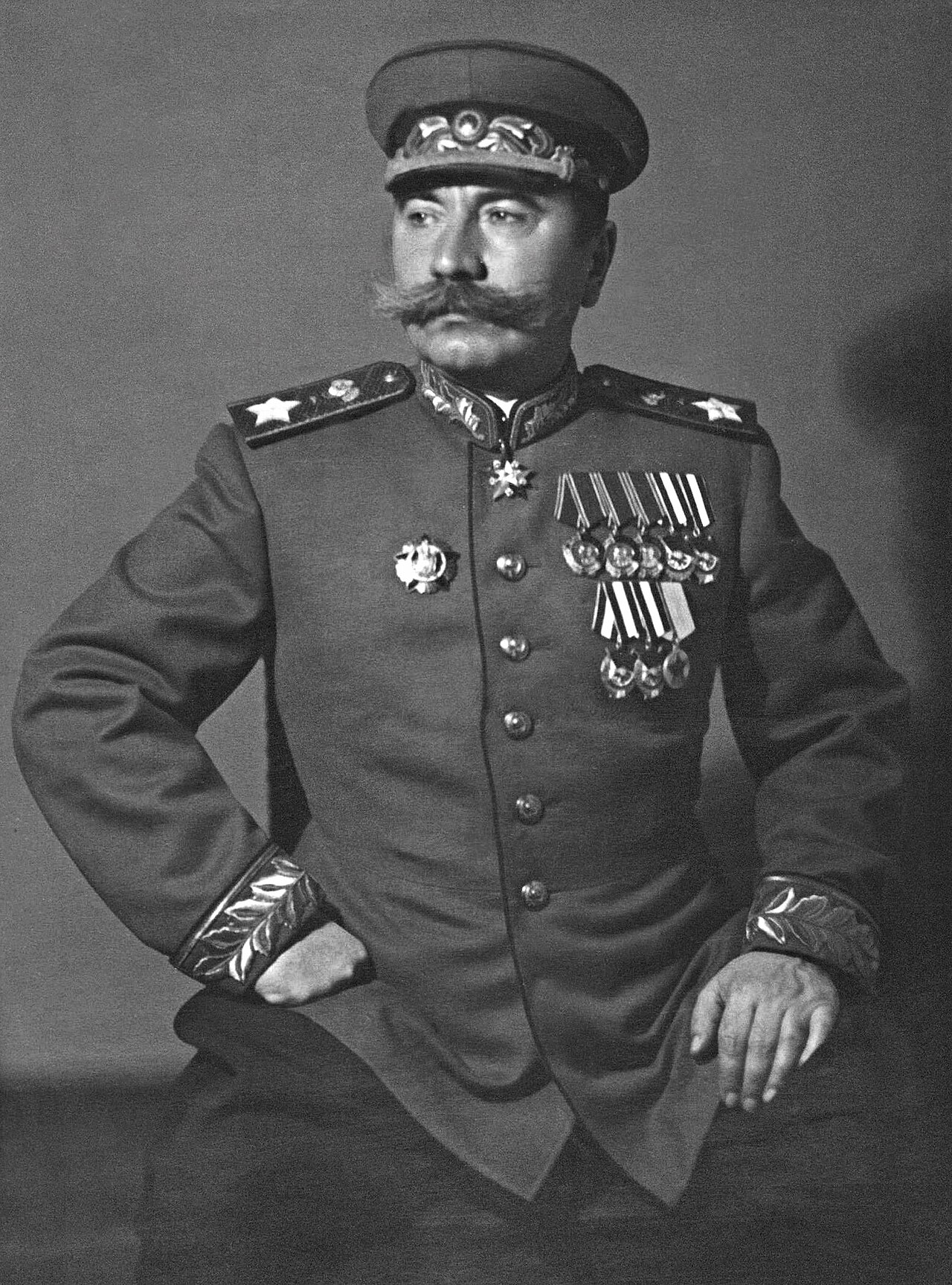
Portrait of Semyon Budyonny

Photo: не указан · CC BY 4.0 · Wikimedia Commons

Born in Russia · Nationality Soviet — Red Army / cavalry / civil war / purges / Second World War

Semyon Budyonny

Documented profile covering 7 controversies, including “1941: Uman and Kyiv disasters under his strategic command, but warning to Stalin of encirclement risk” and “1930s: doctrinal opposition to some of Tukhachevsky's ideas on large armoured formations”.

Are you concerned? Right of reply

Profile No. 2520 · Updated on 12 October 2026

Portrait of Semyon Budyonny

Photo: не указан · CC BY 4.0 · Wikimedia Commons

7Documented controversies
10Sources
0Formal charge · all time
0Conviction

I. Documented controversies

01

July–13 September 1941

1941: Uman and Kyiv disasters under his strategic command, but warning to Stalin of encirclement risk

No legal proceedings

Budyonny was commander-in-chief of the South-Western Direction during the first months of the German invasion, a period marked by the disasters at Uman and then the encirclement of Kyiv. He was replaced by Timoshenko on 13 September.

State of the evidence
Documented

Sources · 1

  1. [1]
    Wikipedia — synthesis citing Glantz, Fugate and KirchubelBattle of Kiev (1941)Secondary sourceMedium reliability

Last verified: 15 September 2026

Add to this entry

02

années 1930–1939

1930s: doctrinal opposition to some of Tukhachevsky's ideas on large armoured formations

No legal proceedings

Budyonny vigorously defended the future role of cavalry and opposed some of Tukhachevsky's proposals for independent armoured formations, going so far as to associate certain concepts with 'sabotage' in the political climate of the purges.

State of the evidence
Disputed
Attribution
Directly implicated

Sources · 2

  1. [1]
    Wikipedia — cited biographical synthesisSemyon BudyonnySecondary sourceMedium reliability
  2. [2]
    U.S. Army Center of Military HistoryHistorical Perspectives of the Operational ArtOfficial documentVery high reliability

Last verified: 15 September 2026

Add to this entry

03

11 June 1937

1937: participation as judge in secret trial of Tukhachevsky and other commanders subsequently rehabilitated

No legal proceedings

Budyonny sat on the special military tribunal that tried Tukhachevsky and seven other senior commanders for an alleged anti-Soviet conspiracy. They were sentenced to death and executed almost immediately; their convictions were later overturned.

State of the evidence
Documented
Attribution
Directly implicated

Sources · 2

  1. [1]
    DiplomaticPost — archival transcript reproductionTranscript of the Special Judicial Presence in the Tukhachevsky caseMedium reliability
  2. [2]
    LarousseMikhaïl Nikolaïevitch ToukhatchevskiSecondary sourceHigh reliability

Last verified: 15 September 2026

Add to this entry

04

fin 1919–1920

1919–1920: violence against civilians and prisoners attributed to First Cavalry Army under his command

No legal proceedings

Budyonny's First Cavalry Army developed a reputation for looting, rape and murder of civilians and prisoners from its earliest campaigns.

State of the evidence
Documented

Sources · 1

  1. [1]
    Institute of National Remembrance (Poland)The Defense of Independence — 1st Horse ArmyOfficial documentVery high reliability

Last verified: 15 September 2026

Add to this entry

05

été 1920

Summer 1920: First Cavalry Army commits some of Red Army's most violent anti-Jewish pogroms

No legal proceedings

Research into antisemitism during the Russian Revolution identifies pogroms committed by Budyonny's First Cavalry Army during the Polish–Soviet War as among the most brutal committed by Red Army forces.

State of the evidence
Documented

Sources · 1

  1. [1]
    Cambridge University Press / International Review of Social HistoryBrendan McGeever, Antisemitism and the Russian Revolution — reviewAcademic publicationVery high reliability

Last verified: 15 September 2026

Add to this entry

06

June–August 1920

1920: killing of Polish prisoners by First Cavalry Army units, including at Zadwórze

No legal proceedings

Historians at the IPN document numerous cases of Polish prisoners being killed by the First Cavalry Army, including more than 300 defenders at Zadwórze on 17 August 1920.

State of the evidence
Documented

Sources · 1

  1. [1]
    Instytut Pamięci NarodowejJeńcy polscy w niewoli sowieckiejOfficial documentVery high reliability

Last verified: 15 September 2026

Add to this entry

07

August 1920

August 1920: First Cavalry Army remains towards Lviv rather than supporting Warsaw offensive

No legal proceedings

While Tukhachevsky requested the transfer of Budyonny's cavalry towards Warsaw, the First Cavalry Army remained engaged in attempts to take Lviv and did not provide the expected support to the Western Front.

State of the evidence
Documented

Sources · 2

  1. [1]
    Institute of National Remembrance (Poland)Battle of Warsaw, 1920Official documentVery high reliability
  2. [2]
    Institute of National RemembranceThe Defense of Independence — Battle of WarsawOfficial documentVery high reliability

Last verified: 15 September 2026

Add to this entry

II. Constellation of documented links

No documented link with another published profile for now.

Two profiles are linked when a documented controversy of one names the other. The link points to that controversy and its sources; it does not indicate a personal relationship.

III. Has something changed?

A new court decision, a missing source, a mistake? Tell us what should be updated: every request is read by the editorial team.

Support the archive

Controversia checks and updates its profiles independently. Support is optional and has no effect on the content of profiles.

Donate

iPhone and iPad

Install Controversia

  1. Tap Share
  2. then Add to Home Screen

Tap Share, then Add to Home Screen.