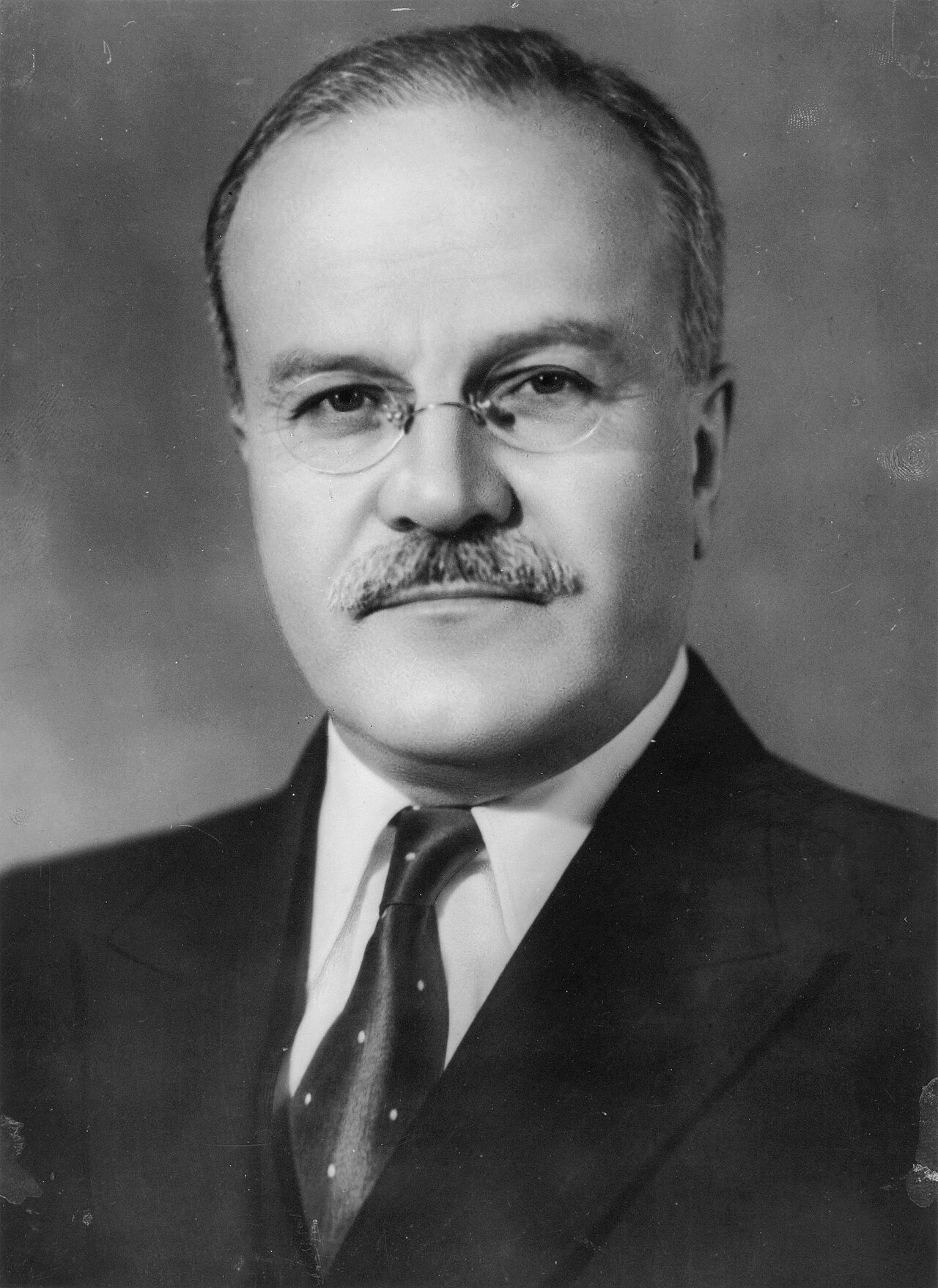
Portrait of Vyacheslav Molotov

Photo: G. Weil for TASS · Public domain

Born in Russia · Nationalities Russian Empire, Soviet — Politics / government / diplomacy / repression

Vyacheslav Molotov

Documented profile covering 9 controversies, including “1962–1984: expulsion from party followed by late reinstatement despite avowed loyalty to Stalinism” and “1957: participation in “Anti-Party Group” attempting to remove Khrushchev”.

Are you concerned? Right of reply

Profile No. 2570 · Updated on 12 October 2026

Portrait of Vyacheslav Molotov

Photo: G. Weil for TASS · Public domain

9Documented controversies+ 2 background events
13Sources
0Formal charge · all time
0Conviction

I. Documented controversies

01

1962–1984

1962–1984: expulsion from party followed by late reinstatement despite avowed loyalty to Stalinism

Civil / administrative proceedings

After his persistent criticism of Khrushchev, Molotov was expelled from the party and lived in obscurity. In 1984, aged 94, he was symbolically readmitted.

State of the evidence
Documented
Attribution
Political responsibility

Sources · 2

  1. [1]
    Encyclopedia of Russian History / Encyclopedia.comMolotov, Vyacheslav MikhailovichEncyclopediaHigh reliability
  2. [2]

Last verified: 15 September 2026

Add to this entry

02

June 1957

1957: participation in “Anti-Party Group” attempting to remove Khrushchev

No legal proceedings

Molotov, Malenkov and Kaganovich initially secured a majority in the Presidium to remove Khrushchev. He brought the matter before the Central Committee, where his opponents were defeated and removed from the leadership.

State of the evidence
Documented
Attribution
Political responsibility

Sources · 2

  1. [1]
    Encyclopedia of Russian History / Encyclopedia.comAnti-Party GroupEncyclopediaHigh reliability
  2. [2]
    U.S. Department of State, Office of the HistorianSoviet announcement on the removal of Molotov, Malenkov and Kaganovich from the Presidium and Central CommitteeArchiveVery high reliability

Last verified: 15 September 2026

Add to this entry

03

February–June 1956

1956: opposition to de-Stalinisation and loss of Foreign Affairs ministry

No legal proceedings

Closely identified with Stalin's legacy, Molotov opposed Khrushchev's new line following the 20th Party Congress and lost the Foreign Affairs portfolio.

State of the evidence
Documented
Attribution
Political responsibility

Sources · 2

  1. [1]
    Encyclopedia of Russian History / Encyclopedia.comMolotov, Vyacheslav MikhailovichEncyclopediaHigh reliability
  2. [2]
    Encyclopedia of Russian History / Encyclopedia.comAnti-Party GroupEncyclopediaHigh reliability

Last verified: 15 September 2026

Add to this entry

04

1949–1953

1949–1953: arrest of his wife Polina Zhemchuzhina, which Molotov acknowledges voting for in Politburo

Conviction — against Polina Zhemchuzhina

Protagonist not prosecuted — these proceedings are not counted in their formal charges or convictions.

Polina Zhemchuzhina, Molotov's wife and a former Soviet official, was arrested and imprisoned amid the Stalinist campaigns of the late 1940s. Molotov later admitted having voted in the Politburo in favour of her arrest.

State of the evidence
Documented
Attribution
Directly implicated
Person targeted by the proceedings
Polina Zhemchuzhina
Role of the person profiled
Protagonist not prosecuted

Sources · 1

  1. [1]
    Encyclopedia of Russian History / Encyclopedia.comMolotov, Vyacheslav MikhailovichEncyclopediaHigh reliability

Last verified: 15 September 2026

Add to this entry

05

November 1939–August 1940

1939–1940: foreign policy accompanying war against Finland and annexation of Baltic states and Romanian territories

No legal proceedings

Within the geopolitical framework created by the 1939 pact, the USSR attacked Finland, then occupied and annexed the Baltic states and took Bessarabia and Northern Bukovina. Molotov was then head of Soviet diplomacy.

State of the evidence
Documented
Attribution
Political responsibility

Sources · 2

  1. [1]
    United States Holocaust Memorial MuseumGerman-Soviet PactEncyclopediaVery high reliability
  2. [2]
    Encyclopedia of Russian History / Encyclopedia.comMolotov, Vyacheslav MikhailovichEncyclopediaHigh reliability

Last verified: 15 September 2026

Add to this entry

06

5 March 1940

1940: Politburo approval of Beria's proposal leading to Katyn executions

No legal proceedings

Beria's memorandum proposing the killing of thousands of Polish prisoners of war and detainees bears Molotov's approval alongside those of Stalin, Voroshilov and Mikoyan; the executions followed in spring 1940.

State of the evidence
Documented
Attribution
Directly implicated

Sources · 1

  1. [1]
    Sciences Po — Mass Violence and Resistance Research NetworkThe Katyń Massacres of 1940Academic publicationVery high reliability

Last verified: 15 September 2026

Add to this entry

07

1937–1938

1937–1938: approval of hundreds of sentencing lists during the Great Terror

No legal proceedings

Preserved execution lists show Molotov as one of the most active leaders in approving them, with his signature appearing on approximately 372 lists according to archival research.

State of the evidence
Documented
Attribution
Directly implicated

Sources · 2

  1. [1]
    Institut für Zeitgeschichte München-BerlinPolitical Justice under Stalin — 'The Lists' of Extrajudicial ConvictionsAcademic publicationVery high reliability
  2. [2]
    Persée / Institut d'histoire du temps présentLes « opérations de masse » de la « Grande terreur » en URSS (1937-1938)Academic publicationVery high reliability

Last verified: 15 September 2026

Add to this entry

08

1930–1933

1930–1933: government responsibility for forced collectivisation and policies accompanying famine

No legal proceedings

As chairman of Sovnarkom and a close Stalin ally, Molotov participated in implementing forced collectivisation. In 1932, he was sent to Ukraine to accelerate grain requisitions that were already having catastrophic consequences.

State of the evidence
Documented
Attribution
Political responsibility

Sources · 3

  1. [1]
    Encyclopedia of Russian History / Encyclopedia.comMolotov, Vyacheslav MikhailovichEncyclopediaHigh reliability
  2. [2]
    Электронная библиотека исторических документов / HistoryRussiaПисьмо В.М. Молотова И.В. Сталину о хлебозаготовках на Украине. 21 ноября 1932 г.Very high reliability
  3. [3]
    Encyclopedia of UkraineFamine-Genocide of 1932–3EncyclopediaHigh reliability

Last verified: 15 September 2026

Add to this entry

09

1928–1930

1928–1930: purge of non-Stalinists in Moscow party organisation

No legal proceedings

As Moscow party First Secretary, Molotov politically eliminated officials who were not aligned with Stalin and consolidated the Stalinist apparatus in the capital.

State of the evidence
Documented
Attribution
Directly implicated

Sources · 1

  1. [1]
    Encyclopedia of Russian History / Encyclopedia.comMolotov, Vyacheslav MikhailovichEncyclopediaHigh reliability

Last verified: 15 September 2026

Add to this entry

II. Documented background

Documented biographical or institutional milestones (elections, appointments, foundings, acquisitions…). These are not controversies and are not counted as such.

  1. 23 August 1939

    1939: negotiation and signing of German–Soviet pact and its secret protocol

    As People's Commissar for Foreign Affairs, Molotov negotiated and signed the German–Soviet non-aggression pact with Ribbentrop. The secret protocol divided spheres of influence in Eastern Europe and provided for the territorial partition of Poland.

    Sources · 3
    1. Yale Law School — Avalon Project — Nazi-Soviet Relations 1939-1941: Secret Additional Protocol
    2. United States Holocaust Memorial Museum — German-Soviet Pact
    3. Encyclopedia of Russian History / Encyclopedia.com — Molotov, Vyacheslav Mikhailovich
  2. 17–28 September 1939

    1939: note to Polish ambassador followed by formalisation of Poland's partition with Nazi Germany

    On 17 September, Molotov arranged for notification that the Polish state had allegedly ceased to exist as the Red Army crossed the eastern border. On 28 September, he signed Soviet–German agreements redefining the border and organising economic and territorial cooperation.

    Sources · 3
    1. U.S. Department of State, Office of the Historian — Foreign Relations of the United States — note of 17 September 1939 and Soviet entry into Poland
    2. U.S. Department of State, Office of the Historian — Foreign Relations of the United States, 1939 — Soviet-German agreements of September 1939
    3. United States Holocaust Memorial Museum — German-Soviet Pact

III. Constellation of documented links

No documented link with another published profile for now.

Two profiles are linked when a documented controversy of one names the other. The link points to that controversy and its sources; it does not indicate a personal relationship.

IV. Has something changed?

A new court decision, a missing source, a mistake? Tell us what should be updated: every request is read by the editorial team.

Support the archive

Controversia checks and updates its profiles independently. Support is optional and has no effect on the content of profiles.

Donate

iPhone and iPad

Install Controversia

  1. Tap Share
  2. then Add to Home Screen

Tap Share, then Add to Home Screen.