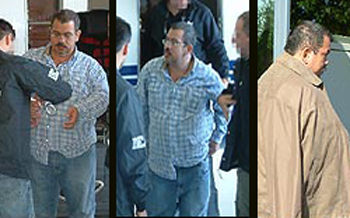
Portrait of Diego Murillo Bejarano

Photo: DEA · Public domain

Born in Colombia · Nationality Colombian — organised crime / paramilitarism / drug trafficking / Oficina de Envigado / AUC

Diego Murillo Bejarano

Documented profile covering 9 controversies, including “November 2003: Demobilisation of Bloque Cacique Nutibara, later accused of including criminals or opportunistic recruits” and “2005–2010: Sentenced to 45 years for murder of deputy Orlando Benítez, his sister and driver”.

Are you concerned? Right of reply

Profile No. 2074 · Updated on 12 October 2026

Portrait of Diego Murillo Bejarano

Photo: DEA · Public domain

9Documented controversies
10Sources
2 followed by a conviction

I. Documented controversies

01

2003–2011

November 2003: Demobilisation of Bloque Cacique Nutibara, later accused of including criminals or opportunistic recruits

Allegations

Don Berna officially surrendered several hundred Bloque Cacique Nutibara members in one of the first collective demobilisations under the AUC process. Years later, former paramilitary Freddy Rendón, "El Alemán", claimed that the operation had been largely staged by recruiting or recycling individuals to inflate the numbers.

State of the evidence
Alleged

Last verified: 14 September 2026

Add to this entry

02

2005–2010

2005–2010: Sentenced to 45 years for murder of deputy Orlando Benítez, his sister and driver

Conviction

Following an arrest warrant that had contributed to his surrender in 2005, Murillo was tried for the murders of deputy Orlando Benítez Mora, his sister and his driver. Acquitted at first instance in 2007, he was ultimately sentenced on appeal to 45 years' imprisonment in 2010.

Legal status — source text
45-year Colombian sentence after a prior acquittal was reversed
Attribution
Accused

Sources · 2

  1. [1]
  2. [2]

Last verified: 14 September 2026

Add to this entry

Case · 2 documented stages

2004–2009: Federal prosecution, extradition to United States and sentence of over 31 years for cocaine

Conviction
03

2004–2009

2004–2009: Federal prosecution, extradition to United States and sentence of over 31 years for cocaine

Conviction

Murillo faced US prosecution for conspiracy to import cocaine and money laundering. He was extradited in May 2008 alongside thirteen other paramilitary leaders and subsequently sentenced in the United States in 2009 to 31 years and three months in prison, together with a financial penalty.

State of the evidence
Documented
Attribution
Accused

Sources · 2

  1. [1]
    U.S. Department of JusticeFourteen Colombian Paramilitary Leaders Extradited to the United StatesOfficial documentVery high reliability
  2. [2]

Last verified: 14 September 2026

Add to this entry

07

1994–années 2000

From 1994: Takes control of Oficina de Envigado

Conviction

After Escobar's death and the disappearance of his former protectors, Murillo consolidated his control over the Oficina de Envigado, a network combining drug trafficking, contract killers, violent debt collection and control of criminal markets in the Aburrá Valley.

Attribution
Directly implicated

Last verified: 14 September 2026

Add to this entry

04

2003–2005

2003–2005: Maintenance of parallel criminal organisations despite demobilisation

No legal proceedings

Investigations into the paramilitary process indicate that Murillo maintained or fostered parallel criminal networks, notably Los Traquetos and Los Paisas, while his official organisations were entering demobilisation.

State of the evidence
Documented

Sources · 1

  1. [1]
    InSight CrimeÉlites y crimen organizado en Colombia: Don BernaInvestigative journalismHigh reliability

Last verified: 14 September 2026

Add to this entry

05

2000–2003

2000–2003: Creation and command of Bloque Cacique Nutibara, urban paramilitary organisation

Investigation

Murillo established the Bloque Cacique Nutibara as an urban paramilitary wing linked to his criminal power in Medellín, before officially joining the AUC command. The group fought rival organisations and imposed violent control over several neighbourhoods.

State of the evidence
Reported by the press
Attribution
Directly implicated

Sources · 2

  1. [1]
    InSight CrimeColombia elites and organized crime: Don BernaInvestigative journalismHigh reliability
  2. [2]

Last verified: 14 September 2026

Add to this entry

06

2002–2003

2002–2003: Paramilitary consolidation in Comuna 13 after Operation Orión

Civil / administrative proceedings

Following Operation Orión, conducted by state forces in Medellín's Comuna 13, paramilitary organisations linked to Don Berna strengthened their territorial control. This episode is central to subsequent investigations into disappearances, violence and cooperation or tolerance by certain public officials.

Sources · 2

  1. [1]
    InSight CrimeColombia elites and organized crime: Don BernaInvestigative journalismHigh reliability
  2. [2]

Last verified: 14 September 2026

Add to this entry

08

1992–1993

1992–1993: Participation in Los Pepes network against Pablo Escobar

No legal proceedings

Following a break with Escobar's associates, Murillo joined the clandestine alliance known as Los Pepes, which carried out a violent campaign against the Medellín Cartel's property and members during the hunt for Escobar.

State of the evidence
Documented
Attribution
Directly implicated

Last verified: 14 September 2026

Add to this entry

09

années 1980

1980s: Involvement with EPL followed by entry into Medellín criminal networks

No legal proceedings

Before becoming a paramilitary leader, Diego Murillo Bejarano was involved with the EPL and subsequently worked in the networks of traffickers Fernando Galeano and Gerardo Moncada, who were linked to the Medellín Cartel. This marked his entry into regional armed and criminal structures.

State of the evidence
Documented
Attribution
Directly implicated

Sources · 2

  1. [1]
    InSight CrimeColombia elites and organized crime: Don BernaInvestigative journalismHigh reliability
  2. [2]

Last verified: 14 September 2026

Add to this entry

II. Constellation of documented links

  • Linked profile (portrait or initials) — click to open it
  • Line width: number of documented references
  • Hover over or tap a line: controversies and sources

Two profiles are linked when a documented controversy of one names the other. The link points to that controversy and its sources; it does not indicate a personal relationship.

List of documented links (1)
  1. Pablo Escobar1 documented reference

III. Has something changed?

A new court decision, a missing source, a mistake? Tell us what should be updated: every request is read by the editorial team.

Support the archive

Controversia checks and updates its profiles independently. Support is optional and has no effect on the content of profiles.

Donate

iPhone and iPad

Install Controversia

  1. Tap Share
  2. then Add to Home Screen

Tap Share, then Add to Home Screen.