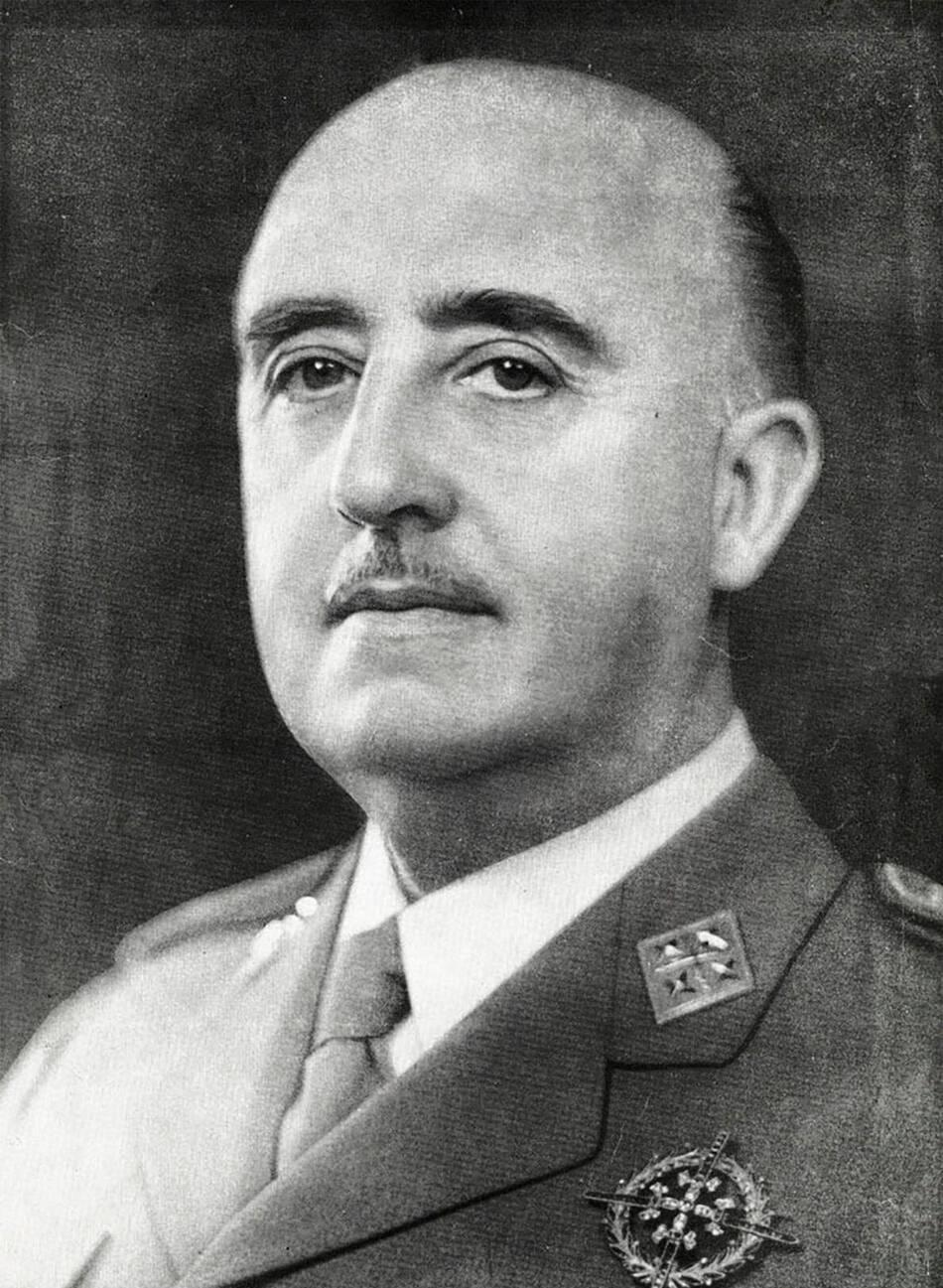
Portrait of Francisco Franco

Photo: Unknown author Unknown author · CC0 · Wikimedia Commons

Born in Spain · Nationality Spanish — Politics / civil war / dictatorship / repression / democratic memory / international relations

Francisco Franco

Documented profile covering 15 controversies, including “1939–1975: Authoritarian dictatorship, prohibition or neutralisation of opposition and political control” and “1939–1975: Censorship of press, arts and public expression”.

Are you concerned? Right of reply

Profile No. 1889 · Updated on 12 October 2026

Portrait of Francisco Franco

Photo: Unknown author Unknown author · CC0 · Wikimedia Commons

15Documented controversies
10Sources
0Formal charge · all time
0Conviction

I. Documented controversies

01

1939–20 November 1975

1939–1975: Authoritarian dictatorship, prohibition or neutralisation of opposition and political control

No legal proceedings

Franco ruled Spain as a dictator for almost four decades, without political pluralism comparable to parliamentary democracies, repressing opposition organisations and movements.

State of the evidence
Documented
Attribution
Political responsibility

Sources · 2

  1. [1]
    HISTORYFrancisco FrancoPressHigh reliability
  2. [2]
    Boletín Oficial del EstadoLey 20/2022, de 19 de octubre, de Memoria DemocráticaOfficial documentHigh reliability

Last verified: 13 September 2026

Add to this entry

02

1939–1975

1939–1975: Censorship of press, arts and public expression

No legal proceedings

The regime imposed extensive censorship on the press, publishing, cinema and other forms of expression, with particularly strong ideological surveillance during the first decades.

State of the evidence
Documented

Sources · 2

  1. [1]
    HISTORYFrancisco FrancoPressHigh reliability
  2. [2]
    Boletín Oficial del EstadoLey 20/2022, de 19 de octubre, de Memoria DemocráticaOfficial documentHigh reliability

Last verified: 13 September 2026

Add to this entry

03

1939–1975

1939–end of Franco era: Repression of Catalan, Basque and Galician languages and cultures and other regional identities

No legal proceedings

The dictatorship imposed the primacy of Castilian Spanish in many public spheres and repressed or marginalised several regional languages and cultural expressions, particularly Catalan and Basque.

State of the evidence
Documented

Sources · 2

  1. [1]
    HISTORYFrancisco FrancoPressHigh reliability
  2. [2]
    Boletín Oficial del EstadoLey 20/2022, de 19 de octubre, de Memoria DemocráticaOfficial documentHigh reliability

Last verified: 13 September 2026

Add to this entry

04

1939–1975

1939–1975: Political courts and convictions subsequently declared illegitimate or void

Protagonist not prosecuted

Protagonist not prosecuted — these proceedings are not counted in their formal charges or convictions.

Military courts and political tribunals, including those targeting Freemasonry, communism or public order, convicted opponents and dissidents. Subsequent Spanish democratic legislation characterises these bodies and convictions as illegitimate and provides for numerous decisions to be declared void.

State of the evidence
Documented
Role of the person profiled
Protagonist not prosecuted

Sources · 1

  1. [1]
    Boletín Oficial del EstadoLey 20/2022, de 19 de octubre, de Memoria DemocráticaOfficial documentHigh reliability

Last verified: 13 September 2026

Add to this entry

05

années 1950–1970

1950s–1970s: Legal persecution and internment of homosexual and transgender people

No legal proceedings

Under Franco, homosexual and transgender people were subjected to surveillance, convictions and internment under repressive legislation. Tefía camp in the Canary Islands became an emblematic site of this persecution and forced labour.

State of the evidence
Documented

Sources · 2

  1. [1]
    La Moncloa / Gobierno de EspañaTefía, memoria de la represión franquista contra las personas LGTBIOfficial documentHigh reliability
  2. [2]
    Boletín Oficial del EstadoLey 20/2022, de 19 de octubre, de Memoria DemocráticaOfficial documentHigh reliability

Last verified: 13 September 2026

Add to this entry

06

après 1945–années 1970

After 1945: Spain offers refuge to certain Nazi-linked collaborators and criminals

No legal proceedings

Francoist Spain became a refuge for several collaborators and wanted officials after the war. The case of Léon Degrelle, sentenced to death in Belgium for high treason, is emblematic: he obtained Spanish citizenship in 1954, protecting him from extradition.

State of the evidence
Documented
Attribution
Political responsibility

Sources · 1

  1. [1]
    United States Holocaust Memorial MuseumLéon DegrelleOfficial documentHigh reliability

Last verified: 13 September 2026

Add to this entry

07

1937–années 1950

1930s–1950s: Forced labour of Republican prisoners and penal colonies

No legal proceedings

Republican prisoners were employed in battalions, penal detachments and forced labour projects. The Spanish government has since officially recognised several of these sites and the harsh conditions imposed on detainees.

State of the evidence
Documented

Sources · 2

  1. [1]
  2. [2]
    Boletín Oficial del EstadoLey 20/2022, de 19 de octubre, de Memoria DemocráticaOfficial documentHigh reliability

Last verified: 13 September 2026

Add to this entry

08

1940–1943

1940–1943: Closeness to Axis, conditional willingness to enter war and ambiguous policy towards refugees

No legal proceedings

Franco maintained close relations with the Axis and stated in 1940 that he was willing, subject to conditions, to enter the war alongside Germany and Italy. At the same time, Spain served as a transit route for refugees, while periodically closing or tightening its border, interning undocumented people and sharply reducing admissions under German pressure.

State of the evidence
Documented
Attribution
Directly implicated

Sources · 2

  1. [1]
    United States Holocaust Memorial MuseumIn Transit, SpainArchiveHigh reliability
  2. [2]
    United States Holocaust Memorial MuseumEscape from German-Occupied EuropeOfficial documentHigh reliability

Last verified: 13 September 2026

Add to this entry

09

1939–années 1940

1939–1940s: Post-war executions and political repression

No legal proceedings

Following the Nationalist victory, repression continued through executions, detention, military courts and sanctions against the defeated side and political opponents. The USHMM estimates approximately 50,000 post-war executions in the early years.

State of the evidence
Documented
Attribution
Directly implicated

Sources · 2

  1. [1]
    United States Holocaust Memorial MuseumSpanish Civil WarOfficial documentHigh reliability
  2. [2]
    Boletín Oficial del EstadoLey 20/2022, de 19 de octubre, de Memoria DemocráticaOfficial documentHigh reliability

Last verified: 13 September 2026

Add to this entry

10

1936–années 1940

1936–1940s: Network of concentration camps and mass internment

No legal proceedings

The Nationalist side and later the Franco regime used an extensive system of camps and internment for prisoners and opponents. USHMM sources refer to more than 500,000 people being sent to around sixty camps by 1940.

State of the evidence
Documented
Attribution
Directly implicated

Sources · 2

  1. [1]
    United States Holocaust Memorial MuseumSpanish Civil WarOfficial documentHigh reliability
  2. [2]
    Boletín Oficial del EstadoLey 20/2022, de 19 de octubre, de Memoria DemocráticaOfficial documentHigh reliability

Last verified: 13 September 2026

Add to this entry

11

July 1936–1939

1936: Seeks assistance from Nazi Germany and fascist Italy to save and strengthen uprising

No legal proceedings

Franco secured assistance from Hitler and Mussolini, notably crucial air support to transfer the Army of Africa to the peninsula, followed by extensive German and Italian military assistance.

State of the evidence
Documented
Attribution
Directly implicated

Sources · 1

  1. [1]
    United States Holocaust Memorial MuseumSpanish Civil WarOfficial documentHigh reliability

Last verified: 13 September 2026

Add to this entry

12

1936–1939

1936–1939: Nationalist campaign of terror, executions and violence against opponents and civilians

No legal proceedings

In conquered areas, Nationalist forces carried out deadly repression against left-wing activists, trade unionists, Republican officials and others considered enemies. The USHMM estimates approximately 100,000 executions attributable to the Nationalists during the war.

State of the evidence
Documented
Attribution
Directly implicated

Sources · 2

  1. [1]
    United States Holocaust Memorial MuseumSpanish Civil WarOfficial documentHigh reliability
  2. [2]
    Amnesty InternationalSpain blocks investigations into Franco-era crimesNGOHigh reliability

Last verified: 13 September 2026

Add to this entry

13

January–printemps 1939

1939: Mass exodus of Republicans and displacement associated with Franco's victory

No legal proceedings

As Franco's forces won the war, approximately half a million Republicans and civilians fled to France, fearing repression by the new regime in particular.

State of the evidence
Documented

Sources · 2

  1. [1]
    United States Holocaust Memorial MuseumSpanish Civil WarOfficial documentHigh reliability
  2. [2]
    Boletín Oficial del EstadoLey 20/2022, de 19 de octubre, de Memoria DemocráticaOfficial documentHigh reliability

Last verified: 13 September 2026

Add to this entry

14

26 April 1937

1937: Bombing of Guernica by Condor Legion with approval of Franco's side

No legal proceedings

German aircraft of the Condor Legion, supported by Italian forces, bombed Guernica. Historical sources record Franco's approval and regard the attack as a major symbol of the bombing of civilian populations during the war.

State of the evidence
Documented

Sources · 2

  1. [1]
    HISTORYNazis test Luftwaffe on GuernicaPressHigh reliability
  2. [2]
    United States Holocaust Memorial MuseumSpanish Civil WarOfficial documentHigh reliability

Last verified: 13 September 2026

Add to this entry

15

17–18 July 1936

1936: Central participation in military uprising against Spain's Second Republic

No legal proceedings

Franco joined and quickly became one of the principal leaders of the military uprising launched against the elected Republican government, triggering the Spanish Civil War.

State of the evidence
Documented
Attribution
Directly implicated

Sources · 2

  1. [1]
    United States Holocaust Memorial MuseumSpanish Civil WarOfficial documentHigh reliability
  2. [2]
    HISTORYFrancisco FrancoPressHigh reliability

Last verified: 13 September 2026

Add to this entry

II. Constellation of documented links

  • Linked profile (portrait or initials) — click to open it
  • Line width: number of documented references
  • Hover over or tap a line: controversies and sources

Two profiles are linked when a documented controversy of one names the other. The link points to that controversy and its sources; it does not indicate a personal relationship.

List of documented links (4)
  1. Ante Pavelic1 documented reference
  2. Joan Laporta1 documented reference
  3. Léon Degrelle1 documented reference
  4. Pedro Sánchez1 documented reference

III. Has something changed?

A new court decision, a missing source, a mistake? Tell us what should be updated: every request is read by the editorial team.

Support the archive

Controversia checks and updates its profiles independently. Support is optional and has no effect on the content of profiles.

Donate

iPhone and iPad

Install Controversia

  1. Tap Share
  2. then Add to Home Screen

Tap Share, then Add to Home Screen.