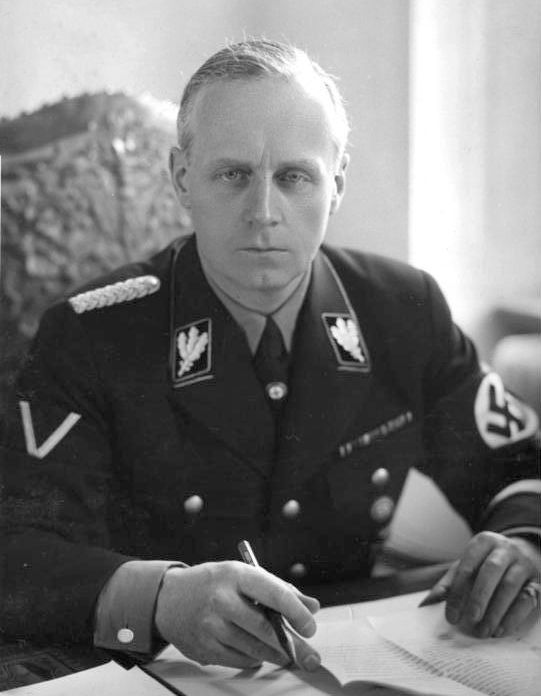
Portrait of Joachim von Ribbentrop

Photo: Unknown Unknown · Public domain

Born in Germany · Nationality German — Nazism / diplomacy / wars of aggression / Holocaust

Joachim von Ribbentrop

Documented profile covering 9 controversies, including “1944–1946: involvement in unlawful killing plans, then convicted on all four counts and executed” and “1938–1945: Nazification of Foreign Ministry and growing involvement in anti-Jewish persecution”.

Are you concerned? Right of reply

Profile No. 2650 · Updated on 12 October 2026

Portrait of Joachim von Ribbentrop

Photo: Unknown Unknown · Public domain

9Documented controversies
6Sources
1 followed by a conviction

I. Documented controversies

Case · 9 documented stages

1944–1946: involvement in unlawful killing plans, then convicted on all four counts and executed

Conviction
01

June 1944–16 October 1946

1944–1946: involvement in unlawful killing plans, then convicted on all four counts and executed

Conviction

The judgment criticised him, in particular, for a meeting concerning the lynching of Allied airmen and attempts to conceal a plan to murder a French general held prisoner. At Nuremberg, he was found guilty of conspiracy, crimes against peace, war crimes and crimes against humanity, and hanged on 16 October 1946.

State of the evidence
Established by a court
Attribution
Accused

Sources · 2

  1. [1]
    Avalon Project / Yale Law SchoolJudgment: RibbentropCourt recordVery high reliability
  2. [2]
    Memorium Nuremberg TrialsVerdicts of the IMTOfficial documentVery high reliability

Last verified: 14 September 2026

Add to this entry

02

1938–1945

1938–1945: Nazification of Foreign Ministry and growing involvement in anti-Jewish persecution

Conviction

Following his appointment to the ministry, Ribbentrop increased Nazi representation and headed an apparatus that disseminated antisemitic propaganda, coordinated policies towards Jews abroad and worked with the RSHA and Eichmann through a “Jewish desk”.

State of the evidence
Documented
Attribution
Political responsibility

Sources · 1

  1. [1]
    United States Holocaust Memorial MuseumThe German Foreign Office and the HolocaustOfficial documentVery high reliability

Last verified: 14 September 2026

Add to this entry

03

September 1942–April 1943

1942–1943: orders and diplomatic pressure to accelerate deportation of Jews eastwards

Conviction

The Nuremberg judgment found that in September 1942 Ribbentrop ordered German representatives in satellite states to accelerate deportations; he also protested to Mussolini about Italy's delay in handing over Jews from occupied zones.

State of the evidence
Established by a court
Attribution
Personally implicated

Sources · 2

  1. [1]
    Avalon Project / Yale Law SchoolJudgment: RibbentropCourt recordVery high reliability
  2. [2]
    United States Holocaust Memorial MuseumThe German Foreign Office and the HolocaustOfficial documentVery high reliability

Last verified: 14 September 2026

Add to this entry

04

1943-04-17

April 1943: pressure on Horthy concerning Hungarian Jews using extermination rhetoric

Conviction

During a conference with Hitler and Hungarian Regent Miklós Horthy, Ribbentrop stated that Jews had to be exterminated or sent to concentration camps, according to the Tribunal's judgment.

State of the evidence
Established by a court
Attribution
Directly implicated

Sources · 1

  1. [1]
    Avalon Project / Yale Law SchoolJudgment: RibbentropCourt recordVery high reliability

Last verified: 14 September 2026

Add to this entry

05

1939–1941

1939–1941: diplomatic support for aggression against Denmark, Norway, Netherlands, Balkans and USSR

Conviction

Ribbentrop was informed of or participated in political preparations for several successive acts of aggression, while his ministry produced diplomatic justifications and sought to secure the alignment of allied or satellite states.

State of the evidence
Established by a court
Attribution
Political responsibility

Sources · 2

  1. [1]
    Avalon Project / Yale Law SchoolJudgment: RibbentropCourt recordVery high reliability
  2. [2]
    Avalon Project / Yale Law SchoolJudgement: The Invasion of Denmark and NorwayCourt recordVery high reliability

Last verified: 14 September 2026

Add to this entry

06

March 1938–March 1939

1938–1939: diplomatic pressure against Czechoslovakia and participation in dismantling the country

Conviction

Ribbentrop maintained tensions with the Sudeten German party, sought regional support and participated in pressure that led first to Munich and then to the occupation of the rest of Czechoslovakia in March 1939.

State of the evidence
Established by a court
Attribution
Political responsibility

Sources · 1

  1. [1]
    Avalon Project / Yale Law SchoolJudgment: RibbentropCourt recordVery high reliability

Last verified: 14 September 2026

Add to this entry

07

1939-08-23

23 August 1939: German–Soviet pact and secret protocol dividing spheres of influence in Eastern Europe

Conviction

Ribbentrop signed the German–Soviet non-aggression pact in Moscow and its secret protocol defining spheres of influence concerning, in particular, Poland, the Baltic states, Finland and Bessarabia.

State of the evidence
Documented

Sources · 2

  1. [1]
    German History in Documents and ImagesThe German-Soviet Non-Aggression Treaty (August 23, 1939)Primary sourceVery high reliability
  2. [2]
    United States Holocaust Memorial MuseumJoachim von RibbentropOfficial documentVery high reliability

Last verified: 14 September 2026

Add to this entry

08

August–September 1939

August–September 1939: bad-faith diplomacy preceding attack on Poland

Conviction

The Tribunal found that Ribbentrop played a particularly important role in the diplomatic activity preceding the attack on Poland and negotiated with London while knowing that the attack plan had only been temporarily postponed.

State of the evidence
Established by a court
Attribution
Political responsibility

Sources · 1

  1. [1]
    Avalon Project / Yale Law SchoolJudgment: RibbentropCourt recordVery high reliability

Last verified: 14 September 2026

Add to this entry

09

February–March 1938

1938: diplomatic participation in coercion of Austria and signing of Anschluss law

Conviction

Ribbentrop participated in the Berchtesgaden conference where Austria was threatened, subsequently relayed to London an account denying the German ultimatum and signed the law incorporating Austria into the Reich on 13 March.

State of the evidence
Established by a court
Attribution
Political responsibility

Sources · 1

  1. [1]
    Avalon Project / Yale Law SchoolJudgment: RibbentropCourt recordVery high reliability

Last verified: 14 September 2026

Add to this entry

II. Constellation of documented links

  • Linked profile (portrait or initials) — click to open it
  • Line width: number of documented references
  • Hover over or tap a line: controversies and sources

Two profiles are linked when a documented controversy of one names the other. The link points to that controversy and its sources; it does not indicate a personal relationship.

List of documented links (1)
  1. Miklós Horthy1 documented reference

III. Has something changed?

A new court decision, a missing source, a mistake? Tell us what should be updated: every request is read by the editorial team.

Support the archive

Controversia checks and updates its profiles independently. Support is optional and has no effect on the content of profiles.

Donate

iPhone and iPad

Install Controversia

  1. Tap Share
  2. then Add to Home Screen

Tap Share, then Add to Home Screen.