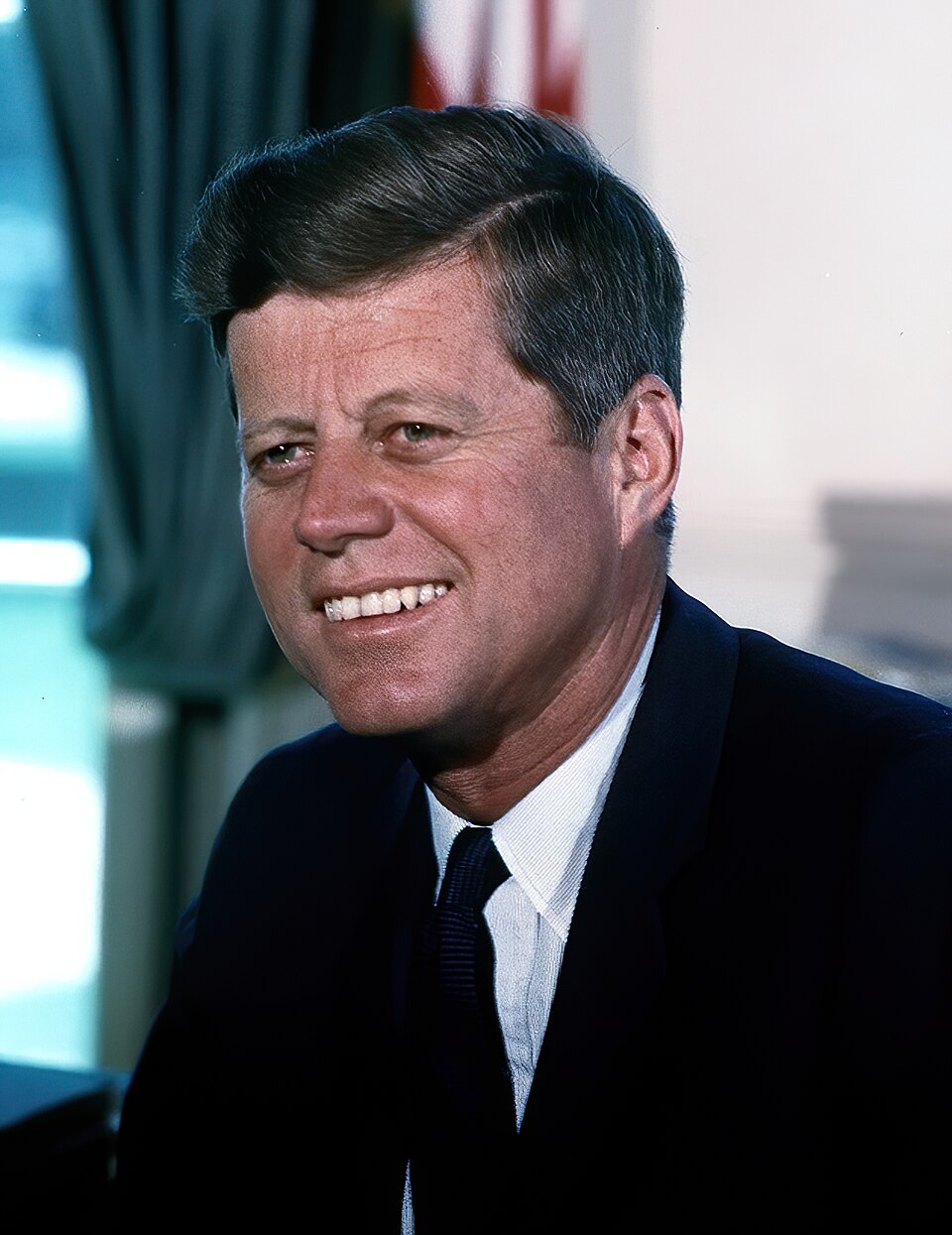
Portrait of John F. Kennedy

Born in United States · Nationality American — Politics / U.S. presidency

John F. Kennedy

Also known as: John Fitzgerald Kennedy, JFK, Jack Kennedy

35th President of the United States (1961–1963), born in 1917 in Brookline, Massachusetts, assassinated in Dallas in 1963.

John F. Kennedy, a senator from Massachusetts and then the 35th President of the United States, narrowly won the 1960 election and was assassinated in Dallas on 22 November 1963. His presidency was marked by the Bay of Pigs fiasco, covert operations against Cuba and CIA plots against Fidel Castro revealed by the Senate in 1975, the secret deal that ended the missile crisis and the green light for the 1963 coup in South Vietnam. Other controversies concern what was hidden from the public: his health, the authorship of his Pulitzer-winning book and his relationship with a woman linked to the Mafia.

Are you concerned? Right of reply

Profile No. 5824 · Updated on 31 October 2026

Portrait of John F. Kennedy
10Documented controversies+ 1 background event
16Sources
0Formal charge · all time
0Conviction

I. Documented controversies

01

1963–2025

Dallas assassination: opposing conclusions of the Warren Commission and the House committee (1979)

Case dismissed / dropped — against Lee Harvey Oswald

Protagonist is the victim — these proceedings are not counted in their formal charges or convictions.

Kennedy was assassinated in Dallas on 22 November 1963; the suspect, Lee Harvey Oswald, was killed two days later. The Warren Commission concluded in 1964 that Oswald acted alone. In 1979 the House Select Committee on Assassinations found that Kennedy was 'probably' assassinated as a result of a conspiracy, relying on acoustic evidence of two gunmen, without being able to identify the other gunman. In 2025, the release of documents ordered by Donald Trump revealed nothing, according to scholars, that undercut the lone-gunman conclusion.

State of the evidence
Divergent official conclusions; conspiracy not established.
Legal status — source text
No trial: Oswald died before he could be tried.
Attribution
Kennedy was the victim of the assassination.
Person targeted by the proceedings
Lee Harvey Oswald
Role of the person profiled
Protagonist is the victim

Sources · 2

  1. [1]
  2. [2]
    The Boston GlobeJFK assassination files: congressional hearing1 April 2025MediaHigh reliability

Last verified: 31 October 2026

Add to this entryAny news?

02

1956–2008

1957: Pulitzer Prize for 'Profiles in Courage', a book largely written by Ted Sorensen

No legal proceedings

Kennedy won the 1957 Pulitzer Prize for Biography for 'Profiles in Courage'. That year, columnist Drew Pearson said on ABC that Kennedy's aide Ted Sorensen was the real author; Kennedy obtained a sworn statement from Sorensen denying it. Decades later, Sorensen acknowledged that he had drafted most of the chapters and had been paid for the work.

State of the evidence
Sorensen's role acknowledged by Sorensen himself; Kennedy's exact share debated by historians.
Legal status — source text
No proceedings.
Attribution
Authorship of a prize-winning book presented as his own.

Sources · 1

  1. [1]
    Washington ExaminerGhost's StoryMediaHigh reliability

Last verified: 31 October 2026

Add to this entryAny news?

03

1960–1975

1960–1962: relationship with Judith Campbell, who also associated with Mafia boss Sam Giancana

Allegations

Judith Campbell (later Exner) said she had an affair with Kennedy, to whom she said Frank Sinatra introduced her, while also associating with Chicago Mafia boss Sam Giancana. In 1975 she testified about it before a Senate committee. She later claimed to have carried messages from Kennedy to Giancana, including about a plot against Fidel Castro, which has not been confirmed.

State of the evidence
Relationship described before the Senate in 1975; alleged messenger role unconfirmed.
Legal status — source text
No proceedings.
Attribution
A relationship posing a security risk because of the woman's links to the Mafia.

Sources · 1

  1. [1]
    CBS NewsAlleged Ex-JFK Mistress Dies25 September 1999MediaHigh reliability

Last verified: 31 October 2026

Add to this entryAny news?

04

1947–1963

1947–1963: Addison's disease and serious health problems hidden from the public

No legal proceedings

Kennedy suffered from Addison's disease (adrenal insufficiency), officially diagnosed in 1947, and from chronic back pain: two back operations in 1954 and 1955 failed and he took daily pain medication for the rest of his life. These problems were hidden or played down during his career and presidency; their extent only became known in 2002, when historian Robert Dallek gained access to his medical records.

State of the evidence
Medical records studied by historians and physicians.
Legal status — source text
No proceedings.
Attribution
Concealment of his health from voters.

Sources · 2

  1. [1]
    PBS NewsHourPresident Kennedy's Health SecretsMediaHigh reliability
  2. [2]
    CBS NewsJFK Was In More Pain Than Most KnewMediaHigh reliability

Last verified: 31 October 2026

Add to this entryAny news?

05

1961–1963

1961–1963: Operation Mongoose and CIA plots against Fidel Castro

No legal proceedings

After the Bay of Pigs, the Kennedy administration launched Operation Mongoose, a covert campaign of sabotage and destabilisation against Cuba led by General Edward Lansdale. In 1975 the Senate's Church Committee established that the CIA had mounted plots to assassinate Castro; it reported that in autumn 1961 the president and his brother Robert berated a CIA official for doing nothing 'about getting rid of Castro and the Castro regime', but said it was unable to determine who authorised the assassination plots.

State of the evidence
Facts established by a Senate investigating committee; authorisation of the assassinations not established.
Legal status — source text
No proceedings.
Attribution
Political responsibility for covert operations against Cuba.

Sources · 2

  1. [1]
    Sénat des États-Unis (copie AARC)Alleged Assassination Plots Involving Foreign Leaders — Findings and Conclusions (Church Committee, 1975)20 November 1975Official documentHigh reliability
  2. [2]
    Sénat des États-UnisChurch CommitteeOfficial documentHigh reliability

Last verified: 31 October 2026

Add to this entryAny news?

06

August–November 1963

1963: green light for the coup against Ngo Dinh Diem in South Vietnam

No legal proceedings

On 24 August 1963, a State Department telegram, 'Cable 243', authorised Ambassador Henry Cabot Lodge to tell South Vietnamese generals that the United States would not oppose the overthrow of President Ngo Dinh Diem. The coup of 1 November 1963 ended with the killing of Diem and his brother. White House recordings show Kennedy hesitant about this support; the episode is seen as a step in America's involvement in Vietnam.

State of the evidence
Telegram and recordings published.
Legal status — source text
No proceedings.
Attribution
The Kennedy administration's support for a coup.

Sources · 2

  1. [1]
  2. [2]

Last verified: 31 October 2026

Add to this entryAny news?

07

October 1962

October 1962: Cuban missile crisis and the secret deal on the Jupiter missiles

No legal proceedings

During the October 1962 missile crisis, the USSR officially withdrew its missiles from Cuba in exchange for a vague U.S. pledge not to invade. Secretly, Kennedy sent his brother Robert to offer Soviet ambassador Anatoly Dobrynin, on 27 October, the withdrawal of U.S. Jupiter missiles from Turkey. The administration concealed the deal for decades, presenting the crisis as a Soviet climb-down without concessions.

State of the evidence
Deal established by declassified archives.
Legal status — source text
No proceedings.
Attribution
Concealment of a concession made to the USSR.

Sources · 2

  1. [1]
    National Security Archive (The Nation)The Cuban Missile Crisis Cover-UpMediaHigh reliability
  2. [2]

Last verified: 31 October 2026

Add to this entryAny news?

08

17–19 April 1961

April 1961: failed Bay of Pigs invasion

No legal proceedings

On 17 April 1961, some 1,400 Cuban exiles recruited and trained by the CIA landed at the Bay of Pigs to overthrow Fidel Castro. The operation, prepared under Eisenhower and launched with Kennedy's approval, failed in under two days: 114 attackers were killed and more than 1,100 taken prisoner. The failure strengthened Castro.

State of the evidence
Facts established by State Department archives.
Legal status — source text
No proceedings.
Attribution
Decision to launch a covert invasion of Cuba.

Sources · 2

  1. [1]
    Département d'État, Office of the HistorianThe Bay of Pigs Invasion and its Aftermath, April 1961–October 1962Official documentHigh reliability
  2. [2]
    History.comBay of Pigs InvasionMediaHigh reliability

Last verified: 31 October 2026

Add to this entryAny news?

09

1960–30 May 1961

1961: assassination of Rafael Trujillo, U.S. weapons supplied to his opponents

No legal proceedings

According to the Church Committee, U.S. officials including President Kennedy knew by early May 1961 that opponents of Dominican dictator Rafael Trujillo intended to assassinate him, and the United States had supplied them with rifles and pistols. On 16 May 1961 Kennedy approved a recommendation not to bring about Trujillo's overthrow until his successor was known, and the machine guns the dissidents requested were not delivered. Trujillo was killed on 30 May 1961.

State of the evidence
Facts established by a Senate investigating committee.
Legal status — source text
No proceedings.
Attribution
Knowledge of an assassination plan backed by U.S. weapons.

Sources · 1

  1. [1]
    Sénat des États-Unis (copie AARC)Alleged Assassination Plots Involving Foreign Leaders — Findings and Conclusions (Church Committee, 1975)20 November 1975Official documentHigh reliability

Last verified: 31 October 2026

Add to this entryAny news?

10

November–December 1960

1960: allegations of vote fraud in Illinois and Texas

Allegations

Kennedy carried Illinois by about 9,000 votes and Texas by about 46,000; without those two states Nixon would have won. Republicans accused Chicago mayor Richard Daley's political machine of ballot-stuffing in Cook County, and the influence of Kennedy's running mate Lyndon Johnson was questioned in Texas. Democrats accused Republicans of similar practices in southern Illinois. Nixon did not formally contest the result, and historians still debate the issue.

State of the evidence
Allegations documented by historians; no decisive fraud has been established.
Legal status — source text
No ruling changed the result.
Attribution
Vote fraud attributed to the Democratic side in two states.

Sources · 2

  1. [1]
    National Constitution CenterThe drama behind President Kennedy's 1960 election winMediaHigh reliability
  2. [2]
    JSTOR DailyShould Nixon Have Demanded a Recount?MediaHigh reliability

Last verified: 31 October 2026

Add to this entryAny news?

II. Documented background

Documented biographical or institutional milestones (elections, appointments, foundings, acquisitions…). These are not controversies and are not counted as such.

  1. 8 November 1960

    1960: elected 35th President of the United States

    On 8 November 1960, Democratic senator John F. Kennedy defeated Republican vice-president Richard Nixon by 303 electoral votes to 219, with a lead of about 112,000 votes out of 68 million cast.

    Sources · 1
    1. National Constitution Center — The drama behind President Kennedy's 1960 election win

III. Constellation of documented links

No documented link with another published profile for now.

Two profiles are linked when a documented controversy of one names the other. The link points to that controversy and its sources; it does not indicate a personal relationship.

IV. Has something changed?

A new court decision, a missing source, a mistake? Tell us what should be updated: every request is read by the editorial team.

Support the archive

Controversia checks and updates its profiles independently. Support is optional and has no effect on the content of profiles.

Donate

Controversia profile, updated 31 October 2026. Latest version: https://controversia.info/en/fiche/john-f-kennedy

iPhone and iPad

Install Controversia

  1. Tap Share
  2. then Add to Home Screen

Tap Share, then Add to Home Screen.