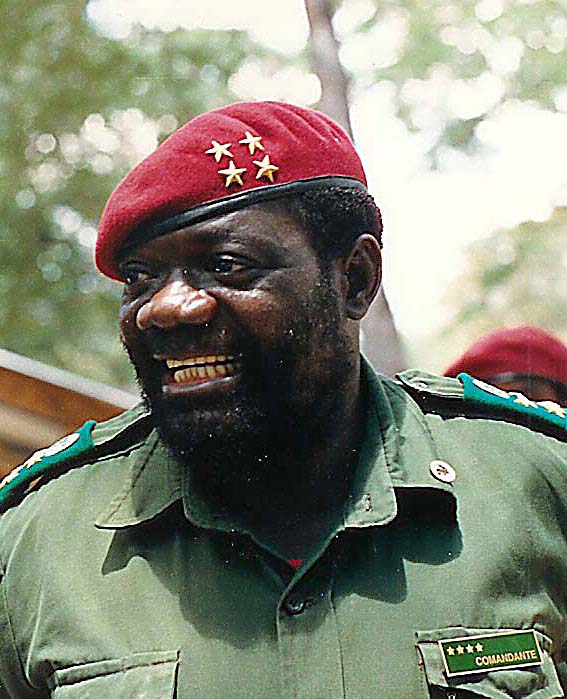
Portrait of Jonas Savimbi

Photo: Ernmuhl · CC BY-SA 3.0 · Wikimedia Commons

Born in Angola · Nationality Angolan — rebellion / civil war / violations of laws of war / diamonds / international sanctions

Jonas Savimbi

Documented profile covering 13 controversies, including “1998–2002: Renewed war, forced displacement and further recruitment of children” and “1996–2000: Financing war through diamonds and systematic evasion of UN sanctions”.

Are you concerned? Right of reply

Profile No. 2216 · Updated on 12 October 2026

Portrait of Jonas Savimbi

Photo: Ernmuhl · CC BY-SA 3.0 · Wikimedia Commons

13Documented controversies
11Sources
0Formal charge · all time
0Conviction

I. Documented controversies

01

1998–February 2002

1998–2002: Renewed war, forced displacement and further recruitment of children

No legal proceedings

Full-scale war resumed in 1998. Human Rights Watch documented forced civilian displacement, mining of rural areas, indiscriminate bombardment and abduction of children and adults by UNITA for military and logistical service. Estimates cited refer to several thousand children bearing arms for UNITA during the final phase.

State of the evidence
Documented
Attribution
Command responsibility

Sources · 1

  1. [1]
    Human Rights WatchForgotten Fighters: Child Soldiers in AngolaNGO reportVery high reliability

Last verified: 14 September 2026

Add to this entry

02

1996–2000

1996–2000: Financing war through diamonds and systematic evasion of UN sanctions

No legal proceedings

The UN Panel of Experts concluded that diamonds were UNITA's main source of wealth and described Savimbi as personally controlling some of the rough-diamond assets used to purchase weapons, fuel and political support. The Council was informed that he had established supply systems and networks of facilitators designed to circumvent sanctions.

State of the evidence
Documented
Attribution
Directly implicated

Last verified: 14 September 2026

Add to this entry

03

January–2000

2000: Chinguar killings, extrajudicial executions, mutilations and forced recruitment attributed to UNITA

No legal proceedings

As government forces approached Chinguar, Human Rights Watch reported that approximately 140 soldiers and civilians were killed by UNITA. Other executions, punitive mutilations and forced recruitment were reported in several localities during the year.

State of the evidence
Documented
Attribution
Command responsibility

Sources · 1

  1. [1]
    Human Rights WatchHuman Rights Watch World Report 2001: AngolaNGO reportVery high reliability

Last verified: 14 September 2026

Add to this entry

04

1998–January 2000

1998–2000: Accusation of personally ordering shootdown of two UN aircraft

No legal proceedings

In January 2000, the Security Council received video evidence from former UNITA military officials alleging that Savimbi had personally ordered the downing of two United Nations aircraft in Angola, incidents in which twenty-two people died.

Attribution
Personally implicated

Sources · 1

  1. [1]

Last verified: 14 September 2026

Add to this entry

05

November 1994–1998

1994–1998: Violations of Lusaka Protocol, retention of military structure and rearmament

Civil / administrative proceedings

After the Lusaka Protocol, UNITA's disarmament and integration remained incomplete. Human Rights Watch documents continued arms acquisitions in violation of agreements and UN resolutions, while UNITA retained substantial military capabilities and rearmed.

State of the evidence
Documented
Attribution
Political responsibility

Last verified: 14 September 2026

Add to this entry

06

1992–1996

1992–1996: Abductions, forced labour, hostages and movement restrictions in UNITA-controlled areas

No legal proceedings

Human Rights Watch describes abductions of civilians, forced porterage, use of certain foreigners as hostages or human shields, restrictions on movement, confiscation of food and unpaid labour in UNITA-controlled areas.

State of the evidence
Documented
Attribution
Command responsibility

Last verified: 14 September 2026

Add to this entry

07

1993–1996

1993–1996: Forced recruitment of children and use of minors in UNITA forces and wartime economy

No legal proceedings

Human Rights Watch found that UNITA's forced recruitment of children and adolescents was widespread and increasing. Children were used as fighters, auxiliaries or workers connected with diamond-producing areas.

State of the evidence
Documented
Attribution
Command responsibility

Last verified: 14 September 2026

Add to this entry

08

1992–1994

1992–1994: Sieges and indiscriminate bombardment of Huambo, Kuito and other cities

No legal proceedings

Human Rights Watch documents prolonged sieges and indiscriminate shelling of urban areas by UNITA. The report estimates approximately 10,000 deaths during the battle of Huambo and 20,000 to 30,000 during the siege of Kuito, with up to a thousand shells fired daily at certain points.

State of the evidence
Documented
Attribution
Command responsibility

Sources · 1

  1. [1]

Last verified: 14 September 2026

Add to this entry

09

1992–1994

1992–1994: Attacks on humanitarian aid, mining of access routes and starvation strategy against besieged cities

No legal proceedings

UNITA attacked relief operations, mined roads and fields, sabotaged transport and prevented civilians from reaching crops. Human Rights Watch considers that these practices were intended to starve populations in besieged towns.

State of the evidence
Documented
Attribution
Command responsibility

Sources · 1

  1. [1]

Last verified: 14 September 2026

Add to this entry

10

September–October 1992

1992: Rejection of first national election results generally judged free and fair, followed by renewed mobilisation

No legal proceedings

After an election in which José Eduardo dos Santos led without an absolute majority and a presidential run-off should have been held, UNITA rejected the results despite observers' generally positive assessment and remobilised its forces. War resumed less than a month after the vote.

State of the evidence
Documented
Attribution
Political responsibility

Sources · 2

  1. [1]
    Human Rights WatchDemocracy or Monopoly?: Angola's Reluctant Return to ElectionsNGO reportVery high reliability
  2. [2]

Last verified: 14 September 2026

Add to this entry

11

fin des années 1970–1991

Late 1970s–1991: Persistent allegations of internal purges and elimination of rivals within UNITA

No legal proceedings

Former UNITA officials accused Jonas Savimbi of ordering extrajudicial executions of rivals and internal dissidents. The 1999 US human rights report states that several former UNITA leaders claimed he personally ordered certain killings.

Sources · 2

  1. [1]
    U.S. Department of StateU.S. Department of State Human Rights Report for 1999 - AngolaNGO reportVery high reliability
  2. [2]
    The Washington PostUNITA Probe Blames Deaths on DefectorPressHigh reliability

Last verified: 14 September 2026

Add to this entry

12

November 1988–1991

1988–1991: Detention, internal "trial" and disappearance of Tito Chingunji and Wilson dos Santos

No legal proceedings

Tito Chingunji, a former UNITA representative in Washington, and Wilson dos Santos were recalled to Jamba, accused of high treason, confined and subsequently disappeared. Savimbi had publicly assured others that they were still alive before UNITA acknowledged their deaths.

Attribution
Directly implicated

Sources · 2

  1. [1]
    The Washington PostUNITA Probe Blames Deaths on DefectorPressHigh reliability
  2. [2]

Last verified: 14 September 2026

Add to this entry

13

12–13 November 1991

November 1991: Killing of Chingunji, dos Santos, family members and guards — disputed command responsibility

No legal proceedings

UNITA's internal investigation acknowledged that Chingunji, dos Santos, their wives, children and guards had been shot and their bodies thrown into a river. Savimbi denied ordering the executions and attributed them to Puna, while declaring that he accepted full responsibility as leader of the movement.

Sources · 2

  1. [1]
    The Washington PostUNITA Probe Blames Deaths on DefectorPressHigh reliability
  2. [2]

Last verified: 14 September 2026

Add to this entry

II. Constellation of documented links

  • Linked profile (portrait or initials) — click to open it
  • Line width: number of documented references
  • Hover over or tap a line: controversies and sources

Two profiles are linked when a documented controversy of one names the other. The link points to that controversy and its sources; it does not indicate a personal relationship.

List of documented links (1)
  1. José Eduardo dos Santos1 documented reference

III. Has something changed?

A new court decision, a missing source, a mistake? Tell us what should be updated: every request is read by the editorial team.

Support the archive

Controversia checks and updates its profiles independently. Support is optional and has no effect on the content of profiles.

Donate

iPhone and iPad

Install Controversia

  1. Tap Share
  2. then Add to Home Screen

Tap Share, then Add to Home Screen.