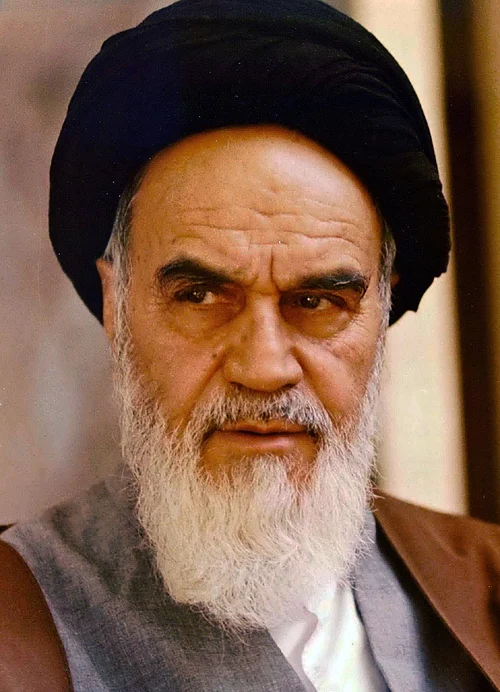
Portrait of Rouhollah Khomeini

Born in Iran · Nationality Iranian — Politics / Supreme Leader of Iran

Rouhollah Khomeini

Also known as: Ruhollah Khomeini, Rouhollah Mousavi Khomeini, Ayatollah Khomeini

Iranian cleric and leader (1902–1989), founder of the Islamic Republic and its first supreme leader.

Ruhollah Khomeini led Iran’s 1979 revolution and remained supreme leader until 1989. His decisions are disputed over compulsory veiling, the hostage crisis, political and university purges, the 1988 mass executions and his call to kill Salman Rushdie. The absence of a personal criminal judgment does not erase documented historical orders and decisions.

Are you concerned? Right of reply

Profile No. 6097 · Updated on 8 November 2026

Portrait of Rouhollah Khomeini
5Documented controversies
7Sources
0Formal charge · all time
0Conviction

I. Documented controversies

01

14 February 1989

1989: fatwa calling for Salman Rushdie and publishers to be killed

No legal proceedings

Khomeini issued a fatwa calling for the death of Salman Rushdie, author of The Satanic Verses, and those knowingly involved in publishing it. The pronouncement triggered threats and remains a central issue in debates over free expression and political violence.

State of the evidence
The fatwa’s wording and date are recorded in historical sources.
Legal status — source text
No established personal criminal conviction concerning this event.
Attribution
Public call for the killing of a writer and publishing personnel.

Sources · 1

  1. [1]
    Wilson CenterPart 1: Khomeini’s Fatwa on Rushdie16 August 2022MediaHigh reliability

Last verified: 8 November 2026

Add to this entryAny news?

02

1980–1989

1980s: persecution of the Bahá’í minority

No legal proceedings

The UN Special Rapporteur’s 2024 report describes persecution of the Bahá’í community in the Islamic Republic’s first decade, including killings, confiscations and exclusion from employment and education. The policies occurred under Khomeini’s regime, but the source does not establish that he personally ordered each individual act.

State of the evidence
2024 UN report addressing historical violations, including those against Bahá’ís.
Legal status — source text
Historical findings of a UN Special Rapporteur; no criminal judgment against Khomeini.
Attribution
Institutional responsibility for policies targeting a religious minority.

Sources · 1

  1. [1]
    UN Special Rapporteur on Iran / OHCHRAtrocity Crimes and Grave Violations of Human Rights: Iran 1981–1982 and 198817 July 2024Official documentHigh reliability

Last verified: 8 November 2026

Add to this entryAny news?

03

July–September 1988

1988: order underlying mass executions of political prisoners

No legal proceedings

Amnesty International documented the extrajudicial execution of thousands of political prisoners in summer 1988. It links the operation to a fatwa issued by Khomeini and implemented by prison officials; the UN Special Rapporteur also documented the period’s atrocities.

State of the evidence
Fatwa and witness testimony documented by Amnesty International; historical findings without a criminal trial of Khomeini.
Legal status — source text
No personal conviction; Khomeini died in 1989. The events are documented by rights organisations and the UN.
Attribution
Religious order that led to mass extrajudicial executions.

Sources · 4

  1. [1]
    Amnesty InternationalIran: committing crimes against humanity by concealing fate of thousands of slaughtered political dissidents4 December 2018Investigative journalismHigh reliability
  2. [2]
    Amnesty InternationalIran: Violations of human rights 1987 – 19901 December 1990Investigative journalismHigh reliability
  3. [3]
    Human Rights WatchWho Will Pressure Taliban to Respect Women’s Rights? Daily Brief8 June 2022MediaHigh reliability
  4. [4]
    UN Special Rapporteur on Iran / OHCHRAtrocity Crimes and Grave Violations of Human Rights: Iran 1981–1982 and 198817 July 2024Official documentHigh reliability

Last verified: 8 November 2026

Add to this entryAny news?

04

November 1979–January 1981

1979–1981: support for the US embassy hostage crisis

No legal proceedings

On 4 November 1979 revolutionary students seized the US embassy in Tehran. Khomeini subsequently endorsed their action, leading to the detention of US diplomats and staff for 444 days. A declassified intelligence cable also attributed prior approval to him, but that specific claim rests on the intelligence report.

State of the evidence
Subsequent endorsement is historically established; prior personal approval is alleged in an intelligence cable, not adjudicated.
Legal status — source text
No established personal criminal conviction concerning this event.
Attribution
Political support for the detention of diplomatic hostages.

Sources · 2

  1. [1]
    U.S. Department of State, Office of the HistorianThe Iranian Hostage CrisisOfficial documentHigh reliability
  2. [2]
    U.S. Department of State, Office of the HistorianHistorical Documents: November 10, 1979 Intelligence Cable10 November 1979Official documentHigh reliability

Last verified: 8 November 2026

Add to this entryAny news?

05

February–December 1979

1979: summary executions following the revolution

No legal proceedings

Revolutionary courts formed after the shah’s overthrow rapidly sentenced former officials, military officers and opponents to death. Rights organisations criticised summary proceedings; Khomeini’s political backing of the new system does not itself prove that he ordered each execution.

State of the evidence
Historical research and a UN Special Rapporteur’s review of the regime’s early years.
Legal status — source text
No established personal criminal conviction concerning this event.
Attribution
Political responsibility for a system of summary revolutionary justice.

Sources · 1

  1. [1]
    UN Special Rapporteur on Iran / OHCHRAtrocity Crimes and Grave Violations of Human Rights: Iran 1981–1982 and 198817 July 2024Official documentHigh reliability

Last verified: 8 November 2026

Add to this entryAny news?

II. Constellation of documented links

  • Linked profile (portrait or initials) — click to open it
  • Line width: number of documented references
  • Hover over or tap a line: controversies and sources

Two profiles are linked when a documented controversy of one names the other. The link points to that controversy and its sources; it does not indicate a personal relationship.

List of documented links (3)
  1. Salman Rushdie2 documented references
  2. Ali Khamenei1 documented reference
  3. Mahmoud Ahmadinejad1 documented reference

III. Has something changed?

A new court decision, a missing source, a mistake? Tell us what should be updated: every request is read by the editorial team.

Support the archive

Controversia checks and updates its profiles independently. Support is optional and has no effect on the content of profiles.

Donate

Controversia profile, updated 8 November 2026. Latest version: https://controversia.info/en/fiche/rouhollah-khomeini

iPhone and iPad

Install Controversia

  1. Tap Share
  2. then Add to Home Screen

Tap Share, then Add to Home Screen.