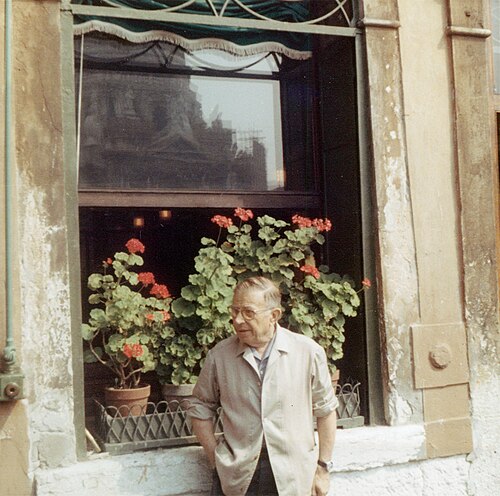
Portrait of Jean-Paul Sartre

Photo: User:T1980 · CC BY 3.0 · Wikimedia Commons

Born in France · Nationality French — Science / intellectuals / activism

Jean-Paul Sartre

Documented profile covering 10 controversies, including “Signing of 1977 appeal to relax criminal law on adult–minor relationships” and “Visit to Andreas Baader: Condemnation of detention conditions while disapproving of RAF terrorism”.

Are you concerned? Right of reply

Profile No. 2386 · Updated on 12 October 2026

Portrait of Jean-Paul Sartre

Photo: User:T1980 · CC BY 3.0 · Wikimedia Commons

10Documented controversies
12Sources
0Formal charge · all time
0Conviction

I. Documented controversies

01

May 1977

Signing of 1977 appeal to relax criminal law on adult–minor relationships

No legal proceedings

Sartre was among eighty signatories calling for revision and relaxation of criminal provisions governing certain sexual relationships between adults and minors and publicly questioning children's and adolescents' capacity to consent.

State of the evidence
Documented

Last verified: 15 September 2026

Add to this entry

02

December 1974

Visit to Andreas Baader: Condemnation of detention conditions while disapproving of RAF terrorism

No legal proceedings

Sartre visited Andreas Baader in prison and described the isolation conditions of Red Army Faction members as 'intolerable', calling on German intellectuals to defend their rights.

State of the evidence
Reported by the press

Last verified: 15 September 2026

Add to this entry

03

April 1970

Assuming editorship of La Cause du peuple after arrest of previous editors

No legal proceedings

After the previous editors of the Maoist newspaper La Cause du peuple were arrested, Sartre formally became its publication director and declared that he personally assumed the legal and criminal responsibilities attached to that role.

State of the evidence
Documented

Last verified: 15 September 2026

Add to this entry

04

May–June 1970

Repeated seizures of La Cause du peuple and investigations into incitement to violence, looting and glorification of crimes

Investigation

Several issues of La Cause du peuple were seized under judicial warrants in investigations concerning, among other matters, incitement to violence, looting, crimes against state security and the glorification of theft or murder; almost all the articles in one issue were signed by Sartre.

State of the evidence
Reported by the press

Last verified: 15 September 2026

Add to this entry

05

26 June 1970

Arrest while distributing a seized issue of La Cause du peuple

No legal proceedings

Sartre was arrested with seventeen others while distributing a seized issue of La Cause du peuple, the publication of a dissolved Maoist movement, on Paris's main boulevards.

State of the evidence
Documented

Last verified: 15 September 2026

Add to this entry

06

October 1964

Refusal of Nobel Prize in Literature

No legal proceedings

The Swedish Academy awarded Sartre the Nobel Prize in Literature, which he refused, prompting major international controversy and depriving the institution of the laureate's acceptance.

State of the evidence
Documented

Sources · 2

  1. [1]
    Nobel PrizeJean-Paul Sartre — FactsOfficial documentVery high reliability
  2. [2]
    The New York Review of BooksSartre on the Nobel PrizeStatementHigh reliability

Last verified: 15 September 2026

Add to this entry

07

1961

Foreword to Fanon's The Wretched of the Earth: Radical rhetoric about anti-colonial violence

No legal proceedings

In his foreword to Frantz Fanon's The Wretched of the Earth, Sartre used particularly radical rhetoric about violence by colonised people against colonisers, frequently interpreted as morally legitimising revolutionary violence.

State of the evidence
Documented

Last verified: 15 September 2026

Add to this entry

08

September–November 1960

Manifesto of the 121: Defence of the right to refuse military service during the Algerian War

No legal proceedings

Sartre signed the Manifesto of the 121, which recognised the right to refuse military service and assist Algerians in their struggle against French colonial rule. Its publication triggered a judicial investigation, and he was questioned by police along with Simone de Beauvoir.

State of the evidence
Documented

Last verified: 15 September 2026

Add to this entry

09

November 1956–1957

Break with French Communist Party after suppression of Hungarian uprising

No legal proceedings

Following the Soviet tanks' intervention in Hungary, Sartre broke off his rapprochement with the French Communist Party and denounced Stalinism, Soviet domination and the French communists' support for the repression.

State of the evidence
Documented

Last verified: 15 September 2026

Add to this entry

10

1954

1954 visit to the USSR and claim that freedom of criticism there was 'complete'

No legal proceedings

After an organised visit to the Soviet Union, Sartre gave interviews highly favourable to the regime, notably asserting that freedom of criticism was complete there, a statement that became emblematic of his temporary blindness towards the Soviet system.

State of the evidence
Documented

Sources · 1

  1. [1]
    Bibliothèque nationale de France« La liberté de critique est totale en URSS »ArchiveVery high reliability

Last verified: 15 September 2026

Add to this entry

II. Constellation of documented links

  • Linked profile (portrait or initials) — click to open it
  • Line width: number of documented references
  • Hover over or tap a line: controversies and sources

Two profiles are linked when a documented controversy of one names the other. The link points to that controversy and its sources; it does not indicate a personal relationship.

List of documented links (2)
  1. Jean Genet1 documented reference
  2. Simone de Beauvoir1 documented reference

III. Has something changed?

A new court decision, a missing source, a mistake? Tell us what should be updated: every request is read by the editorial team.

Support the archive

Controversia checks and updates its profiles independently. Support is optional and has no effect on the content of profiles.

Donate

iPhone and iPad

Install Controversia

  1. Tap Share
  2. then Add to Home Screen

Tap Share, then Add to Home Screen.